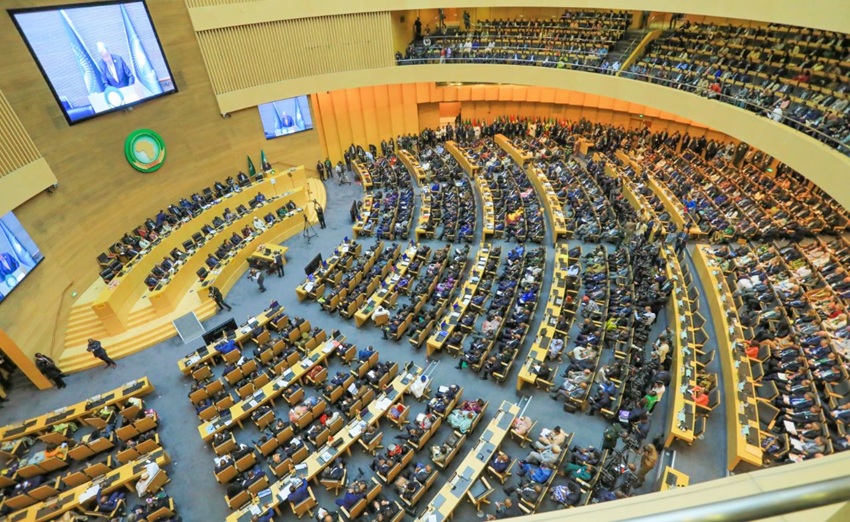
Every year, African leaders gather under the banner of the African Union to define priorities that will shape the continent’s future. The African Union’s 2026 Theme of the Year, “Assuring Sustainable Water Availability and Safe Sanitation Systems to Achieve the Goals of Agenda 2063,” signals an important shift.
It reflects a growing recognition that Africa’s development future depends not only on political stability but on how effectively the continent manages its natural resources.

The Water Challenge and Its Wider Implications
Water is one of Africa’s most abundant yet unevenly distributed resources. The continent holds significant freshwater reserves, including major river basins and groundwater systems, yet millions still lack reliable access.
According to the World Bank, roughly 400 million people in Sub Saharan Africa lack access to basic drinking water services, while sanitation gaps remain even wider. At the same time, the UN World Water Development Report warns that global water demand could exceed supply by up to 40 percent by 2030, with climate change intensifying pressure on vulnerable regions.
In this context, the AU’s focus on water is more than symbolic. It represents a broader transition from political themes toward development driven priorities. For decades, Africa’s policy conversations have rightly emphasized peace as a foundation for progress. But the reality emerging across the continent suggests a complementary truth: without development, peace itself becomes fragile.
Youth protests across regions increasingly reflect frustrations over livelihoods, infrastructure, and opportunity rather than purely political grievances. The nexus between peace and development is shifting, and Africa’s policy agenda must shift with it, yet the significance of AU themes often remains confined to conference halls.
Bridging the Gap Between Policy and Reality
For many Africans, continental meetings feel distant, highly diplomatic spaces dominated by heads of state, foreign affairs ministries, regional institutions, and development partners. While resolutions shape policy direction, the connection between those decisions and everyday life is not always visible.
This disconnect is striking when viewed against the lived reality of African integration. Across borders, communities already cooperate in ways policy frameworks are still trying to formalize. Traders move goods daily between neighboring countries. Patients cross borders to access healthcare. Students attend schools in communities on the other side of national boundaries. In many border regions, people do not experience borders as barriers but as administrative lines that sit alongside shared culture, family ties, and economic necessity.
Agenda 2063 speaks of “The Africa We Want,” but the success of that vision depends on whether it becomes tangible at community level. Integration cannot exist only in protocols. It must exist in roads that function, border procedures that enable trade, payment systems that work, and services that are accessible regardless of nationality within a region.
Key Role of the Private Sector and Implementation Players
Political agreements establish the way, but businesses make integration tangible. Infrastructure corridors unlock logistics resources. Harmonized border systems provide access to agricultural trade and financial integration lowers burdens for small traders. When governments create the enabling environment, business translates policy into jobs and economic activity.
The opportunity is significant. Consider food systems. Countries such as Djibouti import the majority of their food supply, while others in the region produce agricultural surpluses. Efficient trade corridors linking production zones to consumption markets could reduce import dependence, stabilize prices, and support farmers.
The African Continental Free Trade Area (AfCFTA) is the policy lever for this transformation, and is set to remove 30 million Africans from extreme poverty by 2035, but to do this, logistics companies, financial institutions, technology vendors, and thousands of small businesses must be involved.
Equally important is empowering informal traders, who already drive a substantial share of intra African trade. Simplified customs procedures, interoperable payment systems, and infrastructure at border markets could convert existing activity into formal growth without disrupting livelihoods.
Making Policies Relevant: Inclusion and Communication
Broadening participation in continental processes therefore becomes essential. AU meetings cannot remain spaces where Africa discusses Africa in the absence of Africans beyond government. Private sector actors, youth innovators, local traders, diaspora investors, and civil society are not peripheral stakeholders. They are implementation partners.
Communication also matters. The challenge is not simply visibility but relevance. Citizens engage when policies change their daily experience. When crossing a border becomes easier. When water systems function. When regional trade lowers the price of food. When integration reduces friction rather than adding bureaucracy.
The Africa We Want must move beyond aspiration into convenience. This requires a more comprehensive approach from continental institutions working alongside Regional Economic Communities. Policy must be explained in practical terms. Implementation must prioritize user experience. Measurement of success must include how ordinary Africans interact with regional systems, not only the number of agreements signed.
Water, the AU’s 2026 focus, illustrates this principle clearly. Access to water is not only a technical issue. It shapes health, agriculture, energy, urbanization, and gender equality. It determines whether communities can build livelihoods. Addressing water therefore offers an opportunity to demonstrate how continental priorities can deliver visible impact.
The broader message is simple but urgent.
The Africa We Want cannot be built in boardrooms alone. It must be built by Africans in markets, farms, startups, ports, classrooms, and border towns. It must include those on the continent and those in the diaspora. It must treat businesses as partners, communities as stakeholders, and citizens as co-creators.
Africa has never lacked vision. What it now needs is participation at scale. If continental meetings succeed in opening their processes to implementation actors and focusing on practical outcomes, they can become more than diplomatic milestones. They can become platforms that accelerate everyday integration. Summits should set direction. People must drive delivery.
Austine Opata is Head of Communications at the Intergovernmental Authority on Development (IGAD)