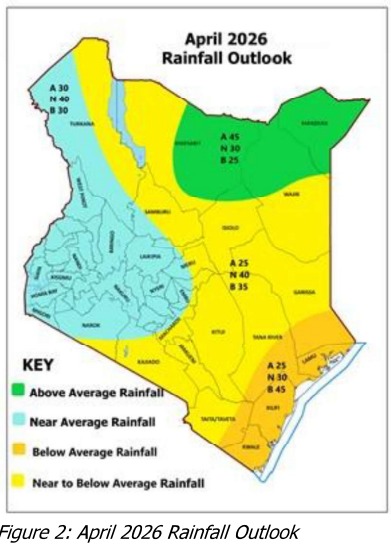
Three Arid and Semi-Arid Lands counties of Mandera, Marsabit and Wajir are expected to receive above average rainfall in April as the long rains season of March, April to May reaches its peak.
The Weatherman is warning that there is a risk of renewed emergencies in areas expected to receive average to above average rainfall.
“Disaster management agencies should maintain evacuation centres and strengthen early-warning dissemination,” says Edward Muriuki the Acting Director of Kenya Meteorological Service Authority (KMSA) and adds,
“Local administrations should monitor dry-river channels and enforce restrictions on settlement or grazing near flood-paths and flood plains.”
He is urging county disaster committees to pre-deploy emergency supplies and coordinate closely with KMSA for real-time alerts.
The April rainfall forecast released by the Kenya Meteorological Service Authority (KMSA) shows Near- to below-average rainfall is likely over most parts of the South-Eastern Lowlands, isolated areas of the Highlands East of the Rift Valley, and parts of the Northwestern and Northeastern.
Below-average rainfall is expected over the coastal region. Near-average rains are likely in the Highlands East and West of the Rift Valley, the Lake Victoria Basin, the Rift Valley and parts of north-western Kenya.
“Rainfall is likely to be slightly depressed during the first half of the month over much of the country but it’s likely to be enhanced towards the end of the month,” says Muriuki
The Weatherman says the average to above-average rainfall expected in the Highlands East and West of the Rift Valley, the Lake Victoria Basin, the Rift Valley, and some parts of North-eastern and North-western Kenya may result in water logging and crop losses.
“Farmers should strengthen field drainage, unclog furrows, and avoid activities that compact already-wet soils.”
In the South-eastern Lowlands and the Coast crops may face uneven moisture availability and increased pest pressure; agricultural officers should guide farmers on targeted irrigation, water-saving practices, and integrated pest management to stabilise production under fluctuating rainfall.
“The likelihood of isolated heavy rainfall events increases the risk of soil erosion, post-flood nutrient leaching and physical damage to maturing crops,” says the Weatherman and advises that farmers should apply soil-conservation measures such as contouring, mulching and timely top-dressing to maintain soil fertility and protect crop yields.
Health authorities are being asked to ensure safe water supplies and promote household-level mosquito control and hygiene campaigns.
“In northern counties expecting above-normal rainfall, renewed flooding could disrupt health-facility access and drug supply; counties should stockpile essential medicines and prepare contingency plans for accessing cut-off communities,” he notes.
While the season is expected to conclude for most parts of the country by late May, the Highlands West of the Rift Valley, Central Rift Valley, the Lake Victoria Basin, and the Coastal region, rains are likely to continue into June, the Weatherman says.