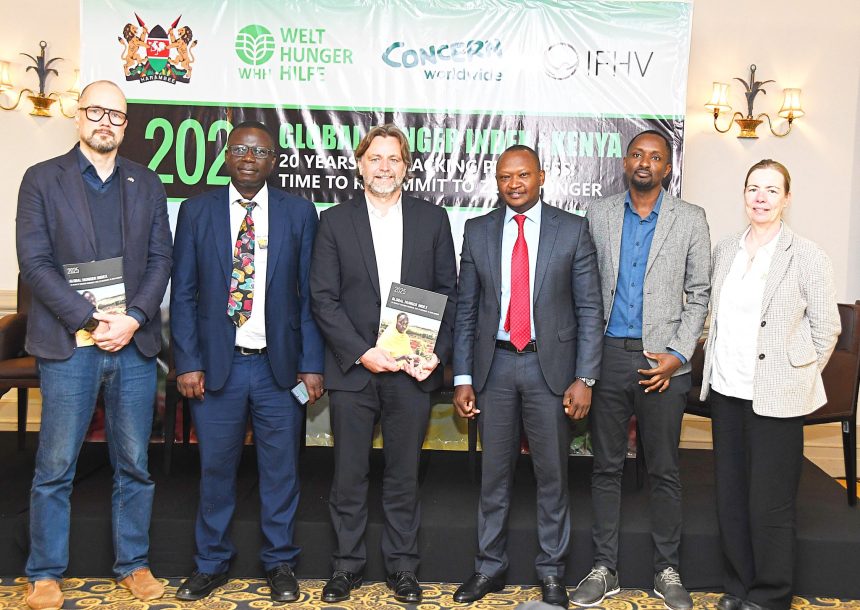
Government has called on the country to think and act beyond conventional approaches in order to achieve Zero Hunger.
Speaking during the launch of the Hunger Index Report held at a Nairobi hotel, the Irrigation Secretary in charge of Land Reclamation, Climate Resilience and Irrigation Water Management, Joel Tanui emphasized that Kenya’s food security outlook is closely tied to climate variability, which continues to affect agricultural productivity across the country.
He was representing the Cabinet Secretary for Water, Sanitation and Irrigation, Eric Mugaa, at the event hosted by Welthungerhilfe, a Germany non-governmental organisations who’s vision is to create a world where all people can exercise their right to a self determined life in dignity and justice.
This year’s theme, “20 Years of Tracking Progress: Time to Recommit to Zero Hunger,” underscores that despite notable global achievements, food systems continue to face immense pressure from climate change, economic disruptions, and geopolitical challenges.
These realities, Tanui noted, demand renewed commitment, innovation, and strategic investment to ensure sustainable food production.
In response, the Government has adopted transformative interventions aimed at achieving food security, with irrigation playing a central role.
Highlighting these efforts, Tanui elaborated on the National Irrigation Sector Investment Plan (NISIP), which he described as a shift from “business as usual” towards a more inclusive and investment driven approach. The plan focuses on five critical pathways.
The first pathway involves mapping and revitalising all public irrigation schemes to enhance efficiency and productivity. The second focuses on strengthening smallholder irrigation by supporting over 2,500 schemes nationwide, empowering communities to work collectively and improve food production.
The third pathway targets the development of Arid and Semi-Arid Lands (ASALs), which make up approximately 80 percent of Kenya’s landmass. Tanui noted that over reliance on the remaining 20 percent of arable land has placed immense pressure on these areas, making it necessary to unlock the potential of ASAL regions. As part of this effort, he highlighted the development of 3,000 acres in Mandera under the Daua Irrigation Cluster marking a significant milestone for irrigation in the region.
The fourth pathway focuses on improving farmers’ access to irrigation equipment. Recognizing that many farmers lack the financial capacity to acquire modern equipment, the government is establishing a de-risking fund to support farmers, enabling them to increase productivity and increase their earnings.
On corporate agribusiness, Tanui noted that the government is promoting the utilisation of idle land by opening it up to private investors for agricultural development. This initiative aims to ensure that available land is fully utilised for production, thereby strengthening national food security.
The Irrigation Secretary also reiterated the Presidential directive on the construction of 50 mega dams, noting that the initiative is expected to bring over 2.5 million acres under irrigation. He described this as a major milestone in advancing the country’s journey towards achieving sustainable food security.
He called on all stakeholders and development partners to join hands in supporting these initiatives and working collectively towards the achievement of Zero Hunger.