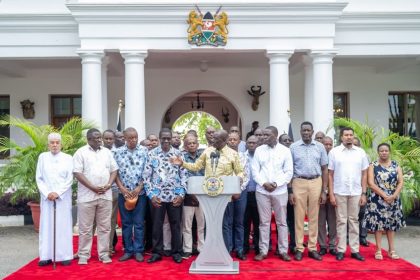
Recently, China Media Group Africa hosted a commemorative event “Echoes of Peace” at the National Museum, featuring screenings of documentaries such as The Sinking of the Lisbon Maru alongside a historical photo exhibition marking the 80th anniversary of the victory of the Chinese People’s War of Resistance against Japanese Aggression.
The Sinking of the Lisbon Maru documents a little-known chapter of World War II: in October 1942, the Japanese cargo ship Lisbon Maru—secretly transporting over 1,800 British prisoners of war from Hong Kong to Japan—was torpedoed off the coast of China’s Zhejiang Province. As the ship sank, local Chinese fishermen risked their lives to rescue more than 300 prisoners amid Japanese army’s hail of bullets, embodying the universal spirit of compassion in the midst of wartime cruelty. Through rare archival footage and interviews with survivors’ families, the film weaves a story of cross-national solidarity that transcends enemy lines.

This screening has enabled people from different regions to resonate through historical images—both China and Africa suffered profound hardships under fascist aggression, and this shared memory becomes even more profound on the occasion of the 80th anniversary of the victory of the World Anti-Fascist War.
China’s War of Resistance against Japanese Aggression was the main battlefield in the East of the World Anti-Fascist War, sounded the clarion call for mankind’s resistance against fascist tyranny. Starting from the September 18th Incident in 1931, the Chinese people, with strong will, launched a 14-year-long bloody struggle. In this war concerning national survival, more than 35 million Chinese military and civilians were killed or injured, with direct economic losses exceeding 100 billion US dollars and indirect economic losses as high as 500 billion US dollars.
The Chinese battlefield, with huge sacrifices, pinned down a large number of Japanese troops, gaining precious time for other anti-fascist battlefields. Before the outbreak of the Pacific War, the Chinese battlefield resisted more than 80% of the total strength of the Japanese army; even after the outbreak of the Pacific War, more than 50% of the Japanese army was still firmly pinned down on the Chinese battlefield. The Chinese army also expeditioned to Myanmar, fought side by side with the allies, made great contributions to opening up the Ledo Road (connecting China and India).
On the distant African continent, the flames of anti-fascism also burned fiercely. When the Italian fascist army invaded Ethiopia, the Ethiopian people launched a desperate resistance. They fought against tanks and artillery with bows and arrows. Even after the capital fell, guerrilla warfare continued nationwide. Finally, with the support of the allies, they drove out the invaders and became the first African country to regain independence by its own efforts during World War II.
On the North African battlefield, African soldiers in the British Commonwealth forces fought a seesaw battle with the German army. People in Morocco, Tunisia and other places spontaneously organized guerrillas to destroy the enemy’s supply lines, laying the foundation for the victory of the Battle of El Alamein. The resistance of the African people was not only to defend their homeland but also broke the fascist plot of trying to control Africa and cut off the allies’ resource channels, injecting key strength into the overall victory of the World Anti-Fascist War.
Although China and Africa are thousands of miles apart in their anti-fascist struggles, they have a natural spiritual resonance. Both were weak countries that were invaded, facing well-equipped strong enemies, and both, with their perseverance in freedom and dignity, wrote legends of defeating the strong with the weak.
Eighty years have passed. The screening of The Sinking of the Lisbon Maru in Kenya has enabled people of different continents to review that period of history in the light and shadow, making us deeply realize that peace is never an innate gift but a treasure that needs to be guarded from generation to generation. At present, the world still faces the challenges of hegemonism and unilateralism, and the concept of a community with a shared future for mankind is becoming increasingly valuable. China has always remembered the lessons of history, actively participated in international peacekeeping operations, promoted the construction of the “Belt and Road Initiative”, and fulfilled its commitment to peace and development with practical actions.
As an important country in East Africa, Kenya has experienced the hardships of colonial rule and is now embracing development with vigorous vitality. The cooperation between China and Kenya, from the Mombasa-Nairobi Railway to medical aid, and from cultural exchanges to capacity-building initiatives, all embodies the spirit of “joint consultation, joint construction and shared benefits”, which is a contemporary continuation of the concept of “unity and cooperation” in the anti-fascist war.
Let us take history as a mirror, transcend time, space and national boundaries, inherit the courage and unity accumulated in the anti-fascist war, and continue to move forward hand in hand on the road of safeguarding peace and promoting development, so that justice and conscience may forever light the path of humanity’s progress.
Zhao Qian is a journalist for CMG Africa based in Nairobi.