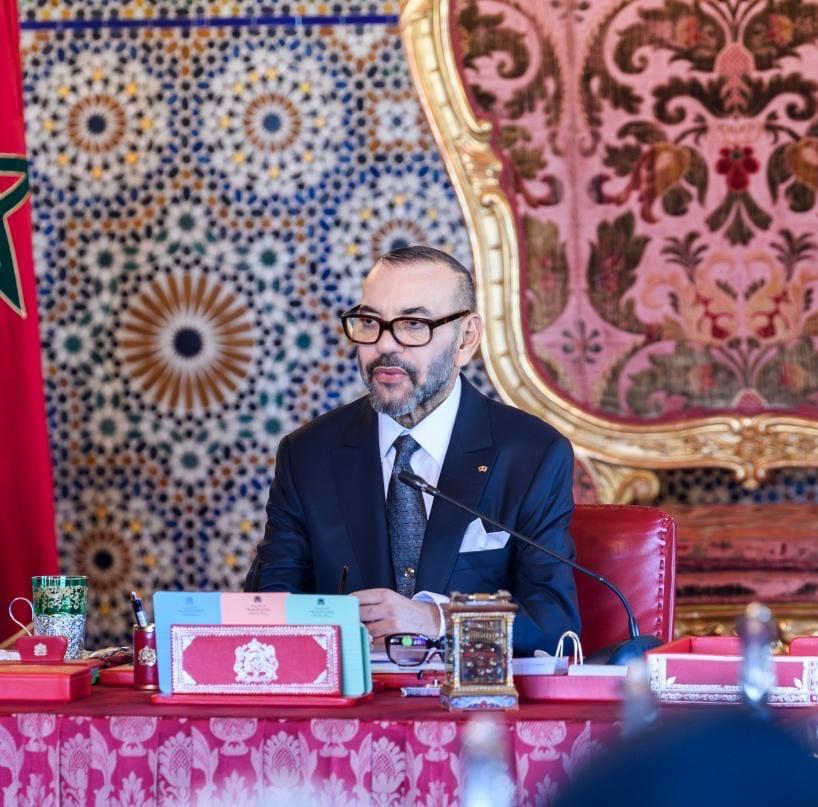
King Mohammed VI of Morocco presided over a Council of Ministers meeting at the Royal Palace in Rabat, dedicated to several major issues: the guidelines for the 2026 Finance Bill, the approval of organic bills and military decrees, and a series of international agreements.
Presented by the Minister of Economy and Finance, the 2026 Finance Bill is in line with the High Royal Guidelines, particularly those set out in the latest Throne Speech and the opening of the parliamentary session.

The Moroccan economy is expected to grow by 4.8% in 2025.
This project aims to consolidate the foundations of the Emerging Morocco program, combining social justice and balanced territorial development, through four strategic priorities:
(a)Consolidation of economic achievements
The government intends to strengthen Morocco’s position among emerging nations by stimulating domestic and foreign private investment, accelerating the implementation of the Investment Charter, developing Morocco’s green hydrogen offering, and diversifying sources of financing.
Special support will be provided to micro, small, and medium-sized enterprises (MSMEs) through technical and financial assistance mechanisms.
Efforts will also be made to promote youth and women’s employment, reduce the effects of drought on rural areas, and support livestock farmers in rebuilding their herds.
(b)New generation of territorial development programs
The 2026 draft budget provides for the launch of integrated regional programs based on local specificities and advanced regionalization.
These programs will target job creation, improved education and health, and the reduction of territorial disparities.
Particular emphasis will be placed on mountainous areas, oases, and sustainable coastal development.
Public investment in health and education will reach MAD 140 billion, with 27,000 new budgetary positions.
In the field of health, new university hospitals will be built in Agadir and Laâyoune, while work will continue on the university hospitals in Béni-Mellal, Guelmim, and Errachidia.
In education, priorities include expanding preschool access, improving teaching quality, and supporting schooling.
1.Consolidating the pillars of the welfare state
The draft finance bill continues the Royal Project to expand social protection, notably through the implementation of direct aid to 4 million households.
Monthly child allowances will be increased, accompanied by specific support for orphaned or abandoned children.
The measures also include extending pension coverage, extending unemployment benefits, and continuing the housing assistance program.
Structural reforms and budgetary balance
The government intends to reform the Organic Law on Finance in order to improve public governance, focusing on results and accountability.
Public enterprises and institutions will be restructured to strengthen their performance and territorial impact.
The text also provides for reforms to the judicial system to bring it closer to citizens and strengthen legal certainty in business matters.
On the political front, the bill proposes to encourage young people under the age of 35 to participate in public life by granting them subsidies covering 75% of their election campaign costs.
Regional constituencies will now be reserved for women in order to strengthen their representation in parliament.
A bill on political parties aims to modernize their legal framework, encourage the creation of new parties, improve their governance, and increase the transparency of their financing.
2. Military reforms
Two decrees have been adopted: The first establishes a special status for civil servants in the Directorate General for Information Systems Security, in order to attract specialized skills through more flexible recruitment and appropriate bonuses.
The second reforms the Royal School of Military Health Services, harmonizing its operation with the national health reform and creating a Scientific Research Council responsible for defining research priorities.
3.International agreements
The Council approved 14 international agreements, including 10 bilateral and 4 multilateral agreements, covering judicial and military cooperation, social security, air services, mutual recognition of driving licenses, and the elimination of double taxation.
These agreements are part of Morocco’s foreign policy aimed at strengthening its African and international partnerships and consolidating its position on the world stage.
The Council of Ministers meeting of October 19, 2025 marks a key step in the implementation of the Moroccan development model: a financial plan focused on inclusive growth, social justice, regionalization, modernization of the state, and the rise of the Kingdom in economic and geopolitical terms.