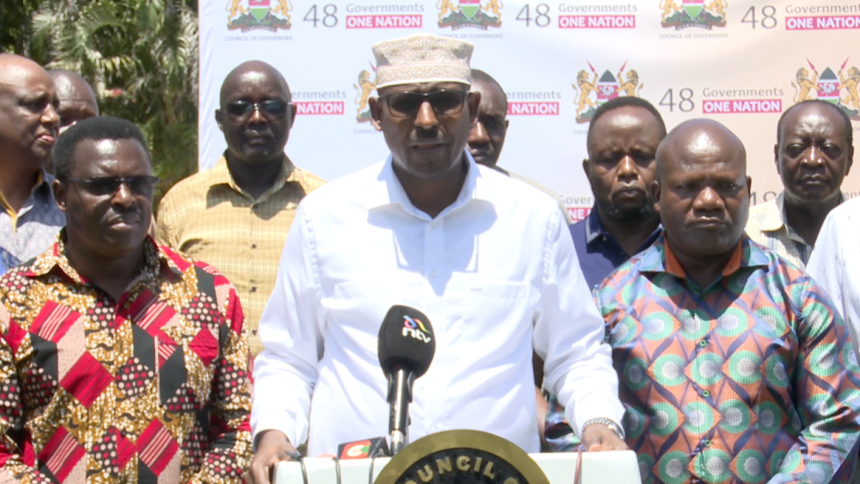
The Council of Governors (COG) has reaffirmed its position regarding Senate oversight, dismissing allegations of non-cooperation and resisting what they term harassment and undue pressure during committee summons.
Speaking at a press briefing in Kilifi, COG Chair Ahmed Abdullahi stated that while governors are committed to accountability, they will not accept “excessive summons” that disrupt county governance.

“We have not stopped any governor from appearing before the Senate Committee on Public Investments and Special Funds (CPIC). We only have an issue with the frequency. Why must a governor go there five times? When is he going to manage the county?” Abdullahi questioned.
He further accused the Senate of overstepping its constitutional authority, citing Article 96(3) while allegedly disregarding Article 226, which assigns oversight of county public entities to county assemblies. Abdullahi indicated that the council is prepared to seek judicial interpretation of the Senate’s oversight scope if necessary.
“Enough is enough. If we have to go back to court to interpret what oversight is and what those appearances should entail, we are willing to go. But it will not be business as usual,” he asserted.
Vice Chair Muthomi Njuki raised concerns about procedural irregularities, questioning the long delays governors face or the requirement to meet with Senate committee chairs prior to official hearings.
“There is a tactic that the Senate oversight committees are using to leverage on extortionist behaviors towards the governors. When you go for a meeting, they call you early and they take you to the office and try to negotiate with you,” he explained.
“Why is it that they expect governors to be there three, four, seven hours after the time of commencement of the meeting? It’s just common sense. The governors are not being seen because they never behave the way the senators want them to behave for the meetings to commence,” Njuki added.
Other governors echoed the sentiment. Bungoma Governor Kenneth Lusaka insists that the county chiefs are not avoiding accountability, but rather seek constructive engagement over falsehoods.
“We want dignity. We want the Senate to go back to its original form, where it’s meant to be. We are supposed to have an interaction, not harassment, not humiliation, and not falsehoods. We were voted for by many Kenyans. To try to demonize us is not right,” he stated.
“We are not mad people who can look at all these governors. We are not mad just to come up and say this is happening in a particular committee. These are the reasons why we are saying that,” Lusaka continued
Hi Nyeri counterpart, Mutahi Kahiga, underscored that governors are not intimidated by the Senate.
“We have sufficient evidence and we have been elected by the people. No one should speak to us as if they are our superior,” he said.
Kisii Governor Simba Arati highlighted alleged extortion tactics during committee sessions, emphasizing that governors are prepared to confront any misconduct.
“Mgala muue lakini haki mpe. There are good people in the Senate, disciplined senators. However, many are out to collect funds for gubernatorial campaigns. We fear no one; this is our country. I am ready to go to the Senate and confront anyone who has taken money—stop the nonsense,” he stated.
Amid these protests, the Senate leadership has criticized governors threatening to boycott their summons, asserting that appearances before the Upper House and its committees are mandatory and not subject to negotiation or leverage.