A multi-agency emergency operation is underway to contain the humanitarian impact of the ongoing drought, with the government focusing on rapid coordination, supply delivery, and protection of livelihoods across the hardest-hit counties.
The response, led on the ground by Deputy President Kithure Kindiki, brings together national and county agencies to synchronise support and social protection measures following the failure of the October–December 2025 short rains.

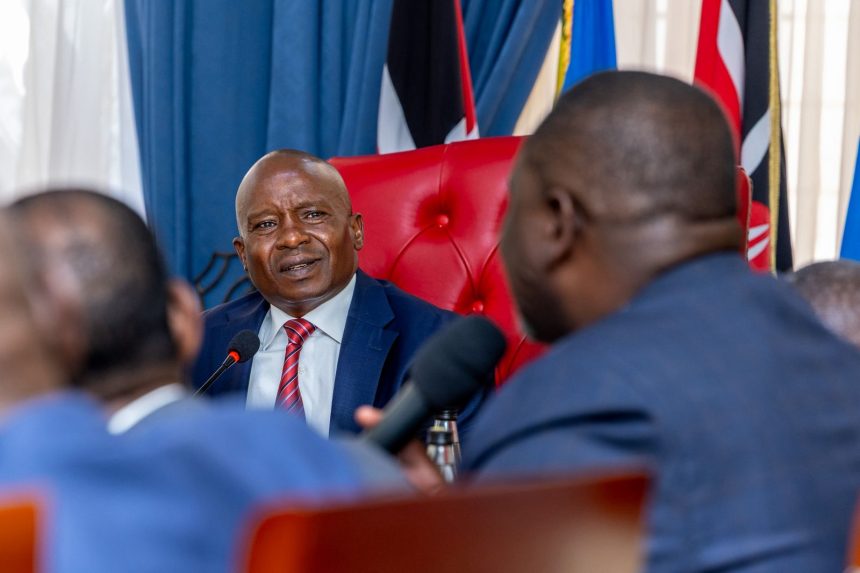
Speaking during a coordination meeting at the Official Residence in Karen, Nairobi, Kindiki said the government had mobilised resources to stabilise vulnerable populations and avert further deterioration of the situation.
“I assure the people of Kenya that the government will not spare any resources to make sure we don’t lose human life and mitigate the effects of the drought on livestock and wildlife,” he declared.
At least 3.3 million people in 23 counties are currently affected, with Mandera, Wajir, Garissa, Tana River, Marsabit, Turkana, Kwale, Meru North, Samburu, and Isiolo classified in the crisis stage.
“Many counties are in need of food for the people and livestock feed. We are tirelessly working on effective last-mile delivery so it does not take long to reach the people. We are also trucking water to the people and livestock,” the Deputy President noted.
The operation also targets at-risk social groups, including school-going children, women, and persons with disabilities, to ensure essential services such as school feeding programmes continue despite harsh conditions.
“We need food to reach our schools so that learners are not disrupted by the ongoing drought situation,” Kindiki said, adding that interventions had been scaled up and diversified to address the needs of the most vulnerable.
The intensified field response follows a Cabinet decision chaired by President William Ruto, authorising the release of KSh 4.1 billion to expand drought mitigation measures.
The funding supplements earlier allocations made in December 2025 and January 2026 for relief food, logistics, and non-food assistance.
Government assessments show drought conditions have deteriorated rapidly since January 2026, pushing millions into acute food insecurity, a figure projected to rise to 3.6 million by June if interventions are not sustained.
Mandera, Wajir, Kwale, and Kilifi counties are in the Alarm phase, while 12 others remain on Alert, most showing a worsening trajectory.
Acute malnutrition continues to rise, affecting more than 810,000 children and 104,000 pregnant and lactating women.
Officials warn that current relief stocks may last only two to three weeks, highlighting the urgency of scaling up supply and distribution networks.
In tandem with humanitarian interventions, the government is preparing for the upcoming planting season by transporting fertiliser through the Metre Gauge Railway (MGR), Standard Gauge Railway (SGR), and intermodal SGR/MGR solutions at key facilities, including Mai Mahiu Station and the Naivasha Inland Container Depot (ICD).
Mai Mahiu Station, with a 4,000-ton storage warehouse, provides integrated rail and warehousing solutions to ensure timely delivery.
Additional depots targeted for fertiliser distribution include Thika, Sagana, Karatina, Kiganjo, Nanyuki, Naivasha, Nakuru, Elburgon, Kipkelion, Butere, Kipkarren River, Yala, Turbo, Webuye, Bungoma, and Malaba.
As Kenya prepares for the long-rains season, rail logistics remain a critical enabler of agricultural transformation and national development, connecting farmers to markets while supporting the country’s growth.