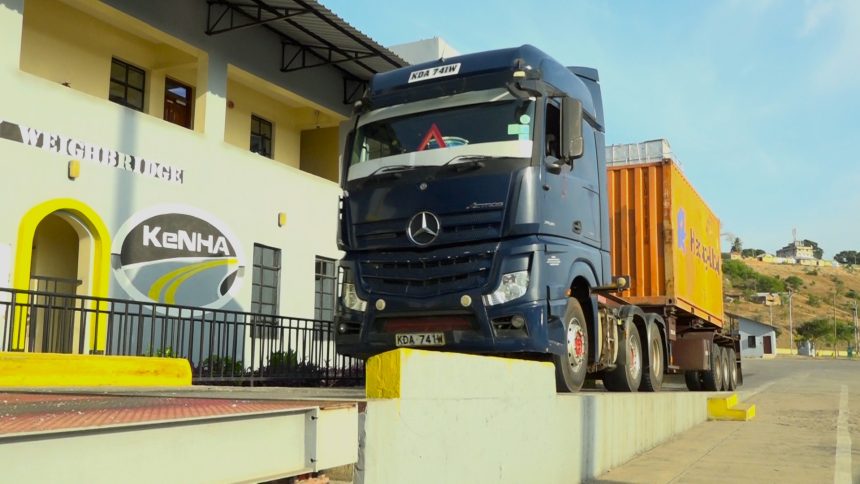
As cargo volumes surge through Kenya’s main maritime gateway and freight traffic intensifies along the Northern Corridor, pressure on the country’s road infrastructure has reached unprecedented levels.
Authorities warn that overloaded trucks not only accelerate road deterioration but also pose serious safety risks and inflate maintenance costs borne by taxpayers.

Against this backdrop, the Kenya National Highways Authority (KeNHA) has intensified axle load enforcement on trucks exiting Mombasa, tightening compliance measures at the strategic Dongo Kundu–Mariakani–Mtwapa weighbridge cluster, the critical gateway for cargo leaving the Port of Mombasa to the hinterland and the wider Northern Corridor.
The crackdown is designed to safeguard road infrastructure, enhance highway safety and shield transporters from costly penalties associated with overloading.
The Dongo Kundu weighbridge, which serves hundreds of trucks daily, has recorded an impressive 98.5pc compliance rate. Officials attribute the milestone to sustained sensitisation of transporters at weighbridges and loading zones, alongside routine calibration of weighing equipment to ensure accuracy.
The cluster is staffed by 234 personnel and supported by 79 police officers who play a central role in enforcing axle load limits and ensuring transporters understand legal requirements on vehicle dimensions and weight distribution before proceeding with their journeys.
Victor Kithome, Manager of the Mariakani, Mtwapa and Dongo Kundu weighbridges and the adjacent 1,466-kilometre road network, underscored the importance of proper axle use, particularly for trucks fitted with lift axles.
“A truck with a lift axle keeps it raised when empty, but once loaded, the axle must be lowered to touch the ground and distribute weight evenly,” Kithome explained.
He cautioned that operating a loaded truck with the lift axle raised shifts excess weight to other axles, resulting in overloading and accelerated damage to road surfaces.
“We encourage drivers and transporters to ensure they do not operate trucks with the lift axle raised when loaded,” he said, noting that the majority of transporters have embraced compliance.
“We are strict on axle load enforcement, and transporters have gradually adopted a culture of self-regulation. They are striving to comply to avoid unnecessary delays at the weighbridge.”
Axle load limits are determined by a vehicle’s axle configuration. Trucks are categorised into two-, three-, four-, five- and six-axle classes. The maximum permissible load for two-axle trucks is 18 tonnes, while three-, four- and six-axle vehicles are capped at 26, 30 and 50 tonnes respectively.
Clear signage displaying axle limits and overload penalty schedules has been installed to guide transporters and enhance transparency.
Despite the gains, the cluster continues to grapple with enforcement challenges. Some truckers have attempted to evade inspection along the southern bypass by diverting through the Jomvu route.
“As the first weighbridge cluster, compliance of most transit trucks is determined here,” Kithome noted. “Other clusters may experience smoother operations, but enforcement begins at this point because overloaded trucks cannot proceed from one cluster to another.”
The County Government of Mombasa has been commended for supporting enforcement efforts by sharing timely information on suspected overloaded vehicles identified at cess collection points.
Anderson Wafula, Technical Manager at Ebenezer Commercial Works Limited — the firm contracted by KeNHA to manage the weighbridges — said axle limits and penalty schedules are prominently displayed for transporters.
He acknowledged that ongoing construction along the Mariakani road has contributed to traffic snarl-ups within the cluster, though the situation is being managed administratively.
“We also have transporters who are notorious for overloading despite continuous sensitisation and engagement,” Wafula said. “To address this, we deploy mobile enforcement teams to monitor feeder roads linking to the national trunk road network and the Northern Corridor.”
With enforcement tightening at the coastal gateway, KeNHA officials maintain that sustained compliance will be key to preserving Kenya’s road infrastructure, improving safety and ensuring more efficient freight movement across the country.