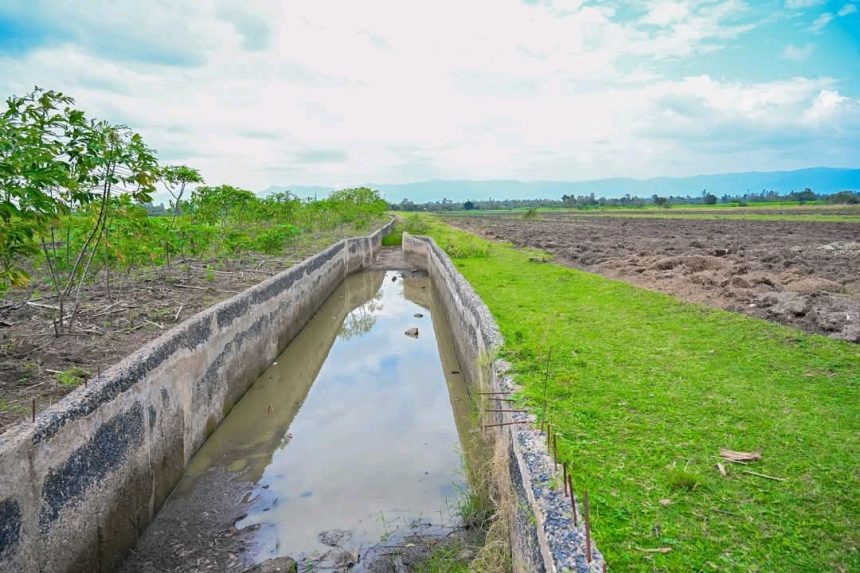
The government has partnered with the Republic of Hungary to rehabilitate and expand Ahero Irrigation Scheme in Kisumu County, in a Ksh 650 million project expected to unlock 1,000 acres for irrigated agriculture.
The project in Nyando, which is being implemented by the National Irrigation Authority (NIA), will convert the Ahero pumping station into a solar-powered hybrid system, reducing reliance on the national grid and cutting operational costs that have weighed heavily on farmers.

Treasury Cabinet Secretary, John Mbadi said the investment was a major step towards boosting rice production in Nyanza and narrowing Kenya’s rice deficit, currently estimated at 700,000 metric tonnes annually.
“Nyanza alone has the potential to produce up to 420,000 metric tonnes if we fully utilise the irrigation potential in this region,” Mbadi said during the launch in Kobong’o, Nyando Sub-County.
“What has been missing is affordable and reliable infrastructure. With this intervention, we are addressing that gap,” he added.
Under the first phase, 625 acres have been earmarked for large-scale rice production, with the remaining 375 acres to be developed in the 2026/2027 financial year through an additional Ksh 50 million allocation by the National Government.
Speaking during the same occasion, Water, Sanitation and Irrigation Cabinet Secretary Eric Mugaa said the Kobong’o expansion was part of broader efforts to revitalise the larger Ahero irrigation scheme, which currently has over 2,300 acres under irrigation.
He noted that recent installation of a new pump at West Kano had unlocked more than 1,000 acres previously affected by backflow from Lake Victoria, demonstrating the impact of targeted infrastructure upgrades.
“Irrigated agriculture is predictable and sure. It gives farmers certainty compared to rain-fed farming, which is vulnerable to climate variability,” Mugaa said, adding that the government was encouraging diversification into high-value horticultural crops to boost farmers’ incomes.
The Hungary-funded project is a turnkey arrangement financed through a five-million-dollar tied-aid credit facility from Budapest.
It includes a 500-kilowatt-peak grid-tied solar power system for the pumping station, rehabilitation of intake works on River Nyando, replacement of two ageing pumps, installation of a new high-capacity pump, riverbank protection and development of a water distribution network for the initial 625 acres.
Hungary’s Ambassador to Kenya, Katalin Nyirati, said her country was keen to support irrigation because of its central role in food security and climate resilience.
“Agriculture is very important to Hungary, and we understand the challenges farmers face due to climate change. Irrigation provides safety, security and independence for farmers,” she said.
She added that Hungary would also support training to equip farmers and technical teams with the skills needed to operate and maintain the system efficiently.
The Principal Secretary for Irrigation, Ephantus Kariuki outlined four critical areas necessary to bridge the rice production deficit: strengthening market linkages, reducing production costs through solarisation, expanding acreage under irrigation and safeguarding environmental resources.
He said only about 40pc of irrigable land in parts of Nyanza region was currently under production, leaving significant potential untapped.
“Farmers are producing, but they struggle with high electricity costs and weak market linkages. By lowering production costs and connecting them to better markets, we can significantly increase output,” Kariuki said.
According to the project brief, the Kabong’o scheme will directly benefit 240 households and create an estimated 5,000 direct and 10,000 indirect jobs.
Farmers are projected to earn gross revenues of approximately Ksh 250,000 per acre per season, translating to about Ksh 250 million annually across 1.6 cropping seasons once the scheme is fully operational.
The 26-month project commenced in December 2024 and is currently 40 per cent complete.
Feasibility studies and design have been finalised, while pumps and solar panels have already been delivered to the country, with contractors now undertaking on-site works. Completion is expected in February 2027.
Once operational, the expanded Ahero–Kobong’o scheme is expected to significantly raise rice output in the Lake Region, strengthen food security and contribute to the country’s broader push towards agricultural self-sufficiency.