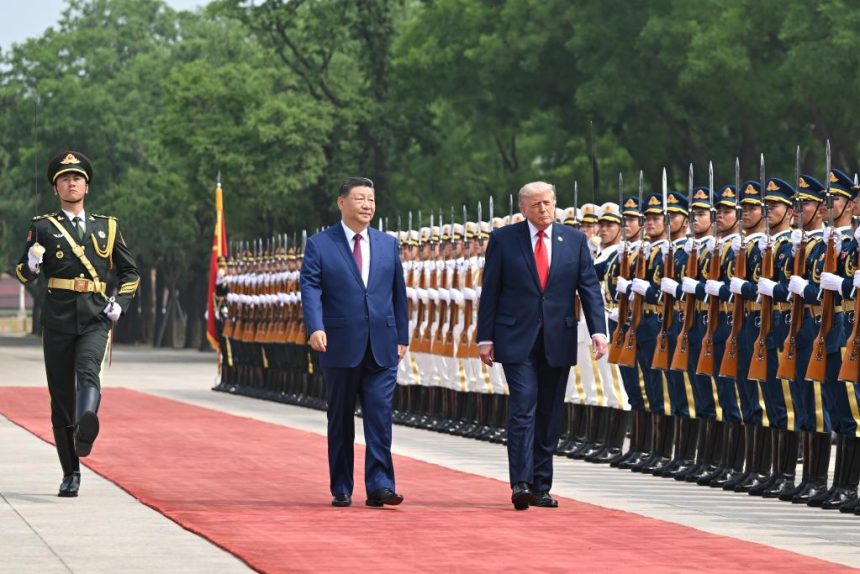
Chinese Foreign Minister Wang Yi says the recent summit between Chinese President Xi Jinping and U.S. President Donald Trump resulted in significant common understandings regarding the Taiwan issue.
Wang, China’s top diplomat, emphasises that Washington does not support Taiwan independence.

Briefing the press after Trump’s state visit to China from May 13 to 15, Wang described the Taiwan issue as “the most important issue between China and the U.S., one that affects the entire relationship.”
“If it is handled properly, the overall relationship will be stable, and the two sides will be able to devote more energy to advancing mutually beneficial cooperation,” Wang explained. “Otherwise, the two countries will have clashes and even conflicts, and the entire relationship will be in great jeopardy.”
Wang described the discussions between the Chinese and U.S. leaders during the summit as “open, thorough, constructive, and strategic,” leading to common understandings on major issues.
He reiterated Beijing’s longstanding position on Taiwan, asserting that “the island is part of China and that reunification remains a core national objective.”
“The mainland and Taiwan belong to one and the same China. This is a fact established since antiquity, the real status quo of the Taiwan Strait, and an important part of the postwar international order,” Wang told the press.
He urged Washington to “strictly abide by the one-China principle and the three China-U.S. joint communiqués” and to fulfil its international obligations.
Wang also emphasised that both Beijing and Washington acknowledge the importance of maintaining peace and stability across the Taiwan Strait.
“To ensure this is the case, one must never indulge or support ‘Taiwan independence,’ because ‘Taiwan independence’ and cross-Strait peace are as irreconcilable as fire and water,” he stated.
According to Wang, China emerged from the summit with the belief that the United States understands Beijing’s concerns and does not support moves towards formal independence for Taiwan.
“Our impression coming out of the summit is that the U.S. side understands China’s position, takes China’s concerns seriously, and, like the rest of the international community, does not agree with or accept Taiwan’s moves toward independence,” Wang said.
Trump reinforced Wang’s position during an interview with Fox News before concluding his visit to China, cautioning Taiwan against seeking formal separation from Beijing.
“I’m not looking to have somebody go independent. We’re not looking to have wars, and if you kept it the way it is, I think China’s going to be OK with that,” Trump said.
He also questioned the prospect of direct U.S. military involvement in a potential conflict over Taiwan.
“We’re supposed to travel 9,500 miles to fight a war. I’m not looking for that,” he remarked.
During a meeting with Trump, President Xi made it clear that mishandling the Taiwan issue could severely damage China-U.S. relations and potentially lead to confrontation.
Xi also highlighted the cultural and historical ties across the Taiwan Strait, stating, “We Chinese on both sides of the Taiwan Strait belong to one and the same family. No one can ever sever the bond of kinship between us.”