Chinese President Xi Jinping has articulated a vision for global artificial intelligence governance, emphasising China’s commitment to supporting developing nations. Xi outlined four key priorities for ensuring safe, inclusive, and equitable AI development.
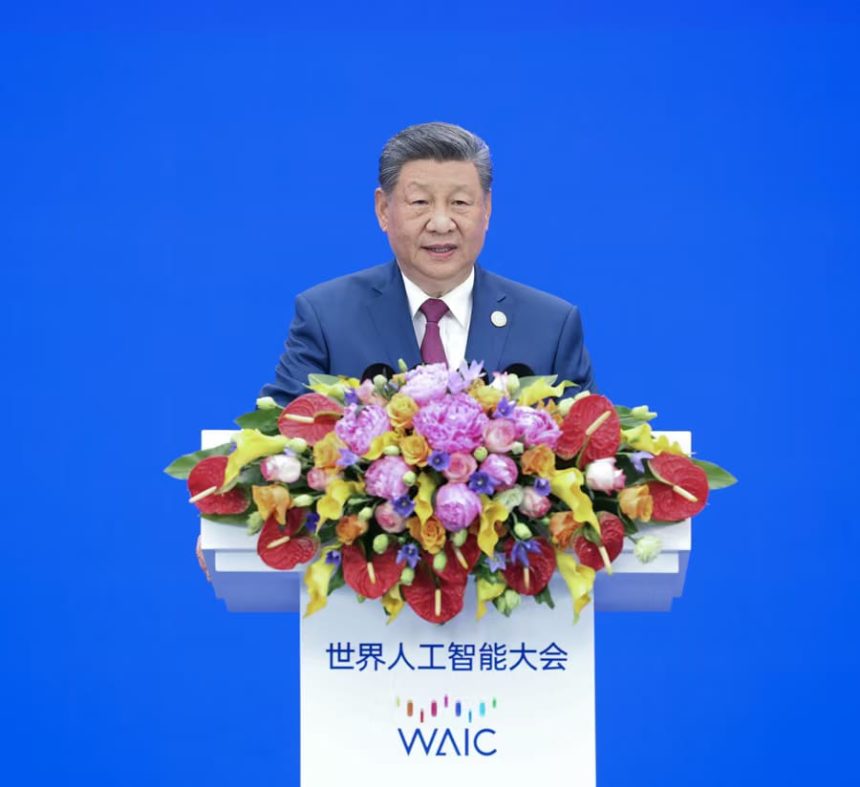
Addressing the 2026 World AI Conference and High-Level Meeting on Global AI Governance in Shanghai, Xi underscored the need for a fair and just global AI governance system. He urged countries to collaborate in order to ensure that AI serves humanity while also tackling concerns around security, ethics, and the widening technological gap.

Xi noted that the rapid progress of AI represents a pivotal moment in human history, offering significant opportunities for economic and social advancement. However, he also pointed out the unprecedented governance challenges that arise with this progress, necessitating coordinated international efforts.
“The new round of technological revolution and industrial transformation is advancing at a faster pace, and the world has entered an unprecedented period of active innovation on AI technologies. Intelligent connectivity, human-machine collaboration, cross-sector integration, joint creation and sharing, and other intelligent technologies are unleashing enormous power,” Xi expressed.
The Chinese leader stressed the importance of addressing fundamental questions surrounding the future of AI, including coexistence between humans and machines, ensuring secure algorithm-driven decision-making, managing ethical risks through adaptive governance, and ensuring that all countries benefit from AI developments despite the growing digital disparities.
“These questions demand serious consideration and real answers from the whole international community,” he said.
The Chinese leader outlined four key principles that he said should guide global AI development and governance.
Firstly, he called for increased openness and international collaboration to accelerate innovation. He urged countries to embrace open-source technologies, enhance scientific cooperation, drive industrial innovation, and expand AI applications across traditional and emerging sectors.
Xi envisioned AI as a new engine for global economic growth, ensuring that technological progress benefits businesses and societies worldwide.
Secondly, Xi stressed the need to strengthen safeguards to maintain AI security and ensure human control over its applications. He advocated for robust legal and regulatory frameworks, technological monitoring systems, early warning mechanisms, and emergency response measures to prevent the misuse and exploitation of AI technologies.
“AI should be a trusted tool for humanity. We should take seriously the various types of inherent and secondary risks that AI may trigger,” Xi cautioned, while also warning against exaggerating national security concerns in a manner that could hinder international cooperation.
The third principle focused on inclusivity and cultural diversity, with Xi advocating for AI development that respects the diversity of civilisations rather than diminishing it.
He urged countries to ensure that AI reflects shared human values while promoting understanding, cultural exchange, and mutual learning among nations.
Lastly, Xi highlighted the importance of strengthening global governance through multilateral cooperation. He affirmed support for the United Nations as the central platform for international coordination on AI, calling for closer alignment on governance rules, technical standards, and national AI strategies.
Developing countries
Xi underscored the significance of assisting developing countries in building AI capacity to bridge technological and digital divides, cautioning that unequal access to AI could perpetuate historical injustices.
“AI development should not be a solo performance by a single country, but a symphony of international cooperation,” he asserted.
Xi welcomed the establishment of the World Artificial Intelligence Cooperation Organization in Shanghai as a significant step towards international AI governance and a response to calls from developing nations for enhanced global collaboration.
“This is a major move by China to answer the call of the Global South and unite the international community together to promote AI development and governance vigorously. It will be an important milestone in the history of AI development,” Xi remarked.
Xi announced a series of commitments that China will undertake in the next five years to support global AI development, including providing training and seminar opportunities for 5,000 participants from developing countries, establishing international AI application cooperation centres with regional organisations such as ASEAN, the African Union, BRICS, the League of Arab States, the Shanghai Cooperation Organisation, and the Community of Latin American and Caribbean States, and granting 30 countries access to China’s AI-powered meteorological early warning system, MAZU.
According to Xi, the rapid progress in AI necessitates continuous improvements in governance to ensure that the technology remains guided by human wisdom and international consensus.
“As AI advances at a staggering speed, we must ensure its development is for the positive, for good and for humanity,” he emphasised.
Reiterating China’s commitment to international cooperation, Xi expressed readiness to deepen collaboration with all nations.
“China is ready to be more open, take more practical actions, and assume a more visionary perspective. We are ready to work with all parties to seize the opportunities of AI development and meet the challenges, and join hands to create a brighter future for humanity,” he affirmed.