

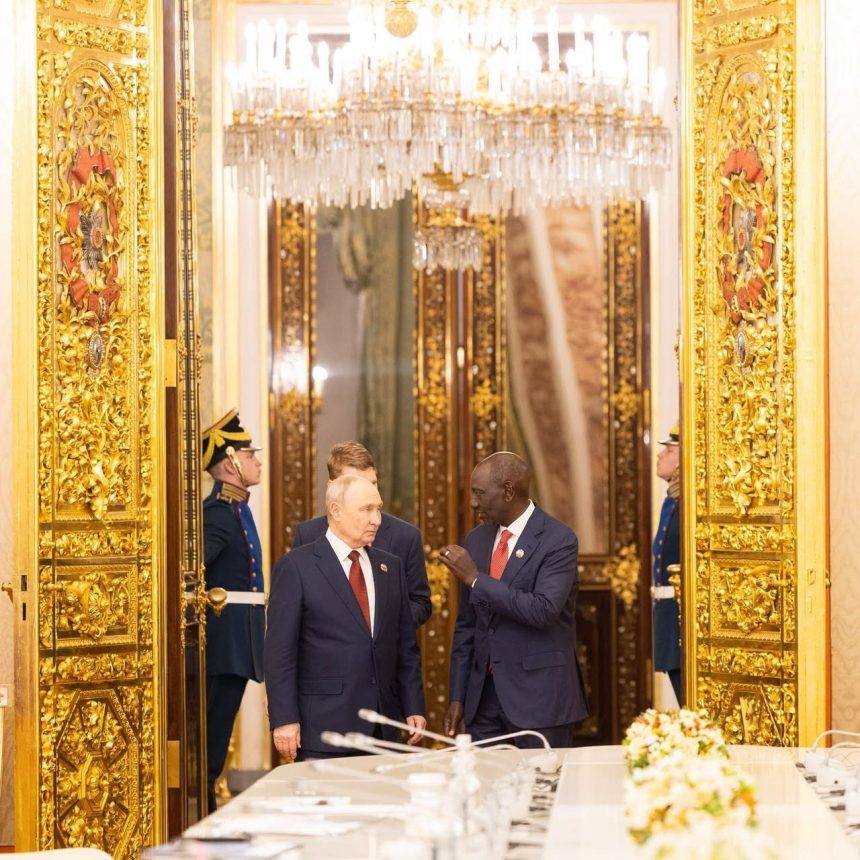
Kenyans will no longer be recruited into the Russian military following an agreement reached between President William Ruto and his Russian counterpart, President Vladimir Putin at the Kremlin in Moscow on Thursday.
During a bilateral meeting after the conclusion of the Third Russia-Africa Economic and Humanitarian Forum on Thursday, the two leaders agreed to designate Kenya as a non-source country for recruitment into the Russian military.

The landmark agreement effectively closes the recruitment channels through which several Kenyans had been illegally enlisted to fight in the Russia-Ukraine war.
“I informed President Putin that I have appointed a Defence Attaché at the Kenyan Embassy in Moscow, who will liaise with the Russian Ministry of Defence to facilitate the repatriation of Kenyans who had travelled to Russia for military purposes,” President Ruto said.
The President further stated that the Defence Attaché would work closely with the Russian Ministry of Defence to facilitate compensation for affected Kenyans and coordinate their safe return home.
At the meeting, the two leaders underscored the need for deeper economic partnership between the two countries given their historical ties.
President Ruto acknowledged the longstanding diplomatic relations between Kenya and Russia, recalling that Russia was the second country to recognise Kenya’s independence in 1963.
He noted that the historical relationship between the two countries provides a strong foundation for expanding cooperation in trade, investment and other areas of mutual interest.
On trade, President Ruto acknowledged the existing imbalance in favour of Russia but emphasised the need to diversify trade opportunities and expand Kenyan exports, particularly tea and flowers, to the Russian market.
“I recognise there is a trade imbalance in favour of Russia, but there is an opportunity to look at what other trade avenues we can explore,” he said.
President Ruto also invited Russian investors to explore investment opportunities arising from Kenya’s National Infrastructure Fund, noting that the initiative would provide commercially viable avenues for private sector participation in infrastructure development.
“These are commercially viable opportunities that can be looked at,” he said.
On his part, President Putin reaffirmed Russia’s commitment to strengthening trade, economic, cultural and humanitarian cooperation with Kenya.
He noted that Russia remains one of Kenya’s leading suppliers of fertiliser and expressed his country’s desire to sustain and expand the existing trade relationship.
“Russia is one of the top fertiliser exporters to Kenya. I reiterate that we need to preserve this trend. We maintain fruitful cultural and humanitarian ties between our countries,” he said.
On education, President Putin announced that the Russian Government had increased the quota for Kenyan students pursuing higher education in Russia.
He disclosed that an additional scholarships would be made available to Kenyan students from the current 70 to 300 annually.
Turning to international cooperation, President Putin underscored the shared positions between Kenya and Russia on strengthening the central role of the United Nations, promoting a multipolar world order and reforming multilateral institutions to ensure greater inclusivity and representation of developing countries.
He further expressed Russia’s support for strengthening the United Nations Environment Programme (UNEP) headquarters in Nairobi, highlighting its significance as a major United Nations presence in the Global South.
The visit culminated in the signing of five Memorandums of Understanding (MoUs), aimed at enhancing bilateral partnership between the two countries across key sectors, including economic cooperation, employment, transport, and diplomacy.
One of the agreements provides for the establishment of the Intergovernmental Russia-Kenya Commission on Economic Cooperation, creating an institutional framework to strengthen bilateral economic ties.
Another MoU provides for cooperation in labour inspection and employment promotion between Russia’s Federal Service for Labour and Employment and Kenya’s Ministry of Labour.
Once the necessary implementation mechanisms are in place, the agreement is expected to open up more employment opportunities for Kenyans in Russia.
The other agreements cover cooperation between the two countries’ Transport ministries to advance Kenya’s transport sector; visa-free travel for holders of diplomatic and service passports; and collaboration in diplomatic training.
President Ruto said the agreements that would unlock new opportunities for trade and investment.
“We believe the economic activities presented to Kenya give us a win-win opportunity for both Kenya and Russia,” he said.
The agreements establish a strong foundation for expanding bilateral cooperation, translating the longstanding relationship between the two countries into tangible economic and development gains.
He was accompanied to the talks by Prime Cabinet Secretary Musalia Mudavadi, Investment, Trade and Industry Cabinet Secretary Lee Kinyanjui, and Kenya’s Ambassador to Russia Peter Mathuki.


