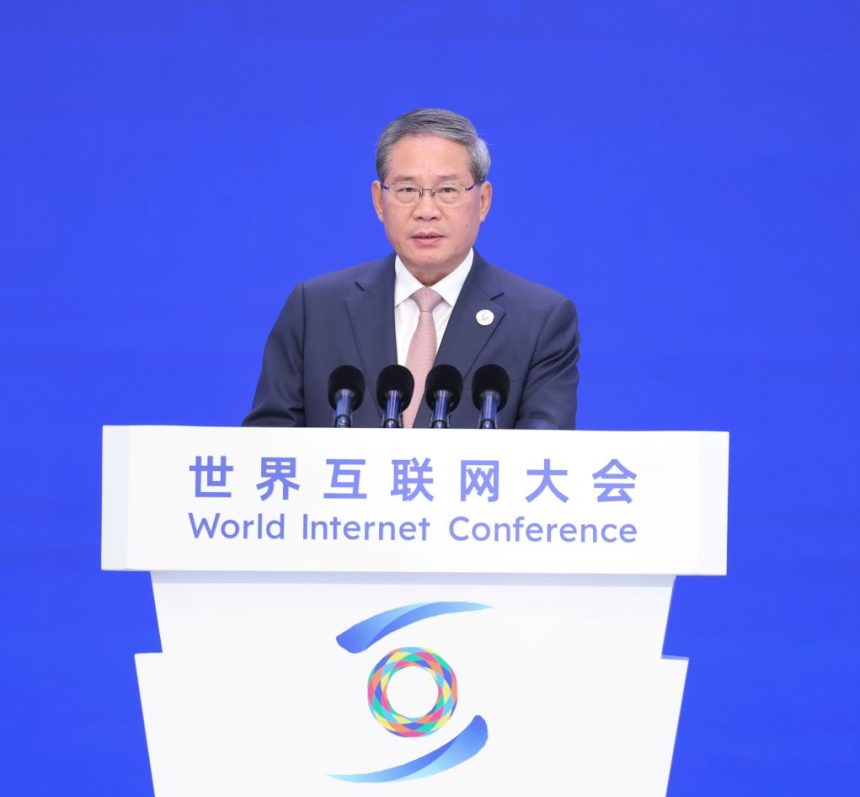
Chinese Premier Li Qiang has reiterated the need for a people-centred approach to internet development and stronger international cooperation. He urged countries to ensure that emerging digital technologies promote human development, bridge inequalities and contribute to shared global prosperity.
Speaking during the 2026 World Internet Conference Wuzhen Summit in Zhejiang Province, eastern China, Li stated that the internet was undergoing accelerated transformation driven by the convergence of artificial intelligence (AI), cloud computing and blockchain technologies.

He noted that the changes were reshaping societies and economies, creating new ways of life, transforming industries and advancing intelligent production systems.
However, Li cautioned that technological progress must remain anchored in human interests, stressing that AI and the internet should extend human capabilities rather than replace people.
“Human agency must remain paramount, and the ultimate purpose must be to promote people’s all-round development,” he said.
The Premier called for greater attention to the ethical challenges associated with algorithms and AI models, as well as security risks arising from the growing integration of digital technologies with physical systems. He also warned against widening digital inequalities, noting that more than two billion people worldwide remain offline and risk being excluded from the benefits of technological advancement.
Li said addressing these challenges would require greater openness in technological innovation, stronger international collaboration and wider access to digital infrastructure and expertise.
He called on countries to encourage open-source development, collaborative research and the wider application of emerging technologies, while strengthening the sharing of knowledge and technology across borders.
“China will continue to promote technology transfer and knowledge sharing to build an open, inclusive and dynamic global ecosystem for digital innovation,” he said.
On cybersecurity, he urged countries to strengthen safeguards through practical cooperation and a shared approach to digital security. He advocated a security framework based on common, comprehensive, cooperative and sustainable principles, while cautioning against the use of national security concerns to restrict legitimate international digital engagement.
China, he said, respects the legitimate cybersecurity concerns of all countries and opposes the overstretching of the concept of national security and the creation of what he described as “digital iron curtains”.
The Premier also emphasised the need to ensure that the benefits of digital transformation reach developing countries, particularly those in the Global South, which continue to face gaps in infrastructure, skills and technological capacity.
“China will actively implement the Global Development Initiative and support Global South countries in building digital infrastructure, cultivating talent and enhancing capacity,” he emphasised.
Li further called for reforms in global internet governance through inclusive dialogue and stronger multilateral cooperation, arguing that countries should prioritise shared interests rather than deepen divisions over technology and cyberspace.
He urged the international community to strengthen coordination, practise genuine multilateralism and work towards a more just and equitable system of global internet governance. China, he said, would continue supporting dialogue platforms guided by extensive consultation, joint contribution and shared benefits.
The Premier said the growing interdependence of the global digital economy made international cooperation essential, noting that no country could achieve sustainable progress in isolation.
“In an increasingly interconnected world, no country can prosper alone,” Li said, reaffirming China’s commitment to working with other countries to ensure digital and intelligent technologies contribute more effectively to global development and human well-being.