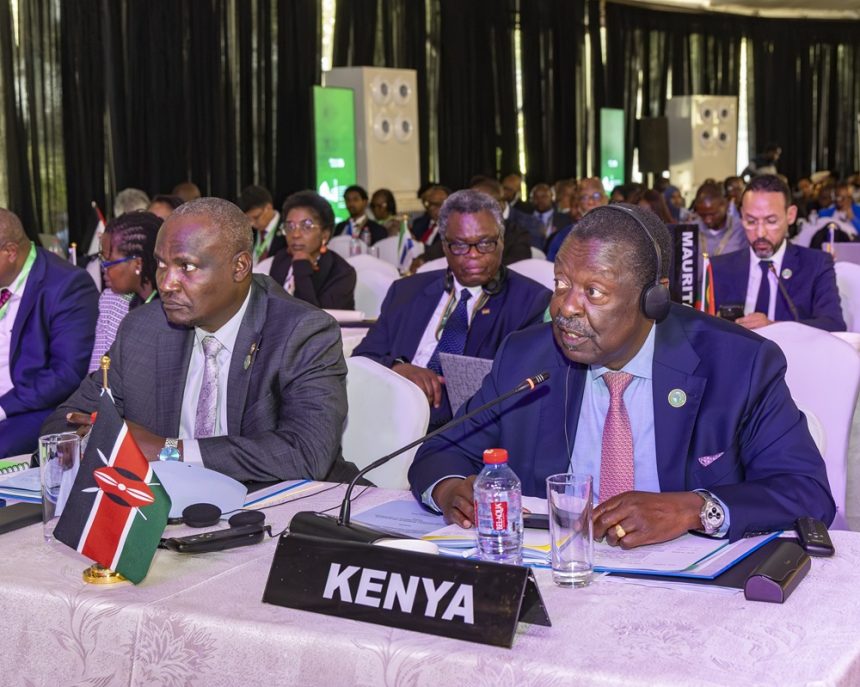
Prime Cabinet Secretary Musalia Mudavadi, has reaffirmed Kenya’s commitment to a financially independent, sustainable and accountable African Union (AU), calling on member states to take greater responsibility for financing the continent’s institutional and development priorities.
Speaking during the Extraordinary Session of the African Union Executive Council and Ministers of Finance on Financing the African Union in Accra, Ghana, Mudavadi who is also the Foreign and Diaspora Affairs CS said Africa’s financial sovereignty was central to the continent’s ability to implement its collective decisions, protect its independence and deliver on the aspirations of Agenda 2063.

Representing President William Ruto, who is the AU Champion for Institutional Reform, the PCS emphasised that sustainable financing was not merely a budgetary consideration but an existential issue for the African Union.
The meeting brought together Ministers responsible for Finance and Foreign Affairs, the African Union Commission, the AU High Representative for Financing the Union, and representatives of African multilateral financial institutions to examine practical and sustainable ways of financing the continental organisation.
Kenya’s delegation included Cabinet Secretary for the National Treasury and Economic Planning, Hon. John Mbadi, whose presence underscored the importance Nairobi attaches to aligning diplomatic commitments with the financial resources required to implement them.
PCS said the continent had made important commitments towards financial sovereignty through the Johannesburg Decision 578 and Kigali Decision 605, which sought to progressively increase member states’ responsibility for financing the Union.
He acknowledged that while member states had made commendable efforts, the financing targets agreed upon remained largely unmet, leaving the AU significantly dependent on external development partners.
Mudavadi observed that the changing global economic and financial landscape made it increasingly important for Africa to mobilise its own resources, strengthen its financial institutions and reduce exposure to unpredictable external funding.
A key highlight of Kenya’s position was its endorsement of Option C, which Dr. Mudavadi described as a viable pathway towards achieving a financially sustainable and effective African Union.
The proposed framework rests on four interconnected pillars. First, a high-value programmatic offer anchored in Agenda 2063.
“Kenya maintains that the African Union must concentrate its resources on programmes that deliver measurable benefits to African citizens,” said Mudavadi.
He added, “The Union’s priorities must be sufficiently compelling to attract investment and demonstrate tangible returns on the resources committed by member states.”
PCS said Kenya supported the adoption of a consolidated budget architecture anchored in a medium-term expenditure framework.
This, he said would strengthen planning, improve resource allocation, enhance expenditure discipline and ensure that funding is directed towards programmes with measurable outcomes.
On the financial autonomy and predictable resource mobilisation, PCS said Kenya supported the bold and universal framework that proposed the implementation of the 0.2 per cent levy on eligible imports, alongside the establishment of a US$1 billion African Union Peace Fund endowment and predictable mechanisms for its replenishment.
“The measures are intended to provide the Union with dependable resources,” said Dr. Mudavadi.
“Africa must have the means to finance the Africa it envisions,” he said.
Mudavadi said Kenya supported building a leaner and more effective African Union by eliminating duplicated mandates, improving coordination among institutions and making better use of existing assets and resources.
He emphasised that financial sustainability must go hand in hand with accountability, transparency, prudent resource management and demonstrable value for money.
He said declining predictability of external development financing, rising sovereign debt vulnerabilities and growing geopolitical uncertainty had made the strengthening of African-owned financial institutions an economic sovereignty imperative.
“Kenya consequently supports a structured AU–AAMFI Strategic Partnership Framework firmly anchored within the African Union’s institutional framework,” said Mudavadi.
The partnership he said is expected to mobilise African capital, strengthen home-grown financial institutions and accelerate the implementation of Agenda 2063.
He urged member states to approach the deliberations with solidarity and shared responsibility, noting that differences in national economic circumstances should not undermine the collective determination to build a financially sustainable Union.
The meeting is expected to develop recommendations on the financing of the African Union for consideration by the Assembly of Heads of State and Government during its 40th Ordinary Session in January 2027.