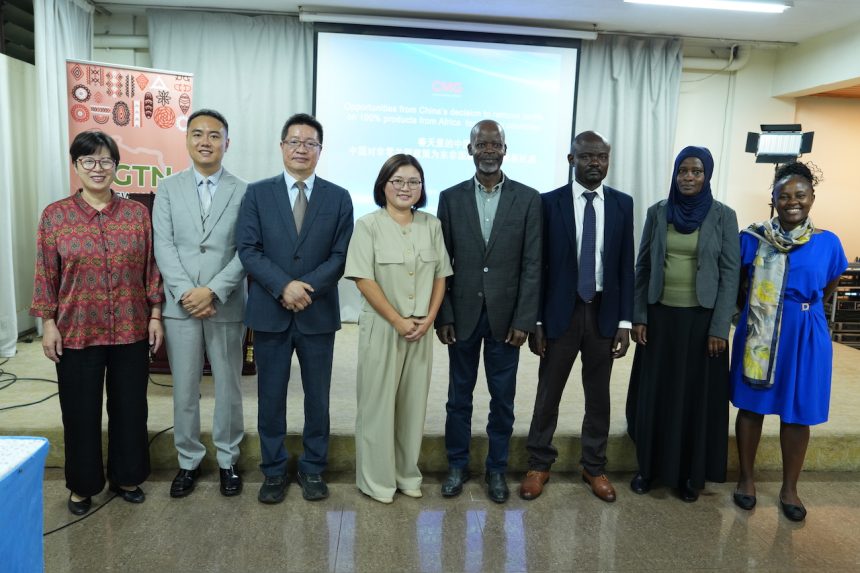
Policymakers, economists, and business leaders now view China’s announcement of a zero-tariff policy on Kenyan products, effective May 1, 2026, as a potential structural shift in trade relations. The policy, which also extends to several other African countries, is anticipated to transform Kenya’s trade dynamics by transitioning from a primarily import-driven relationship with China to a more balanced, export-oriented engagement.
From an economic standpoint, analysts argue that eliminating tariffs will lower transaction and production costs, thereby enhancing Kenya’s competitiveness.
Speaking during a forum in Nairobi, Dr. Mulaku Lemi Nyongeza, a lecturer at the University of Nairobi, described the policy as a strategic opportunity for both Kenya and the broader African continent.
“Removing tariffs lowers the cost of operations, whether you are exporting or importing. It is an opportunity that Kenya and Africa in general should take advantage of,” he stated.
Nyongeza noted that the most immediate benefit is expanded market access, addressing a long-standing barrier in African trade.
“Removing tariffs expands market access. Our access to global markets has been limited, partly due to tariffs. While tariffs are just one barrier, they are a key one. Removing them eliminates a major obstacle,” he remarked.
However, he cautioned that non-tariff barriers, particularly related to quality and regulatory standards, will determine whether Kenya can fully capitalize on this opportunity.
“The products we export must meet strict standards, including quality, size, and processing methods. Kenyans must make an effort to produce for that market,” he said.
The new arrangement also introduces a geopolitical and economic recalibration, with experts suggesting that Kenya may now diversify away from traditional Western markets under frameworks like the African Growth and Opportunity Act (AGOA).
“This policy offers a unique opportunity for China, as a major economy, to remove tariffs for 53 African countries. It also allows African countries to diversify markets and reduce overreliance on traditional partners like the United States under AGOA,” Nyongeza explained.
William Zhuo, Chairman of the Kenya Chinese Chamber of Commerce (KCCC), described the policy as a turning point in bilateral trade dynamics.
“Before, we used to talk about imports from China to sell in Kenya. But now the new policy gives us more opportunity to sell to China from Kenya,” he said.
Zhuo emphasized that the removal of tariffs is likely to reshape Kenya’s trade structure, encouraging local production for export while lowering cost barriers that have previously hindered competitiveness in the Chinese market.
He added that the policy could stimulate foreign direct investment (FDI), as companies seek to establish manufacturing bases in Kenya to take advantage of tariff-free access to China.
“We can attract more direct foreign investment, use local skilled labour to produce quality products, then export to China and avoid those taxes,” Zhuo noted.
Beyond trade flows, stakeholders highlighted the policy’s potential to drive industrialization and job creation.
Zhuo pointed to Kenya’s demographic advantage, particularly its educated youth, as a key factor in leveraging the policy for digital trade and e-commerce growth.
“Kenya has a highly educated youth population with strong ideas and digital innovation skills. In the future, we can leverage this zero-tariff policy to expand e-commerce and digital trade, creating more opportunities for young people,” said Zhuo.
In light of this positive development, communication experts are advocating for a seamless flow of information to prevent anything that could limit uptake, especially among small and medium enterprises (SMEs). Zaina Shisia of the Inter Region Economic Network stressed that awareness and practical guidance are critical bottlenecks.
“The gates are open; the shelves in Shanghai are waiting for African products. This is the chance for Africa to access China under the zero tariff policy. However, beyond the headlines, the major gap is information. Without proper dissemination, these opportunities will remain at the signing table,” she said.
She urged the media to take a proactive role in market education, including highlighting export success stories and simplifying compliance processes.
“The media should also produce ‘how-to’ content that explains packaging, certification, and regulatory requirements for accessing the Chinese market,” Shisia added, suggesting that “media organizations should host forums to educate businesses about the zero-tariff policy, its feasibility, profitability, and operational requirements.”
The policy is also expected to generate cross-sector spillovers, particularly in healthcare, manufacturing, and services.
Dr. Rudong Zhang, CEO of Health Outreach Link2Care, highlighted how China-Africa collaboration can extend beyond trade into technology transfer and service delivery systems.
“China has strong industrial and technological capabilities that can make healthcare more accessible, affordable, and scalable. China-Africa cooperation should go beyond trade and investment to focus on building sustainable systems and infrastructure,” he said.
Drawing from his experience in community healthcare, Zhang stressed the importance of sustainable models in translating policy into real impact.
“Real impact comes not from merely introducing solutions but from ensuring they are sustainable,” he stated.
The experts agreed that the zero-tariff policy represents a significant turning point in Kenya-China trade relations, with the potential to transform Kenya into an export-oriented economy, deepen industrialization, and enhance global market integration.