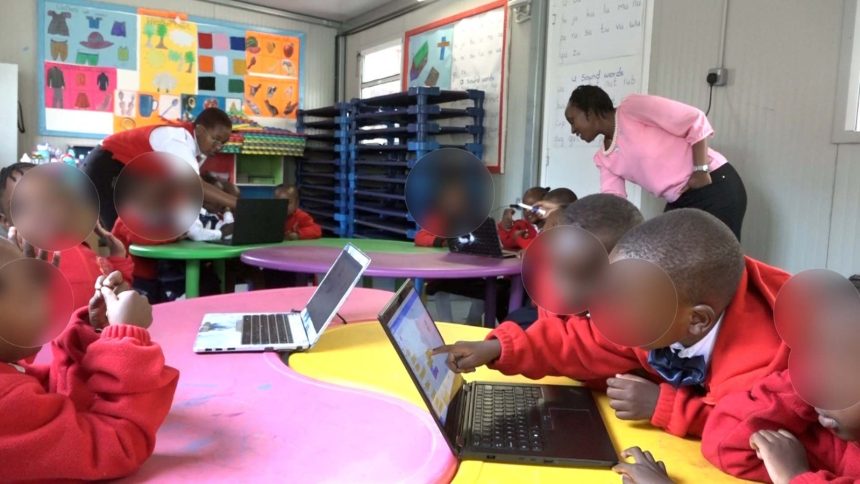
At the Africa Tech Space (ATS) Center in Nakuru, a group of children, brimming with excitement, huddle around computers, their hands eager to learn coding, robotics, Artificial Intelligence (AI), Machine Learning (ML), and other technology-related topics.
Learners aged 7-12, drawn from various institutions, are also enabled to explore physical computing and incubate viable Science, Technology, Engineering, and Mathematics (STEM) ideas.
Tutors at the Centre say the teaching module has not only made learning easy but also fun.
Head tutor and ICT specialist Esther Mureithi says the use of robots makes young learners work in logical and effective ways that foster scientific reasoning and critical thinking, which may not be guaranteed in theoretical learning.
Mureithi indicates that the learners also engage in a ‘robotic challenge’, which entails assembling and programming, which requires a lot of creativity and learning.
This, she states, has not only enhanced their understanding in learning but also enabled them to acquire other skills such as communication skills, teamwork, tolerance, and time management.
To the head tutor, due to technology, geographical boundaries have been dissolved, so a Kenyan child is competing with a child in the USA, South Korea, Japan, Germany, India, or any other part of the world. There is a need to prepare them to cope with a world where competition is becoming more intense.
According to Mureithi, younger generations are growing up interacting with Artificial Intelligence algorithms, yet little attention is paid to the impact of AI-related technologies on children.
“With Kenya fast becoming one of Africa’s booming tech leaders, teaching young children computer skills has become increasingly important. In the future, many jobs will be carried out through technology, and it is therefore imperative that they start learning the skills at a young age.”
Currently, a batch of 60 learners is undergoing the training program at the ATS facility, which is equipped with state-of-the-art equipment that includes laptops and robotic kits. Mureithi discloses that they aim to reach 5,000 young learners by 2030.
The facility is domiciled at the Rift Valley Institute of Business Studies (RVIBS).
The initiative is a collaboration between institutions of higher learning, ICT experts drawn from the Eastern Africa region, tech companies, and industry leaders, among others, aiming at equipping young people with future-ready digital skills while expanding access to education, mentorship, and technology-driven opportunities.
The learners are first introduced to simple concepts like algorithms, commands, and sequences by using relatable examples of everyday life. This includes defining what coding is and how it actually works to make it very simple for them to understand the basic functionality.
Educators then shift to interactive tools and platforms, which make coding more approachable for young children.
These include Websites which have a kid-friendly interface for beginners and Interactive platforms that have gamification in them, which makes learning a more enjoyable experience for children by turning abstract concepts of coding into a fun learning experience.
Mureithi elaborates that trainers then incorporate games and fun activities on the coding platform, making children’s learning experience enjoyable and engaging. This includes game-based lessons, which help children solve problems and challenges by writing codes in them.
They are subsequently taught to break down problems into small steps- a method also known as decomposition. By breaking these complex processes into bite size chunks, the tutors explain that young children can reduce the stress accompanied by a task and can build confidence in themselves as they grow through the process.
The learners are further encouraged to think critically and come up with more creative and innovative solutions to the problem, where they are presented with open-ended challenges that might have multiple answers to them.
Finally, they are encouraged to make learning project-based, which Mureithi indicates, provides kids with a sense of accomplishment in themselves, where they see their ideas coming to life, which is a game-changing experience for them.
Mureithi says it is estimated that in the next 15 years, 75 percent of jobs will require computer skills.
“Once we expose children, they can feel hopeful for the future because they are moving in the direction that the world of work is moving into,” she enthuses.
By the time they start working, they will be “equipped and ready to go into the world of work with the right key competencies that are needed for employability”.
The program is giving the children skills to train the robots to recognize images, sounds, and poses, and program them to respond and perform simple tasks.
As companies increasingly integrate artificial intelligence into their operations, a critical question emerges: are we, as a society that includes employers, educators, policymakers, and technology providers, preparing young people for a workplace where essential AI skills will very soon become the norm, while many traditional entry-level tasks may soon be automated?
Mureithi points out that the skills they acquire make them logical thinkers, develop them for the future, become collaborators, and become digitally savvy. She adds that coding, design, and programming skills the young learners get also help in resilience, stress tolerance, and flexibility.
She notes that the experiences the children acquire through the program spark an interest in them to pursue Science, Technology, Engineering, and Mathematics. STEM-related careers at the tertiary level enhance their creativity and innovation, as well as promote a community of problem solvers and critical thinkers.
“Coding has been introduced at a very early age, and this will enable young people be able to drive the future economy. Coding and programming are the present and future. It is the language, those who are unable will be clustered as being illiterate,” says Mureithi, adding that critical thinking and problem solving are key to Competency Based Curriculum (CBC).
Additionally, she emphasizes that digital skilling is central to Kenya’s national transformation agenda.
“Creativity begins early. If children are exposed to technology at a young age, they can imagine, innovate, and become the next generation of problem-solvers. Digital skills are essential for employability, entrepreneurship, and economic resilience,” she adds.
Mureithi states that the initiative aligns with the government’s Digital Super Highway initiative, which aims to expand access to digital opportunities, enhance service delivery, and prepare Kenyans for a globally competitive workforce.
She affirms that coding, robotics, and machine learning (ML) skills serve as powerful catalysts for Science, Technology, Engineering, and Mathematics (STEM) pathways by transforming abstract concepts into tangible, hands-on projects.
Mureithi points out that the STEM coding and robotics bootcamp initiative is also championing best learning practices and creating a positive attitude towards the subjects for others to emulate.
Through the use of modern and interactive learning materials, the initiative is expected to improve young learners’ attitude, achievement, and confidence, and trigger creativity, thereby nurturing them to become effective lifelong learners equipped with appropriate knowledge, generic skills, as well as values and attitudes necessary for facing 21st-century challenges.
Annette Ngong`e, a researcher at the Tanzanian-based Ubongo Learning, says the STEM Model intervention in the coding and robotics initiative is enhancing learners’ capability in sciences and mathematics.
The training concept for the children, according to Ngong`e, is developed with a mix of education, technology, and entertainment to identify, promote, and ignite the right interest in the STEM pathway.
She advocates for incorporating AI literacy into Africa school’s curricula as early as preschool, focusing not just on technical skills but on critical evaluation and understanding of AI’s limitations.
Ngong`e says research has shown that in the next 10 to 20 years, most of the jobs available will have STEM integrated into them.
“These future scientists, we believe, will not only solve problems, but they will also build and sustain businesses that will grow the Kenyan and African economy at large,” she adds.
The researcher suggests that innovative early childhood learning of STEM be motivated by the fact that teaching coding and robotics to younger learners is vital for developing 21st-century skills.
These subjects, she adds, move learners from being passive consumers of technology to active creators and innovators.
“Robotics provides a tangible way for students to bring their ideas to life. It encourages experimentation, allowing kids to design original projects, games, or interactive stories. The trial-and-error nature of coding and robotics teaches “grit”. When a program fails (debugging), pupils learn that failure is a learning opportunity rather than a dead end,” she notes.