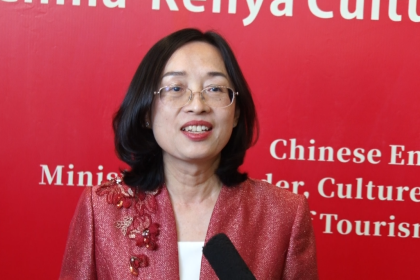
At 60 when most are winding down and preparing for retirement, Bethsheba Otuga was just getting started. She launched Ahadi Pads at 60, and now at 66, her initiative has quietly sparked a revolution of restoring dignity and breaking the silence around menstrual health for countless young girls.
“I was 60 when I began,” she says with a proud smile. “Now I’m 66 and I feel like I am just getting warmed up.”
Otuga is the founder and director of Ahadi Pads, a social enterprise that designs and distributes reusable menstrual pads to girls and women across Kenya. When I recently met her in Nairobi, the writings on her banner caught my eyes, ‘Putting a Period-to-Period Poverty’
I quickly sat down with her to tell the joy that is behind her artwork and indeed Otuga didn’t hide her joy as she shared her journey.
As a young girl humiliated by period stain, Otuga didn’t want other girls to feel what she felt while a young girl.
“I had a stain accident in class,” she recalls. “I was a hardworking student, even wanted to become a teacher. But that one moment brought so much shame and I stopped attending school for a while.”
Years later, after reaching menopause, she was faced with another challenge, heavy flow and limited access to adequate menstrual products.
“I remember thinking, ‘Will I finish all my bedsheets?’” she laughs now, though at the time, the struggle was real. She began cutting up towels and T-shirts to use as makeshift pads. That moment sparked an idea and a mission on how she would bring them into real.
Sewing a Solution
With experience as a high school teacher in English and Business Education, and basic tailoring skills passed down from her enterprising mother, Otuga started experimenting using absorbent fabrics she had at home, she created her first crude pad model.
In 2016, she left formal employment and decided to go all in. “As a widow with children and no stable income, she needed a new path. That path led her to SOMO, a non-profit organization that has developed an innovative smart financing mechanism that targets underbanked and unlocks alternative financing to get to mainstream financing
“There, I got my first grant. I created a proper model. I learned about business. And most importantly I found a community.”
Otuga now leads a small but growing team of four permanent staff and six part-time workers from her workshop. Together, they stitch, package, and distribute washable pads that can last up to two years.
Each pack contains four pads, neatly folded in a waterproof, reusable bag. They’re designed with three to four layers: a soft topper, an absorbent core, a waterproof layer, and a colorful lining. There are also dignity kits with soap, panties, and soaking buckets especially vital for students and low-income women.
“If you don’t have underwear, you can’t use a pad.” “We also distribute panties and vests in schools, and talk about menstrual and reproductive health.”

Restoring Dignity
Otuga sees her product as more than a sanitary solution. “It is about dignity and equality to our young girls,” she adds.
“Menstruation should never be a reason a girl misses school, or a woman feels ashamed,” she says. “We’re making the conversation normal. We’re dignifying menstruation.”
Her products are eco-friendly, reusable, and chemical-free, a strong alternative to the plastic-laden disposables flooding the market.
“We have regular pads, supers for heavier flow, and even ‘mama pads’ for postpartum mothers. We’re now switching to microfiber fabric, which is more absorbent and durable.”
She sources most materials locally but may soon begin importing specialized fabric as demand grows.
Building a Future
Sales vary month to month, but Otuga has seen progress. On February this year alone, she sold products worth KShs 600,000 and she has gotten three loans through SOMO. “Since I started more than 5,000 girls have gotten pads,” she adds.
But profits aren’t her only focus. Her goal is to scale production, hire more women, and expand outreach even outside Kenya
She teaches hygiene practices during school visits and community sessions often to both girls and boys. “If someone is dirty, they’ll be dirty with disposables too,” she says bluntly. “We teach hygiene. It starts with education.”
“SOMO taught us to be resilient. When customers didn’t come during the Covid time, I went to them. I found donors, partners and we distributed pads for free during outreach,” she shared.
When asked what the future holds, she doesn’t hesitate. “I want to grow this. Employ more women. Reach more girls. Make menstruation a dignified experience for everyone.”
“Don’t wait. Even if you’re 60, start something. Use your hands, your mind, your heart. I did.”