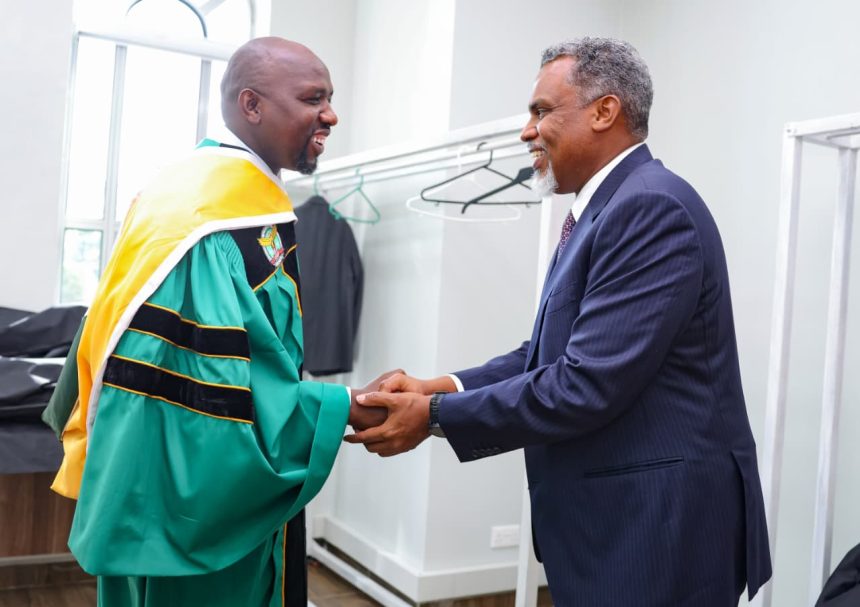
Kenya’s security leadership has praised the newly established National Intelligence and Research University (NIRU) for enhancing intelligence-led operations and improving the country’s response to both conventional and emerging threats.
Speaking during the university’s inaugural graduation ceremony, Interior Cabinet Secretary Kipchumba Murkomen noted that the security sector has already reaped benefits from intelligence-driven insights rooted in structured education and research.
Murkomen emphasized that the institution is developing professional capacity not just for Kenya but for the entire continent. He directly linked recent operational successes to strengthened intelligence capabilities.
“We face transnational threats, including terrorism and organized crime, as well as domestic challenges such as banditry and gang activity. Intelligence-led operations have produced measurable successes, including the recovery of over 1,300 firearms from bandits within a year,” he stated.
He highlighted that this shift has reduced indiscriminate operations and improved targeted enforcement, thereby minimizing collateral impact on communities.
According to the CS, modern security management must rely on data, research, and predictive assessments rather than reactive deployments.
National Intelligence Service Director Noordin Haji echoed Murkomen’s sentiments, calling the university a strategic response to Africa’s evolving threat landscape.
Since receiving its charter in 2024, he disclosed that NIRU has launched master’s programs in counterterrorism and leadership, along with a doctorate in strategic security studies. Haji explained that the curriculum is designed to equip officers with the tools needed to tackle complex, multi-layered risks.
“Africa today faces an era of poly-crisis, where conventional security threats coexist with cyber vulnerabilities, disinformation, climate change, pandemics, and transnational crime,” he said.
“These dynamics demand homegrown, adaptive solutions. NIRU’s approach is anchored in Africa’s historical realities, strategic priorities, and future aspirations,” Haji elaborated.
He also pointed out that intelligence cooperation across Africa has traditionally relied on Western intermediaries, which he described as a structurally limiting model. He said institutions like NIRU foster direct professional networks among African security leaders, allowing for coordinated and timely responses without external facilitation.
Graduates of NIRU include representatives from Burundi, Malawi, Mozambique, Rwanda, Tanzania, Uganda, and Kenya.
In its first year, enrollment spans 21 African countries, bringing the total student population to nearly 100. Plans are in place to expand admissions to at least 32 African states, reinforcing a pan-African mandate.
NIRU’s strategic plan for 2024–2029 prioritizes science, technology, and interdisciplinary research as foundational pillars for future security systems.
Education Cabinet Secretary Julius Migos Ogamba described the new university as fulfilling a critical niche in education, enhancing human capital within the security sector.
“Through its specialized programmes, the university has fulfilled its mandate in intelligence education and applied research—an essential niche in building human capital for the security sector,” he remarked.
He added that the government will continue to work toward establishing an enabling legal and policy framework for higher education.
“Recent reform bills forwarded to Parliament will strengthen governance and competitiveness in the sector, laying the foundation for a globally competitive education system,” he said