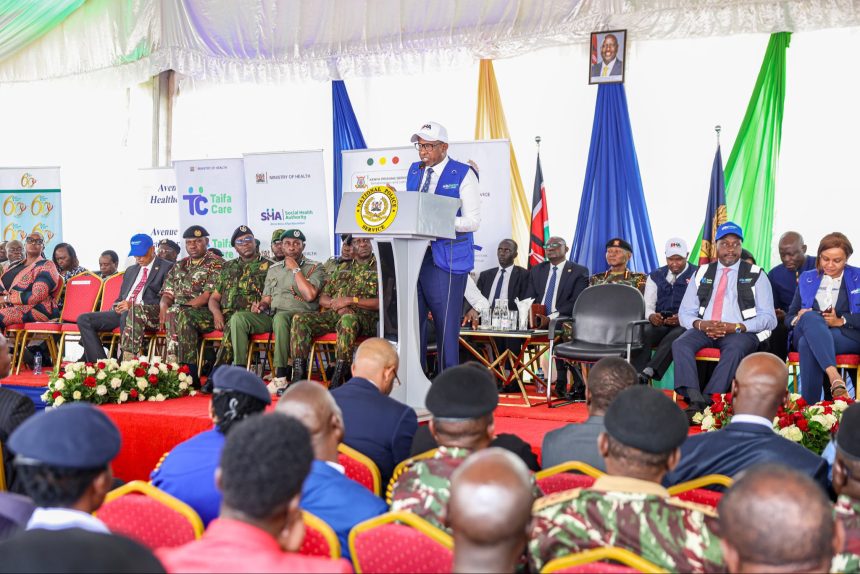
In a landmark move for the welfare of the nation’s security forces, the National Police Service (NPS) and the Kenya Prisons Service (KPS) have officially transitioned to the Public Officers Medical Scheme Fund (POMSF), dubbed the Usalama Cover.
The launch, held at Avenue Hospital in Parklands, marks the formal onboarding of security personnel into the Social Health Authority (SHA) framework.
This initiative fulfils a key presidential directive aimed at providing dignified, comprehensive healthcare to those on the front lines of securing the country.
During the launch, Cabinet Secretary Aden Duale underscored that the health of security personnel is now a core pillar of the national security agenda.
Drawing from his experience as a former Defence Minister, Duale pledged personal oversight to ensure the system delivers on its promises.
“The entire health ecosystem, public or private, remains fully capitalised and capable of offering uninterrupted service,” Duale assured. “Because they are the ones who keep our country safe, the health of these men, women and their children is a top priority for the Ministry of Health and SHA.”
Duale also highlighted that Kenya’s Universal Health Coverage (UHC) agenda is now delivering measurable results, citing the registration of over 30 million Kenyans under SHA and the processing of billions of shillings in claims, evidence of a system that is fully operational and responsive.
Cabinet Secretary for Interior, Kipchumba Murkomen, detailed the extensive scope of the new medical package, emphasising that the Usalama Cover offers a robust safety net for officers and their families.
This enhanced scheme provides seamless access to comprehensive outpatient and inpatient services, alongside critical specialised care, including dental, optical and annual medical checkups.
Speaking at the event, Inspector General of Police Douglas Kanja emphasised that the physical and mental well-being of officers is directly linked to the country’s stability.
“Health coverage is a security issue, not just a medical issue,” IG Kanja stated. “The officers working under me cannot serve effectively if they are constantly worried about how to pay for their own medical bills or those of their families. Good health coverage strengthens morale, readiness, and service delivery.”
Kanja noted that the transition to SHA represents a “workable government-to-government arrangement designed to eliminate inefficiencies and provide more practical, dignified support to our officers.”
Adding the employer’s voice, Dr. Amani Yuda Komora, Chairman of the National Police Service Commission, reaffirmed institutional support for the initiative.
On policy commitment, he said: “I want to unreservedly offer our commitment and support to this initiative and indicate any aspects of policy… we are ready and good to go.” He further emphasised: “We have a duty as the National Police Service Commission to ensure that our servicemen are well taken care of, because the wellness and welfare of our police officers ensures that we also have secure borders.”
The launch brought together top security and health officials, including Commissioner General of Prisons Patrick Aranduh, Deputy IG Eliud Lagat, Deputy IG (APS) Gilbert Masengeli, Deputy Head of Public Service Amos Gathecha, DCI Director Mohammed Amin, SHA CEO Dr. Mercy Mwangangi, Digital Health Agency CEO Eng. Anthony Lenayara and KNPS Accounting Officer Bernice Sialaal Lemedeket.