The Nairobi County Government and the National government have signed a Ksh80 billion cooperation pact to streamline planning and delivery of key projects across the city.
The agreement, signed at State House Nairobi on Tuesday, establishes a joint responsibility framework to oversee implementation of key sectors including housing, roads, water provision and waste management.
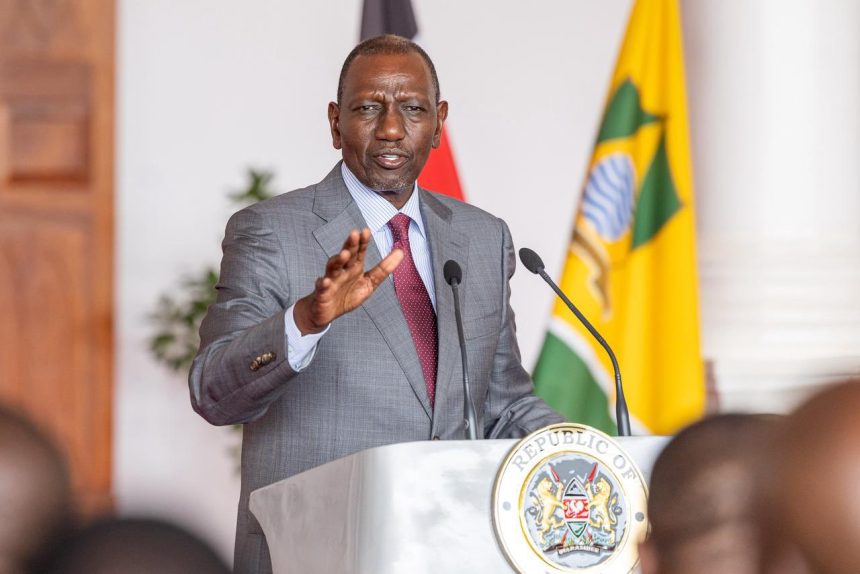
Speaking during the signing ceremony, President William Ruto dismissed claims that the National Government was taking over functions of the county.
“There is no transfer of functions happening. For the avoidance of doubt, I have no interest in running the city of Nairobi, my hands are full,” said Ruto.
His sentiments were echoed by Nairobi Governor Johnson Sakaja who noted that the framework is strictly a collaboration and not a transfer of county functions, distancing it from the Nairobi Metropolitan Services (NMS) model.
“This is not a transfer of functions like it happened during the NMS time, which left the city with Ksh16 billion in pending bills and did not augur well with the spirit of devolution. It is not a transfer but a collaboration which is encouraged and which holds true regard to the mandate given to both of us,” Sakaja said.
Implementation of the deal will be overseen by a joint steering committee chaired by Prime Cabinet Secretary Musalia Mudavadi, with Governor Sakaja as vice chairperson.
Under the agreement, Ksh3.7 billion has been set aside to complete 10,000 stalled street lights and install an additional 40,000 lights across the city. The National Government, through Kenya Power, will also invest Ksh1.5 billion in transformers and last-mile electricity connections in informal settlements.
On security, President Ruto directed Interior Cabinet Secretary Kipchumba Murkomen to establish a dedicated Nairobi Metropolitan Police Unit to enhance security in the capital.
Water and sanitation projects will take a significant share of the funding. A total of Ksh2.1 billion will be spent at the Ng’ethu Water Treatment Plant to curb daily water losses estimated at 50 million litres.
Another Ksh3 billion will be used to stabilise and extend supply along the Gigiri–Shauri Moyo evacuation corridor.
In sanitation, Ksh9 billion has been committed to build two parallel 27-kilometre trunk sewer lines along the Nairobi River corridor, while Ksh6 billion will go towards a new sewer treatment plant with a capacity of 60 million litres per day.
An additional Ksh3 billion will support last-mile sewer connections, with Ksh15 billion earmarked for long-term sewer expansion.
Road infrastructure will also be upgraded, with Ksh8.7 billion allocated for improving roads, bridges and drainage systems while a further Ksh1.7 billion will be used for the construction of 59 kilometres of roads.
A Ksh5 billion programme will target road works in every ward, supported by Ksh3.7 billion from the county government, while Ksh1 billion will be spent on drainage improvements.
Solid waste management will receive Ksh4 billion, including the allocation of 100 acres of land for material recovery facilities, with the National Government contributing Ksh2 billion.