Chinese President Xi Jinping has outlined a four-point framework aimed at safeguarding and promoting peace and stability in the Middle East, stating that China will advocate for diplomatic resolution and multilateral cooperation in response to rising regional tensions.
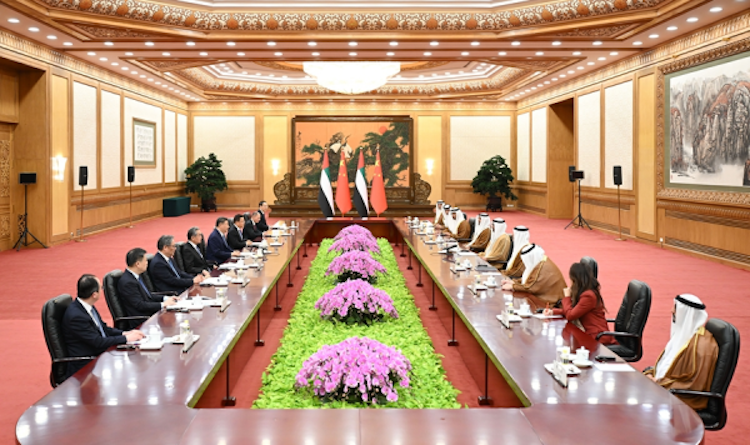
The proposals were presented during a meeting in Beijing with Sheikh Khaled bin Mohamed bin Zayed Al Nahyan, as concerns mount over the fragile security environment in the Gulf and the wider Middle East. The region remains on edge following a volatile ceasefire between Iran and the United States, with analysts warning of broader implications for global security and economic stability.

At the centre of China’s approach are principles that collectively seek to address both immediate conflict risks and longer-term structural challenges in the region.
First, President Xi emphasised the importance of peaceful co-existence among Gulf states, noting that geographic proximity makes sustained cooperation unavoidable.
“It is important to support the Gulf states in improving their ties, work to build a common, comprehensive, cooperative, and sustainable security architecture for the Middle East and the Gulf region, and consolidate the foundation for peaceful co-existence,” he said.
The Chinese leader also underscored the principle of national sovereignty, arguing that respect for territorial integrity and political independence is fundamental to stability, particularly for developing nations.
He stressed that the sovereignty and security of Gulf states must be upheld, alongside the protection of critical infrastructure and institutions. This position aligns with China’s long-standing foreign policy doctrine opposing external meddling.
Xi further highlighted the need to uphold the international rule of law, warning against what he termed the “selective application” of global norms and preventing the world from “returning to the law of the jungle.”
“It is important to firmly uphold the international system with the U.N. at its core, the international order based on international law, and the basic norms governing international relations underpinned by the purposes and principles of the U.N. Charter,” he reaffirmed.
Beyond these, Xi called for a balanced approach to development and security, arguing that the two are mutually reinforcing. He noted that lasting peace cannot be achieved without economic development, while instability undermines growth prospects.
“China stands ready to share with the Gulf countries opportunities through Chinese modernisation and work with them to nurture a fertile ground for regional development and security,” he said.
Xi’s proposals come against the backdrop of heightened uncertainty in the Middle East, where ongoing conflicts and geopolitical rivalries continue to disrupt established security arrangements.
The situation involving Iran, in particular, has raised concerns about the durability of ceasefire arrangements and the potential for escalation, with spillover effects on global energy markets and international shipping routes.
During the meeting, Xi reiterated China’s position as a proponent of dialogue and political settlement, signalling readiness to play a constructive role in mediation efforts.
For his part, Sheikh Khaled bin Mohamed bin Zayed Al Nahyan welcomed China’s role in international affairs, commending its efforts to promote political solutions in the Middle East.
He indicated that the United Arab Emirates is prepared to strengthen coordination with China to support ceasefire initiatives, restore regional stability, and safeguard critical economic interests, including energy security and maritime trade routes.
The four propositions put forward by President Xi Jinping are anchored in Chinese visions such as the Glocal Governance Initiative (GGI) and the Global Security Initiative (GSI) to uphold international fairness and justice, represent the broadest common ground of the international community, and contribute Chinese wisdom and approaches to resolving crises, ending wars, and restoring peace.
Beyond the crisis, China and the UAE expressed their commitment to deepening cooperation across sectors such as energy, trade, technology, and education.