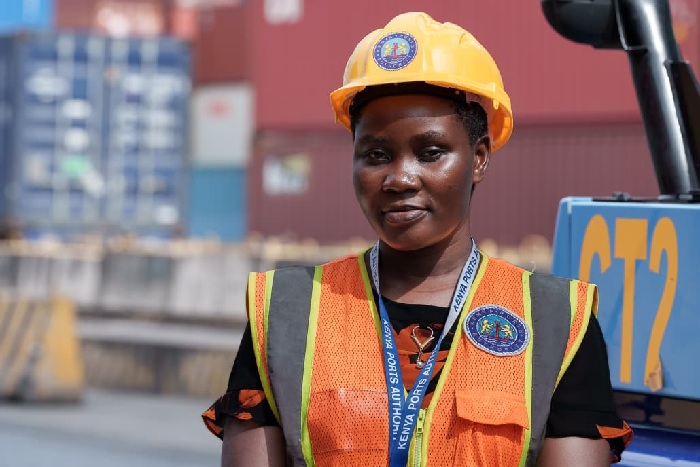
Across Kenya’s busy ports, the logistics chain never sleeps. Ships dock, cargo moves, and trailers are constantly positioned for loading and transport. At the centre of this activity is Daisy Odhiambo, a Terminal Tractor Tug Master at the Kenya Ports Authority (KPA), Mombasa.
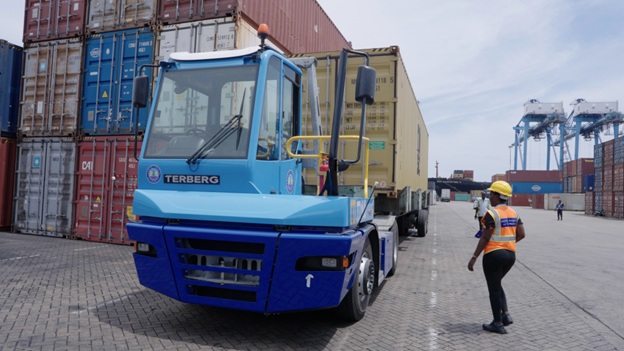
Daisy operates what is commonly known at the port as a tug master, a heavy-duty specialised vehicle designed for manoeuvring trailers in confined spaces such as ports, logistics hubs and distribution centres. The vehicle plays a crucial role in port logistics, transporting containers from ships to storage yards or moving them to the next point in the cargo handling process.

“Hi, I am Daisy Odhiambo, a Mechanical Operator II,” she says with a confident smile. “I work with tug masters. A tug master is like a tractor. We use it at the port to move containers from the ship to the yard or transport containers to the areas where they are needed.”
For the past two years, Daisy has been operating the terminal tractor, navigating the busy container yard and helping ensure cargo flows smoothly through one of East Africa’s most important maritime gateways. But her journey to the driver’s seat of a tug master did not start there. Daisy joined KPA in 2022, beginning her career as a docker, a worker responsible for handling cargo directly on ships.
“A docker works on the ship handling cargo. But I had the urge to operate machines,” she explains.
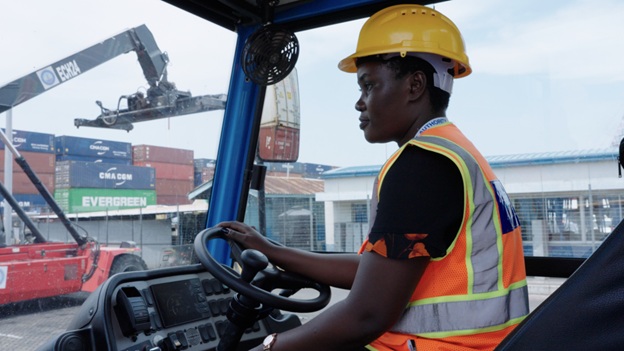
Her career dream was to operate the towering gantry cranes and equipment that dominate the skyline of the port. However, the path to that role required experience and more training.
“I was told that if I wanted to operate machines, I had to start step by step. Train and learn. There are stages you have to follow,” she says. “So I started with the tug master as the first step so that I can move up.”
For Daisy, operating a tug master is more than just a job; it is something she truly enjoys. “To my fellow women who would like to operate a tug master, I want to tell them it is fun,” she says. “Many people say women cannot do this work, but we can. I enjoy operating the tug master.”
Her message to young women starting their careers is simple: do not underestimate how far you can go.
“To be honest, there is a special joy when you leave the ship and find that the STS operator who parked you is a woman. Then, when you go to the yard, you also find that the gantry crane operator is a woman, and here I am as well, operating the tug master as a woman.”
In those moments, she says, something powerful happens. “You realise that you too can reach where another woman has reached. It really makes you feel encouraged.”
The cranes known as Ship-to-Shore (STS) cranes are among the largest and most sophisticated machines at the port, responsible for lifting containers directly from ships.
Daisy’s ambitions do not stop at the tug master, she says. “ Do not look at where you started and think you are still too far behind. I started as a docker and now I am a tug master. I am still aiming to go further to operate the STS cranes.”
Across the port, women like Daisy are reshaping the face of logistics and maritime operations. For Daisy, the journey continues, but one thing is already clear: the road from docker to tug master was only the beginning.