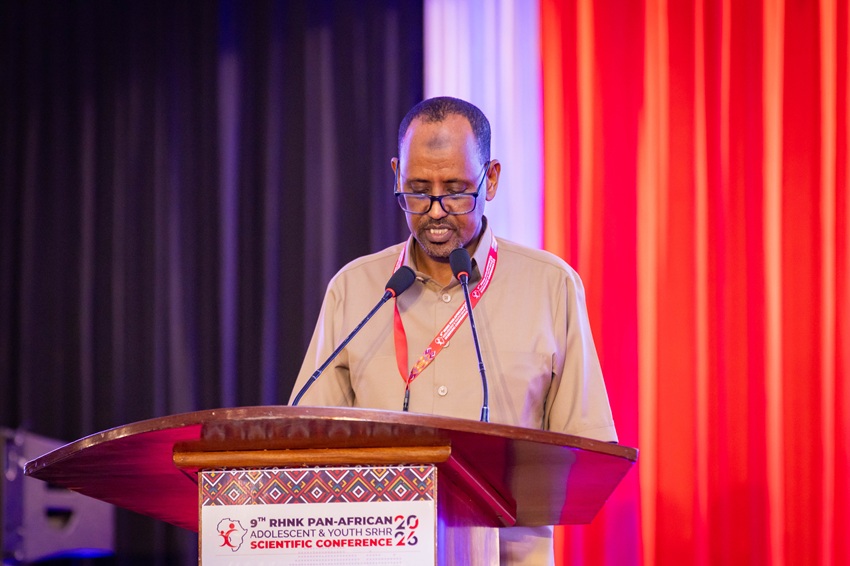
Head of the Family Health Department at the Ministry of Health, has said that the country’s flagship policy of free maternity care for teenage mothers, while necessary, amounts to “damage control.”
Speaking at the just concluded 9th Pan-African Adolescent and Youth Sexual and Reproductive Health and Rights (AYSRHR) Scientific Conference in Mombasa, Dr Bashir Issak told delegates: “Any young woman who walks into a public health facility in Kenya to give birth does so free of charge. No bill, no deposit, no turning away. But this is damage control. Could we have prevented that at a lower cost?”

The question, posed to more than 1,500 delegates from over 40 countries, set the tone for a four-day conference convened by the Reproductive Health Network Kenya (RHNK) in partnership with the Ministry of Health, the National Council for Population and Development, and for the first time, the Government of Uganda as an official partner.
Dr Issak laid out the scale of the challenge in unusually direct terms. Nationally, 15 percent of girls aged 15 to 19 are either pregnant or already mothers. In Samburu County, the figure reaches 50 percent. In 2025, 41 percent of new HIV infections in Kenya were among adolescents and young people aged 15 to 24, while mother-to-child HIV transmission rose from 7.3 to 9.3 percent.
“These are not gaps in statistics. They are gaps in survival,” he said.
Dr Issak also catalogued what the government has done saying that more than 30 million Kenyans are now covered under the Social Health Authority (SHA), accessing primary healthcare free of charge. He noted Kenya has formalised 107,000 community health promoters, many of them women who serve as the first trusted healthcare contact for young people in remote communities. The country has launched a Digital Health Superhighway and the EWENE initiative (Every Woman, Every Newborn, Everywhere), tracking deliveries and maternal outcomes in real time.
“These are not small things,” he said. “But I will not stand here and pretend they are enough. They are not.”
At the heart of Dr Issak’s address was a challenge to the assumption that barriers to adolescent healthcare are inevitable. “Distance. Cost. Stigma. The judgemental healthcare worker. The facility with no youth-friendly service space. And the community norm that tells a young woman that seeking contraception is shameful,” he said. “These barriers are not natural. They were built. And what was built can be dismantled. But not by the Ministry of Health alone.”
He called for action from community and religious leaders, the private sector, and young people themselves, warning that excluding youth from the policy process produces imposition, not progress. “Policy change without youth participation is not policy change. It is policy imposition. And we have had enough of that.”
The conference’s organising framework – the “triple threat” of sexual and gender-based violence, HIV infection, and adolescent pregnancy – was reinforced across every address. Dr Issak argued the three are inseparable: “A girl who experiences gender-based violence is more vulnerable to HIV. A girl who becomes pregnant as an adolescent is more likely to drop out of school and less likely to access reproductive health services for her next pregnancy. A girl who has never received accurate, age-appropriate information about her own body is poorly equipped to protect herself from any of the three.”
Dr Samukeliso Dube, the FP2030 Executive Director, underlined the point with continental data, noting that teenage pregnancy rates range from 39 per thousand in Rwanda to 180 per thousand in Mozambique.
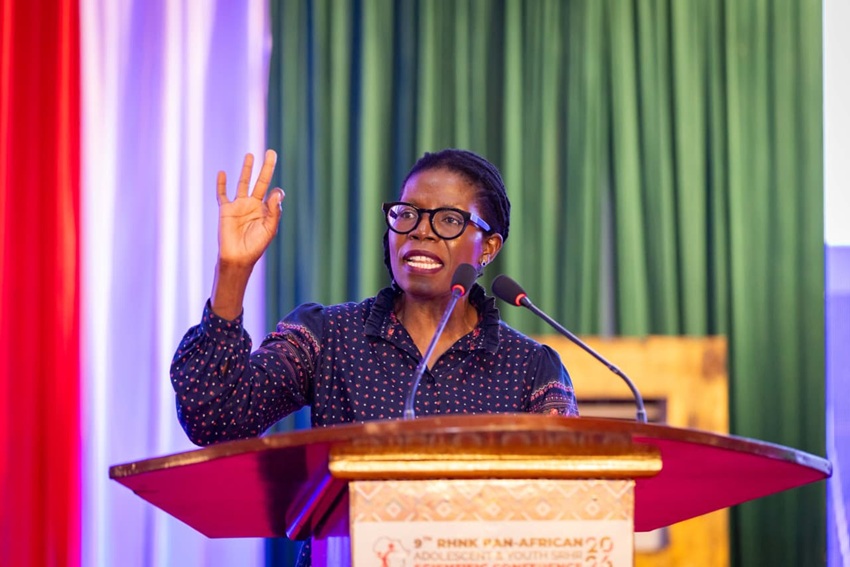
“We are running a continent on luck and hope,” she said. “We have, for many years, hidden behind ‘it’s just maternal health, maternal mortality,’ when we don’t fund reproductive health services for adolescents. Yet we know the very numbers that we see in maternal mortality are driven by these unintended pregnancies.”
RHNK Executive Director Nelly Munyasia announced the launch of a referral document on adolescent consent, developed with the Kenya Judiciary Academy, healthcare providers, and young people from across Africa. The framework is designed to give health workers and courts a shared reference point on when and how adolescents can access reproductive health services — a question that remains among the most contested legal and clinical barriers on the continent.
Munyasia said the judiciary’s engagement had been transformative: “The judiciary told us, if only they knew better, they would not have made the kind of decisions they’ve made in courts.” Justices from Kenya, Zambia, Malawi, and other countries are attending the conference to engage directly with the evidence.
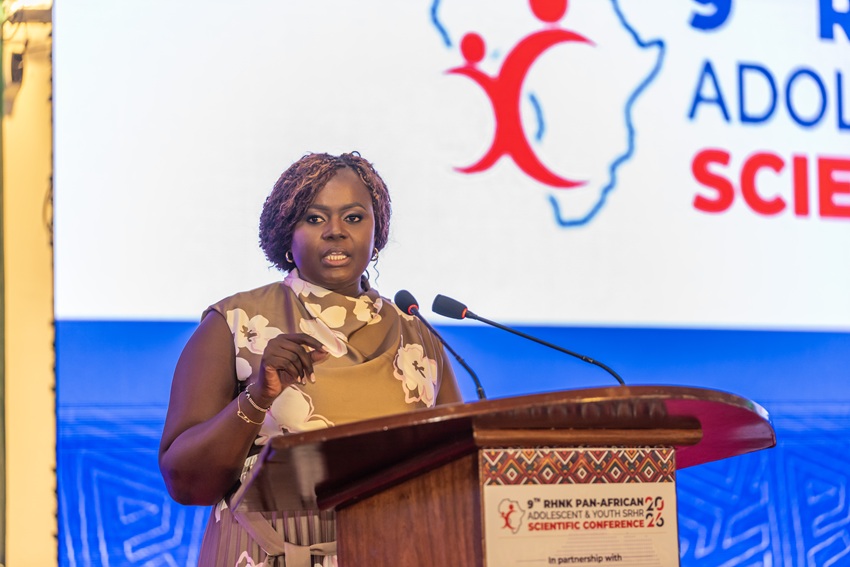
Munyasia grounded the urgency through the story of “Amina”, a composite figure representing hundreds of thousands of girls across Africa each year. “She was afraid of the clinic, because she’d be asked, ‘Where is the guardian?’ She was also scared to go to school, because the teachers were going to send her away,” she said. “Amina is not one girl. She’s hundreds of thousands of girls, across our continent, every single year.”
Across every address, speakers insisted that young people must be treated as architects of policy, not its objects. Dr Shilumani told young delegates directly: “You are not a problem to be managed. You are not a demographic to be monitored. You are an asset, a force, a movement in motion.” She pledged that IPPF Africa would fund youth-led movements and embed young people’s participation in governance “beyond tokenism toward genuine, sustained power sharing.”
Dr Issak echoed the commitment from a government perspective: “This government wants you in the room when decisions are made. Not consulted after the fact. Not represented by adults who speak on your behalf without asking what you think.”
That demand was embodied by Esther, a young tech student speaking from the conference’s live studio, who described growing up in a household where reproductive health information was virtually absent. “Instead of just being told, ‘don’t have sex,’ I wish to learn the different ways how you can have safe sex instead,” she said.