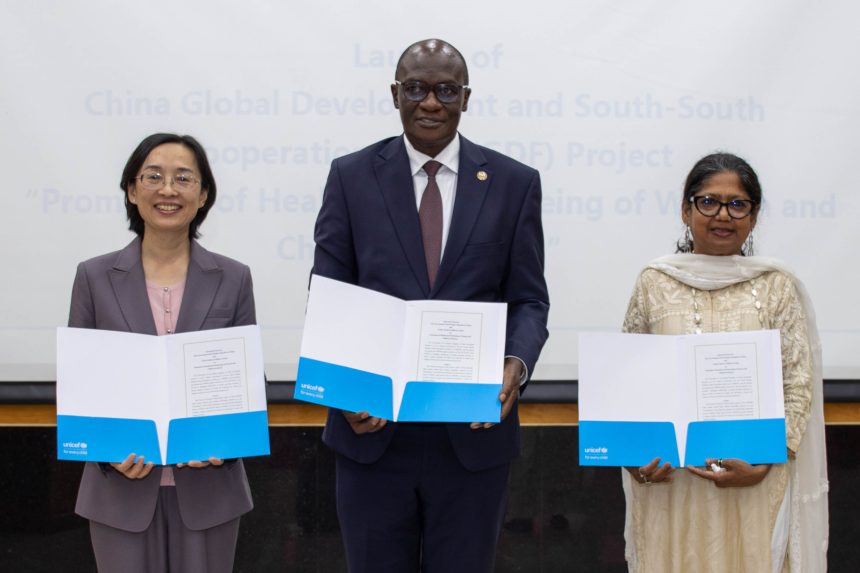
Nairobi, Kenya – Kenya, China, and UNICEF have launched a new USD 3 million partnership aimed at reducing maternal and newborn deaths in Garissa, Wajir and Mandera counties, where access to quality healthcare services remains limited and mortality rates remain among the highest in the country.
The initiative, dubbed Promotion of Health and Well-Being of Women and Children in Kenya,” is funded by the China Global Development and South-South Cooperation Fund, administered by the China International Development Cooperation Agency (CIDCA).

The two-year program aims to bolster maternal and newborn healthcare systems by equipping hospitals and health centers, training frontline healthcare workers, improving water and sanitation infrastructure, and expanding community-based healthcare outreach.
Speaking during the launch, Chinese Ambassador to Kenya, Guo Haiyan, highlighted that the program underscores China’s growing commitment to South-South cooperation and practical partnerships that directly improve lives.
“Maternal and child health cooperation has always been a key priority of Global South cooperation as it serves to protect basic human rights and safeguard human dignity,” Ambassador Guo stated.
She added that the project embodies China’s Global Development Initiative (GDI), proposed by President Xi Jinping, and demonstrates how development partnerships can deliver tangible benefits to vulnerable communities.
“These solid steps prove that the Global Development Initiative is no castle in the air. It is able to deliver real benefits and is an important driver to strengthen South-South cooperation,” she said.
Ambassador Guo noted that the initiative would support county and sub-county health facilities with essential medical equipment and supplies while strengthening primary healthcare networks in the three counties.
“By equipping county and sub-county health facilities and designated health centers with necessary equipment and supplies, we will strengthen primary care networks in these areas, contributing to the reduction of maternal and newborn morbidity and mortality,” she affirmed.
Kenya’s Health Cabinet Secretary, Aden Duale, whose speech was delivered by Director General for Health Dr. Patrick Amoth, emphasized the timely nature of the partnership as the government accelerates efforts to reduce preventable maternal and newborn deaths.
“Every maternal death and every newborn death is a tragedy, particularly because the majority are preventable,” Duale’s statement read.
He acknowledged that despite progress, Kenya still records 355 maternal deaths per 100,000 live births and 21 newborn deaths per 1,000 live births. The burden disproportionately affects underserved counties in the Arid and Semi-Arid Lands (ASAL) region.
“These inequities are unacceptable and must be addressed deliberately and urgently,” he asserted.
Duale linked the programme to the recently launched “Every Woman, Every Newborn Everywhere (EWENE) Acceleration Plan” and the “Maternal and Newborn Health Rapid Results Initiative,” both unveiled by President William Ruto in May.
Through these initiatives, the government has committed Ksh 7.5 billion towards maternal and newborn survival interventions, including expanding the health workforce, improving family planning services, and ensuring essential medical commodities.
“We must ensure that a mother in Mandera has the same opportunity to survive childbirth as a mother in Nairobi,” Duale stressed.
“We must ensure that a newborn born in Wajir has the same chance of celebrating a first birthday as a newborn born anywhere else in the country. Equity must remain at the center of our health agenda.”
The programme will support healthcare workers, including nurses, midwives, nutritionists, and clinical officers, while also strengthening community health systems through trained Community Health Promoters.
UNICEF Representative to Kenya, Dr. Shaheen Nilofer, explained that the partnership is designed to close healthcare access gaps in counties that continue to lag behind national averages.
“Most importantly, this is exactly what Kenya’s focus on Every Woman, Every Newborn, Everywhere means in practice: not only improving averages, but closing gaps,” she said.
“Not only investing in services, but ensuring those services reach women and newborns in the counties that have been left furthest behind.”
According to UNICEF, the program is expected to directly benefit over 652,000 people and indirectly support another 630,000 through stronger health systems and community outreach services.
Nilofer also commended China’s ongoing support for child and maternal health programs across Africa through South-South cooperation frameworks.
“Behind every statistic is a mother, a newborn and a family whose future hangs in the balance. This partnership is about changing those stories. We thank the Government of China for its support to address the issue of maternal and newborn mortality in Kenya. Together, we are supporting the government’s efforts to reach those who are most at risk and to give every child a safe and healthy start to life,” she said.
Officials said the programme aligns with Kenya Vision 2030, the Sustainable Development Goals, and the country’s Universal Health Coverage agenda. And as implementation begins in Garissa, Mandera, and Wajir, the three partners expressed optimism that the initiative would significantly improve maternal and newborn survival rates while strengthening long-term healthcare resilience in northeastern Kenya.