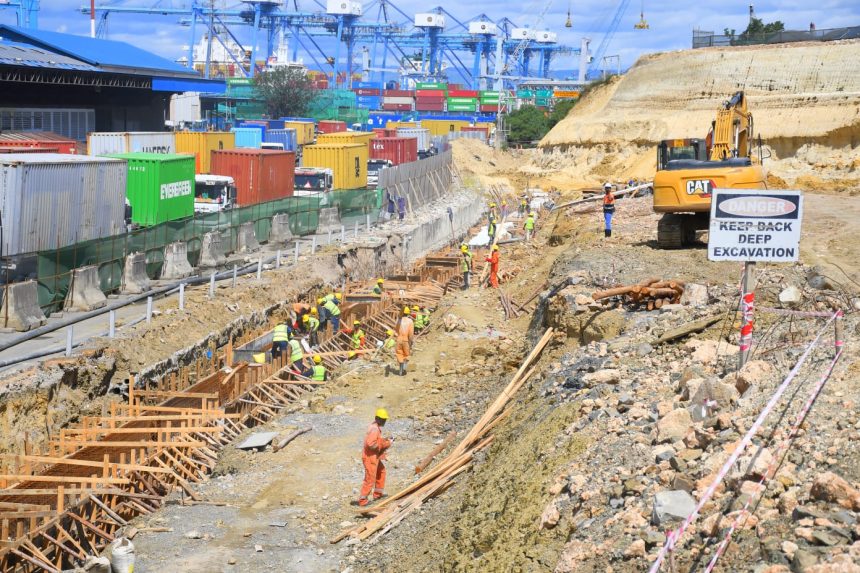
A mega infrastructure project valued at Ksh8.3 billion is steadily taking shape at the Port of Mombasa, the ambitious development is expected to significantly enhance cargo mobility, safety and operational efficiency at the country’s busiest seaport.
The project forms a critical component of the Kenya Ports Authority’s (KPA) long-term infrastructure modernisation programme aimed at supporting the ever-increasing cargo volumes while improving connectivity between the port, Gates 18 and 20, Kipevu Road and the wider Northern Corridor.

Dispelling misinformation surrounding the project and its value for money, KPA CEO Capt. William Ruto said the development stems from recommendations of the 2018 TradeMark Africa Traffic Management Study.
He said the study identified the Back of Port Road corridor as a major bottleneck requiring a grade-separated transport solution to improve cargo evacuation and eliminate traffic conflicts.
Capt. Ruto explained that the project is not a conventional road construction programme but a major port transport interchange involving highly specialised civil, structural, geotechnical, electrical, drainage and security engineering works.
The CEO disclosed that the project was procured through an international competitive tender in which contractors submitted bids ranging between Sh8.3 billion and Sh9.6 billion. The contract was awarded to the M/s Stecol Corporation and Miliki Development Company Joint Venture at Ksh8.3 billion after emerging as the lowest evaluated responsive bidder.
“It is within the market price and I can even say it is cheaper. In terms of our consultant, it is even cheaper. We are getting value for money as KPA. The problem is only we called it a road, instead of calling it a major infrastructure that we are building in the port,” stated Capt. Ruto.
The project, which is now 50 pc complete, is expected to be completed in March 2027. It comprises a 1.8-kilometre dual carriageway, including 704 metres of elevated viaduct supported on bored pile foundations and reinforced concrete box girders, rising up to 15 metres above ground level to safely accommodate heavy port traffic.
“A viaduct is different from a bridge in the sense that for a viaduct, you are putting up a bridge-like structure that spans over a vast tract of land that may have developments below,” explained Eng. Stephen Wasike, the Project Consultant Engineer.
“There’s a limit to how high or how close you should come to the pipeline because it’s a live line carrying petroleum products, and that forced the project to go higher. We also had to pass over an existing KPA facility known as the One-Stop Centre, which houses numerous critical operations and could not be demolished. We therefore had to construct the viaduct above it,” added Eng. Wasike.
The development also includes two major roundabouts, slip roads, ramps and associated traffic management infrastructure, creating an integrated grade-separated transport interchange.
The project has also involved the excavation of Kipevu Hill, requiring approximately 450,000 cubic metres of rock cutting and 150,000 cubic metres of engineered fill.
To stabilise the excavated slope and safeguard adjacent strategic infrastructure, the project includes the construction of a 265-metre Geosynthetic Mechanically Stabilised Earth (GMSE) retaining wall designed to prevent slope failure near the Kenya Pipeline Company petroleum storage tank farms.
The project has further entailed the relocation and protection of critical operational infrastructure, including the port’s primary high-voltage power supply network that serves the entire facility. The network is being rerouted through a purpose-built utility tunnel excavated within Kipevu Hill from the Gate 18 substation.
Water mains, fibre-optic communication networks, medium- and low-voltage electrical services, as well as the Integrated Security System (ISS), are also being relocated.
In addition, a major underground stormwater drainage tunnel is under construction from the gantry workshop to the Kipevu outfall to safely channel runoff and protect both the roadway and surrounding port infrastructure.