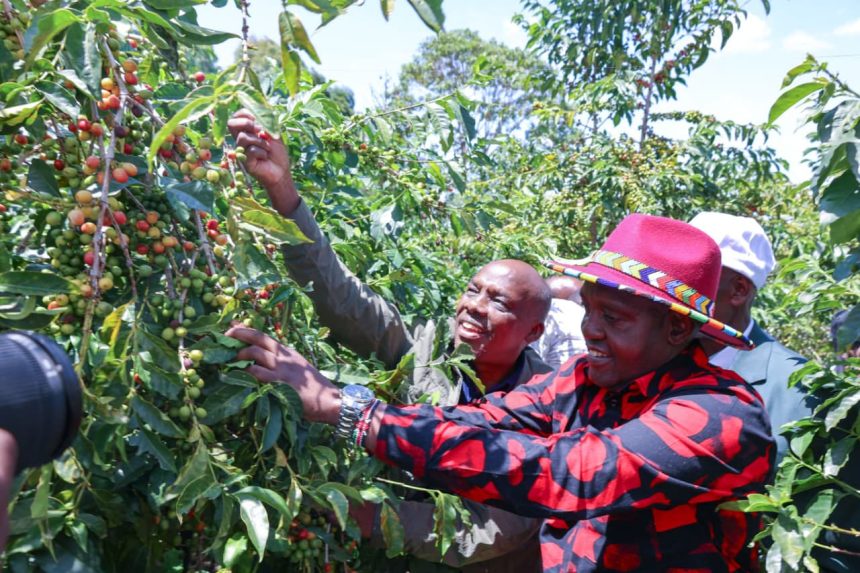
Kenya’s coffee map is shifting, one auction at a time thanks to this transformation in line with the State Department of Agriculture leadership under Principal Secretary Dr. Kipronoh Ronoh.
On the buzzing floor of the Nairobi Coffee Exchange (NCE), the 2025/2026 season has already outpaced the whole of 2024/2025 in both volume and earnings, even though the season is still underway. More coffee is moving, more money is flowing, and a new cast of county “kings” is emerging to challenge the old guard.

At the heart of this transformation is a simple but powerful story: volume is doing the heavy lifting. The NCE has sold 36.36 million kilograms of clean coffee worth about USD 247.6 million, comfortably ahead of last season’s 31.33 million kilograms valued at USD 216.4 million. Yet the average price per kilogram has slipped from USD 6.91 to USD 6.81, a softening of roughly 1.4 percent. Kenya, in other words, is winning through scale, not price spikes a sign of a market where buyers remain keen, but where the competition is getting sharper and more geographically diverse.
Nothing captures that diversity better than the rise of Kericho. Long known more for tea than coffee in the public imagination, Kericho has executed a stunning pivot to become the country’s top coffee performer at the Exchange. In just one season, its volumes have almost doubled from 3.03 million to 6.00 million kilograms, propelling it to number one in both volume and value. Behind those numbers lie coordinated cooperatives, better extension services, and a growing confidence among farmers that coffee is worth their bet again.
Kirinyaga, for years the undisputed reference point for premium Kenyan beans, finds itself in an unusual position: displaced from the top but still commanding respect. Its volumes have fallen by about 32 percent to 4.61 million kilograms, yet it retains the strongest average price among major producers at roughly USD 7.25 per kilogram, well above the national mean. Buyers are still willing to pay a premium for Kirinyaga’s reputation for quality and consistency, proving that brand equity in coffee is as real as in any consumer market. Nyeri, another Central giant, has seen volumes drop by 15 percent, while Murang’a and Kiambu have moved against the tide with robust gains of 28 and 29 percent respectively, cushioning Central Kenya’s overall performance.
The most dramatic energy, however, is radiating from the west. Counties that for years played supporting roles are now stepping into the spotlight. Nandi’s deliveries have surged by 92 percent, Bungoma’s by 97 percent, Kisii’s more than fourfold, and Nyamira’s nearly sixfold. Together with Trans Nzoia and Kericho, these western and Rift Valley counties now contribute 12.44 million kilograms 34 percent of national NCE volume, up from just 19 percent a season earlier. In the same period, the once‑dominant Central bloc of Murang’a, Nyeri, Kirinyaga and Kiambu has seen its combined share shrink from 62 percent to 51 percent. The centre of gravity of Kenyan coffee is quite literally tilting westward.
There are also quiet but telling subplots. Narok has recorded its first sales at the Exchange, hinting at new frontiers for expansion and diversification. Machakos, by contrast, has experienced a steep 58 percent fall in volume, and five registered counties Busia, Vihiga, Kajiado, Taita Taveta and Siaya have posted no auction sales in either of the two seasons. These “silent” counties invite tough questions: is there real potential that remains untapped, or are resources better focused on areas already demonstrating clear upward momentum?
For policymakers and sector leaders, this evolving chessboard demands agile responses. Counties that are surging especially Kericho, Nandi, Bungoma, Kisii and Nyamira need targeted support to reinforce good governance in cooperatives, strengthen extension services, and help farmers climb the value ladder rather than drown in raw‑volume competition. Meanwhile, the declines in Kirinyaga, Nyeri and Machakos must be unpacked carefully: are we seeing lower production, delayed deliveries, or a strategic move toward direct sales that are invisible to NCE statistics? Misreading these signals risks crafting policy for shadows rather than substance.
Equally important is a hard‑headed review of dormant or nil‑sales counties before pouring more money into promotional campaigns. A realistic assessment of agronomic conditions, infrastructure, and farmer interest can ensure that public and private investments are channelled where they will generate lasting impact. And as national volumes climb while prices soften, the surest insurance policy for farmer incomes remains unwavering focus on quality: modern pulping and processing technologies, rigorous factory‑level quality control, and reward mechanisms that signal to farmers that excellence, not just volume, pays.
The NCE figures for 2025/2026 read like the opening chapter of a new era: a Kenyan coffee sector that is broader, bolder, and more regionally inclusive, yet still balanced on the knife‑edge between volume growth and price pressure. Whether this becomes a story of shared prosperity or squeezed margins will depend on how quickly policy, investment, and farmer support can catch up with the reality already playing out under the auction hammer.