China’s economy expanded by 4.7 per cent year-on-year in the first half of 2026, a performance Beijing says demonstrates the country’s resilience amidst a more challenging global economic environment and keeps it on course to meet its annual growth target.
Figures released on Wednesday by the National Bureau of Statistics (NBS) reveal that gross domestic product (GDP) reached 69.57 trillion yuan (approximately US$10.28 trillion) between January and June. Growth in the second quarter moderated to 4.3 per cent from 5.0 per cent in the first three months of the year, yet remained within the government’s full-year target range of 4.5 to 5 per cent.

Speaking at a press briefing, NBS Deputy Commissioner Mao Shengyong stated that the economy remained generally stable during the first half of the year. He noted that major economic indicators stayed within a reasonable range despite external headwinds.
Mao attributed this performance to the continued expansion of what China’s “new quality productive forces,” which include high-end manufacturing, the digital economy, and modern services. Preliminary estimates indicate these sectors contributed over 40 per cent of economic growth during the period.
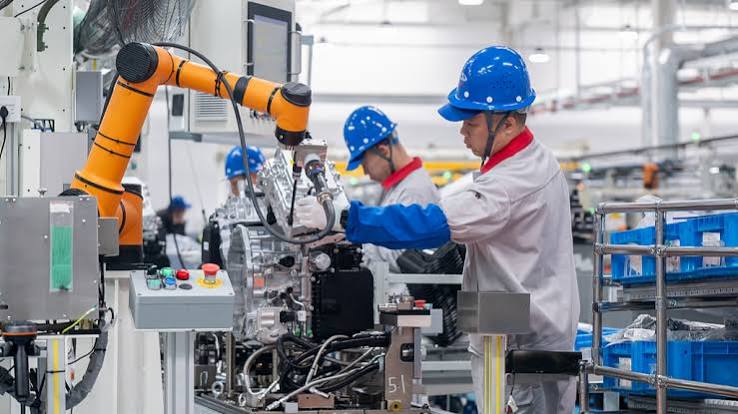
Industrial production continued to underpin growth, with value-added industrial output among enterprises above a designated size increasing by 5.4 per cent year-on-year.
Advanced manufacturing was a standout performer, with equipment manufacturing expanding by 9.3 per cent and high-tech manufacturing growing by 13.3 per cent. Both figures significantly outpaced overall industrial production. The services sector also recorded steady growth of 5.2 per cent.
According to NBS, China’s foreign trade also strengthened, with imports and exports rising by 16.9 per cent year-on-year to a record 25.47 trillion yuan during the first half. Trade in computing hardware, electronic components, and computer parts climbed by 56.6 per cent, reflecting sustained demand for Chinese technology products.
Domestic consumption also improved, albeit at a more moderate pace. Retail sales of consumer goods increased by 2.7 per cent to 24.87 trillion yuan. However, fixed-asset investment, excluding rural households, declined by 5.7 per cent to 22.64 trillion yuan.
Mao acknowledged that growing external uncertainties and imbalances between domestic supply and demand mean the foundation for sustained economic recovery still requires strengthening.
Chinese economists commented that the latest figures reflect an economy undergoing structural transformation.
Hu Qimu, a professor at the Maritime Silk Road Institute of Huaqiao University, said the data point to continued progress in industrial upgrading, technological innovation, and improvements in China’s trade structure.
He added that emerging industries such as artificial intelligence, green technology, and high-end manufacturing are becoming increasingly important engines of growth, supported by expanding economic cooperation with Belt and Road partner countries.
Bruce Pang, an adjunct associate professor at CUHK Business School, identified high-tech manufacturing, stronger consumption, and rising rural incomes as some of the economy’s strongest performers during the first half of the year. However, he noted that investment remained soft, capacity utilisation had weakened, and consumer spending still requires further support.
Pang stated that sustaining the recovery through the second half of the year will depend on policies that encourage investment, stimulate domestic demand, and accelerate industrial upgrading.
Beijing-based economist Tian Yun expects momentum to strengthen further as China’s economic transformation continues.
He believes high-tech manufacturing, exports, and artificial intelligence-related industries are likely to remain key drivers of growth, while additional policy support could help boost consumer demand and improve business confidence.
Chinese officials also highlighted the country’s performance against a backdrop of slowing global growth.
According to Mao, several major economies are expected to record weaker growth this year. The International Monetary Fund recently revised China’s 2026 growth forecast upward to 4.6 per cent while lowering its global growth projection to 3.0 per cent. This reinforces expectations that China will remain one of the principal contributors to global economic expansion.
Analysts said the first-half performance has strengthened expectations that China will achieve its annual growth target, although policymakers are expected to continue focusing on boosting domestic demand, stabilising investment and deepening industrial transformation during the remainder of the year.