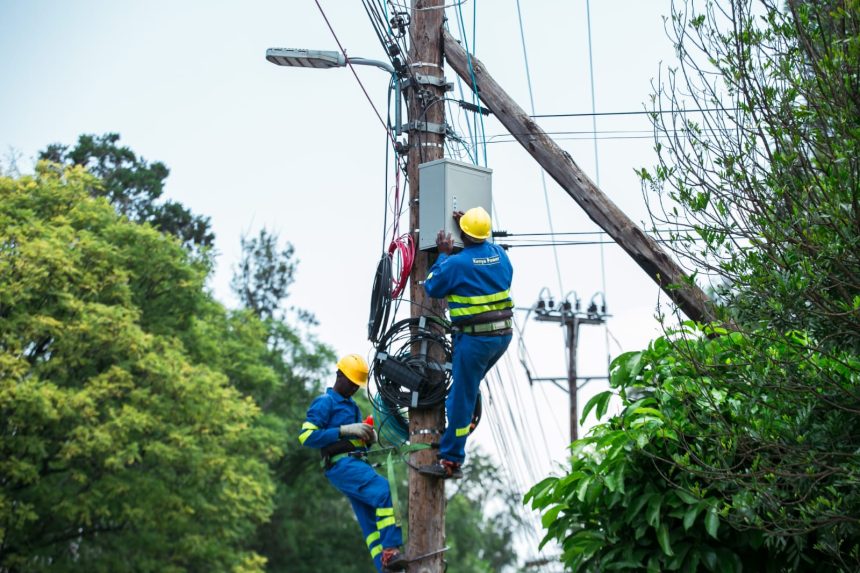
The government is targeting to connect at least 25,000 households in Siaya County to the national grid with Ksh 2.2 billion invest from the exchequer.
The power connection will be undertaken under the Last Mile Connectivity Project which targets rural electrification initiatives.

For residents of Siaya County, the electrification programme now could not have come at a better time. In Imbaya village, local resident Jairus Oyamo recalls how total darkness once made basic activities hazardous.
“Schoolchildren walking in the morning were being mugged, and cattle were being stolen as early as 8:00 PM,” Oyamo said adding “you could not pursue thieves because the village was completely dark.
But with these new streetlights, night feels just like day, he says adding “even at 2:00am , if someone is sick, you can safely take them to the hospital.”
The project has also significantly reduced the financial barrier to connection for rural families.
Richard Owino Golwa, a resident of Luanda Komolo village in North Alego location, Alego Usonga, noted that main power line connections were previously far beyond the reach of average households.
“My neighbour was asked for sh. 10,000 just for the drop line, and another neighbor further up was given a quotation of sh. 70,000 for a single pole,” Golwa explained.
“Now, we received the main electricity connection for free. we only paid to wire our own homes. We no longer struggle or travel just to charge our phones or lanterns,” says a happy Golwa
Beyond safety and household convenience, grid access is sparking local economic ambitions. Ruth Anyango Otieno, also a resident of Luanda Komollo, expressed her relief and outlined plans to launch a local enterprise.
“I am truly thankful to the government,” Otieno said. “My plan now is to buy a posho mill to set up here so I can serve the community and help people access milling services nearby.
“For younger community members, the transition away from kerosene lamps (nyangile) marks a dramatic shift in daily quality of life.
Evelyne Achieng’ shared her gratitude for the development, emphasizing the heightened sense of safety across neighboring compounds. “We used to rely on small kerosene lamps and couldn’t walk around alone at night,” Achieng said.
“Now we have real security. Even if you step out at night to visit another home, everything is clear and safe. We never imagined we would get electricity right in our homes, and I hope the government extends this to other areas too.”
Addressing the technical scope of the rollout, Nicholas Gwadi, who assists in coordinating Last Mile initiatives in Siaya County, highlighted the rapid growth in coverage.
Historically, rural electrification coverage in Siaya stood at less than 20 percent, says Gwadi adding “right now, we have passed 50% a jump of nearly 30 to 40% in less than two years.
Gwadi says that the narrative has shifted from ‘We have never seen it’ to ‘We haven’t been reached yet.’
He says that work is ongoing across multiple fronts, including solar-powered streetlighting programs designed to cut energy bills for the county and curb transformer and wire vandalism.
Cabinet Secretary for Energy and Petroleum Opiyo Wandayi reaffirmed the government’s commitment to ensuring no region is left behind.
“The National Assembly allocated a specific budget of Ksh 2.2 billion to Siaya County for rural electricity expansion,” CS Wandayi stated adding the money is sufficient to connect some 25,000 households in Siaya county this year alone”.
“In the coming financial year,” Wandayi says, “I am confident parliament will allocate additional funds to build on this momentum.”
With installation work moving forward across sub-counties like Ugenya, Rarieda, Bondo, Ugunja, Alego Usonga, and Gem, local leaders and residents alike view the energy rollout as a vital foundation for Siaya’s long-term economic development and public safety.