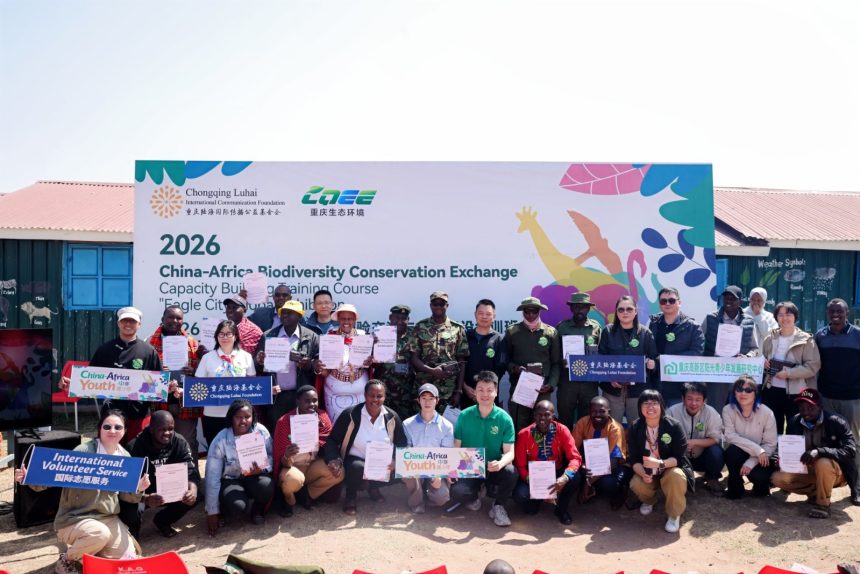
Conservationists drawn from Kenya and China are exploring new ways to deploy new technology in a bid to protect biodiversity.
During the just concluded China-Africa Biodiversity Conservation Exchange and Training Course & “Eagle City” Global Exhibition, experts said real-time tracking of animals has enabled protection of animals, migratory routes and reduced human wildlife conflict.

According to Kenya Wildlife Service (KWS) researchers, Lions in Maasai Mara are fitted with GPS collars to track their movements in real time.
This enables early warnings to be delivered to local communities when lion prides approach human settlements.
KWS said the measure educes livestock losses and prevents retaliatory killings of lions, achieving harmonious coexistence between humans and wildlife.
Stephen Kenta, Rhino and Cheetah Expert of Mara National Reserve, shared technology-backed rhino conservation practices.
Kenya said a smart conservation command centre has been established. Rhinos wear geo-tagged ear tags that trigger automatic system alerts when the animals approach reserve boundaries. Infrared cameras also help document more wild rhino individuals.
Deputy Director-General of Chongqing Municipal Ecology and Environment Bureau Liu Ming presented Chongqing’s progress in urban biodiversity governance, migratory raptor conservation and public engagement.
He noted that Chongqing has enforced the 10-year fishing ban along the Yangtze River and carried out systematic species surveys and monitoring and habitat restoration.
The region now hosts nearly 6,000 wild vascular plant species, over 800 terrestrial wild vertebrate species, more than 180 river fish species, and hundreds of nationally-protected rare plants and animals. Both China and Africa are rich in biodiversity resources. He called for robust exchanges among participants to explore locally-adapted conservation pathways suited to respective national realities.
Zakayo Lairumbe Kipuyo, Founder of the Joy and Hope for Rural Community Foundation, shared conservation practices from Arusha.
Under community stewardship, the organisation advances forest restoration, maintenance of wildlife migration corridors and water source protection, while developing eco-friendly alternative livelihoods to scale up ecological restoration impacts.
Chairman of the Adept Conservation Network Eston Murithim said his organisation protects forest, river and wetland ecosystems by leveraging local community strengths. Through skills training, community patrols, seedling cultivation, ecological restoration and science outreach, the project mitigates human-wildlife conflict and fosters harmonious coexistence between people and wildlife.
Parallel to the main event, themed China-Africa youth biodiversity conservation courses were launched. Integrating ecological practices from China and Africa, the courses adopt interactive formats such as videos and board games to help young people understand conservation through trade-off thinking and collaborative problem-solving. Full course materials and teaching toolkits have been shared with African non-profits, schools and local communities.
Selected as a flagship programme of the 2026 China-Africa Year of People-to-People and Cultural Exchanges, the event serves as a bridge for deeper China-Africa people-to-people ties and green cooperation.
The event had representatives from ecological authorities, protected-area management bodies, non-profit organisations and universities from Chongqing of China, Kenya and Tanzania.