Africa must act with speed to strengthen local manufacturing of health commodities as a pillar of the continent’s health security and sovereignty, President William Ruto has said.
The President said Africa can no longer rely on imported health commodities.
This, he explained, exposes the continent to sub-standard and falsified products, high costs, supply chain disruptions, and unsustainable pressure on national health budgets.
“Local manufacturing of health products is no longer a goal we can postpone; it is an urgent priority. It sits at the heart of Africa’s health security and sovereignty agenda,” he said.
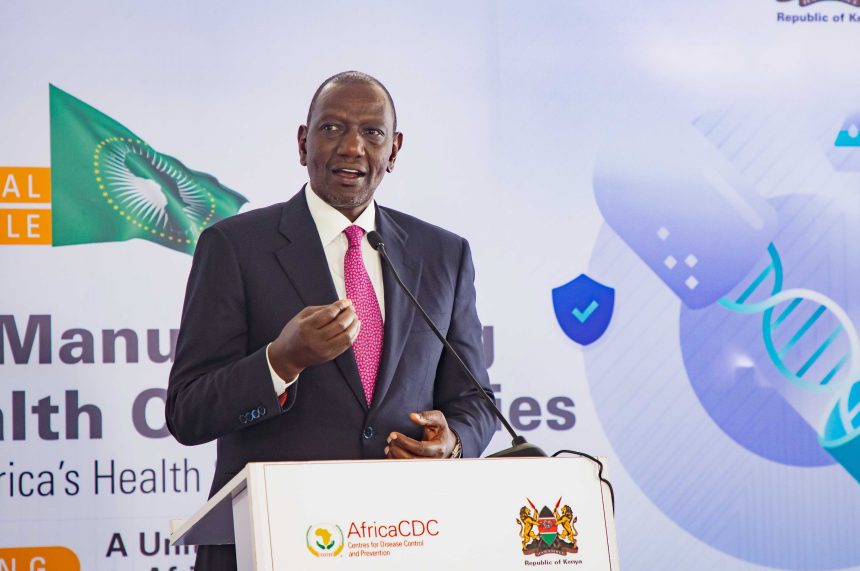
The President spoke when he co-hosted, with the Africa Centres for Disease Control and Prevention (Africa CDC), the Presidential Roundtable on Local Manufacturing of Health Commodities on the sidelines of the 39th Ordinary Summit of the African Union, Addis Ababa, Ethiopia.
The President noted that if Africa manufactured half of the health products it currently imports, it could save between $30 billion and $50 billion annually.
He said this will improve availability, secure better prices, strengthen local manufacturing, and create jobs for Africa’s professionals.
The President noted that the launch of the African Pooled Procurement Mechanism through Africa CDC will address market fragmentation and aggregate demand across countries.
He observed that local manufacturers cannot scale or remain viable without predictable and aggregated markets.
At the same time, the President said that Africa must move away from exporting raw materials and importing finished products.
He said that through regional value chains and harmonised standards, Africa can manufacture competitively for continental market.
“We must also invest consistently in research and development because innovation is essential to long-term independence,” he said.
He called on African states to work toward providing the right enabling environment, sound policy, reliable infrastructure, effective regulation, and affordable finance.
He noted reliable energy, modern logistics, and access to capital are the key drivers of manufacturing.
He called on continental financial institutions, including the African Development Bank and Afreximbank, to continue converting commitments into practical, bankable projects for manufacturers.
“The African Continental Free Trade Area must be powered by African production. Without strong local manufacturing, it risks becoming a channel for imports rather than a driver of African industry,” he said.
As the African Union Champion for Local Manufacturing, President Ruto proposed that the AU convene an extraordinary summit on local manufacturing later this year.
The summit, he said, will review progress and build the partnerships needed to achieve the target of producing at least 60 per cent of Africa’s health products on the continent by 2040.
Africa CDC Director General Jen Kaseya echoed President Ruto’s remarks, asking African states to sign the African Pooled Procurement Mechanism.
He said Africa must work together to solidify the African market and strengthen regulatory agencies in Africa.
He said this will control the prices for African-manufactured health commodities.