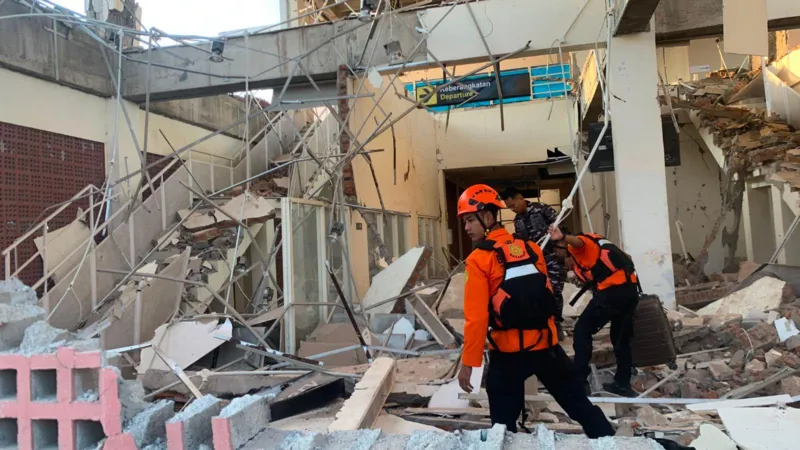
At least fourteen people have died after a 7.7-magnitude earthquake struck Indonesia early on Saturday, the nation’s disaster mitigation agency has said.
BPBD said that others had been injured to varying degrees, cautioning that the figures were preliminary while search and rescue operations were ongoing.

Teams are working to free anyone trapped in buildings damaged by the quake and the dozens of aftershocks that followed. A tsunami warning was issued but lifted around three hours after the initial jolt.
The quake struck the island of Flores shortly before 05:00 local time on Saturday (23:00 GMT on Friday). It had a depth of 15km, Indonesia’s meteorology and geophysics agency stated.
The shallower an earthquake is, the more destructive its effects on the surface tend to be.
Strong aftershocks were felt in the same area, including one with a magnitude of 6.1.
Video taken at the port in Maumere showed large chunks of concrete breaking off the terminal building onto passengers waiting to board an inter-island ferry. Some were thrown into the sea when the gangway to a ship collapsed.
Emanuel Melkiades Laka Lena, governor of East Nusa Tenggara province, told a news conference that they were killed in their sleep by collapsing rubble.
A stream of people could be seen moving inland on motorbikes after authorities issued a tsunami warning. BNPB said 2,000 people had evacuated or relocated on their own.
But it will take time to assess the full extent of the destruction in the region, which is remote and mountainous.
BNPB advised people to remain calm and stay away from coastal areas.
“Residents should also avoid entering buildings, especially those that have already sustained cracks or structural damage,” BNPB said.
“A rapid assessment is currently underway to determine the number of casualties and the extent of the impact. We will provide that information after the data has been verified.”
About 2,000 residents in Nagekeo were evacuated with damage reported to a number of buildings.
Arnold Welianto, who lives in Talibura village, Sikka, East Nusa Tenggara, told the BBC that he was still asleep when he felt the “very strong shaking”.
“I was startled awake and immediately went to my child’s room,” he said.
“Once we were outside, residents in our neighbourhood, which is located close to the shoreline, had already fled their homes and were heading toward the hills and crowding the roads, while some other residents were standing along the roadside because the sea had also receded.
“The water remained low for quite some time, so everyone panicked and ran – I went around to the community health centre, and the people there had already been evacuated.”
Welianto said many residents were choosing to remain outdoors as ongoing aftershocks meant they were afraid to return home.
Indonesia is prone to earthquakes and volcanic activity, lying along the meeting point of three major tectonic plates.