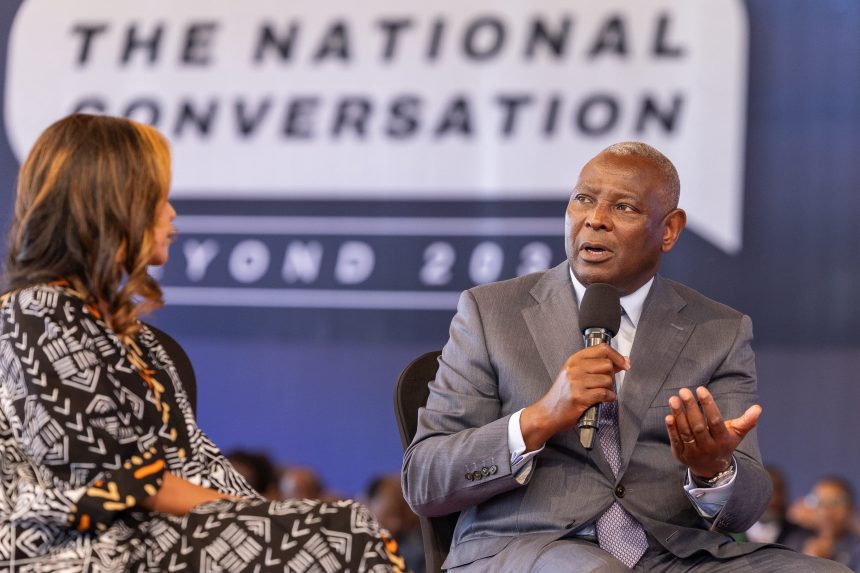
Kenya’s progress under Vision 2030 and the need for continuity in national development plans came into sharp focus Wednesday during a well attended national conversation that roped in key players at the Kenyatta International Convention Centre (KICC).
In his submission, the Founding Chairman of the Kenya Vision 2030 Delivery Board Dr. James Mwangi who is also the Chief Executive Officer of the Equity Group Holdings said Kenya’s achievement of Vision 2030 targets ranges between 50 and 80 per cent, with some areas performing better than others.

He underscored the need for the country to rely on data to assess what has been achieved so far and identify areas that need improvement as it prepares for the next long-term development plan.
According to Dr. Mwangi, He Vision 2060 should build on the areas where Kenya has performed exemplarily well while addressing those where it fell short.
He singled out education and health, saying the country has made progress despite the indicators not being where they should be, adding that Kenya has equally made significant progress in infrastructure.
“Getting 1.2 million children to sit for an exam in one year and graduate the next, that to me is a huge achievement because we have moved from a very low number.”
Dr. Mwangi further suggested that the next vision should be more people-centred and should focus on the needs of future generations.
“This vision is not about our generation. This vision is about our children and our grandchildren.”
He said development should focus on people through areas such as education, security, health, neighbourliness and the environment.
On his part, the Chief Executive Officer of Vision 2030 Delivery Secretariat Mugo Kibati and said Kenya has recorded achievements under all the four Medium-Term Plans implemented since the launch of Vision 2030.
Kibati said the administrations of the late President Mwai Kibaki, former President Uhuru Kenyatta and now President William Ruto have all implemented the Vision 2030 programme through five-year development plans.
“We’re now on the 18th year since the launch of 2030, and on MTP4, the fourth medium-term plan,” said Kibati who is also the Telkom Kenya Chief Executive Officer.
He pointed out major achievements recorded in the political pillar, including the current Constitution in place and the progress that continues to be realized under the devolved system.
Kibati also highlighted infrastructure development in roads, ports and energy, saying electricity has reached different parts of the country.
He cited the Isiolo-Moyale Road as an example, saying it connected northern Kenya to the centre of the country and changed economic activity along the route.
“The Isiolo-Moyale Road, for instance, didn’t exist. And that not only connected the northern part of the country to the center of the country, but actually changed economic activity tremendously,” he said.
Kibati, however, said longer-term transformation projects and social programmes have faced challenges.
He said access to education, affordable quality healthcare, affordable housing and retirement savings remain important areas that require attention under the proposed development framework.
Kibati said funding has been a challenge, including funding for universal healthcare, affordable housing and pensions.
He also said Kenya needs to strengthen its savings culture so that local savings can be used to finance major projects instead of relying on borrowing.
On continuity, Kibati said successive administrations have not always continued programmes started by previous governments.
“The challenge has been that with each successive administration… have not necessarily hewed to continue the programs of the previous administrations,” he said.
He added that Vision 2030 as a wider programme has also become less clear to the public as different administrations introduced their own programmes.
“Vision 2030 as a holistic programme has sort of lost, been lost to the public,” Kibati said.
He proposed the enactment of a law on national planning and economic development to ensure that successive administrations continue programmes aimed at achieving long-term national goals.
He said administrations should be allowed to have their own political priorities, but these should remain aligned with the national development plan.
“Why have an election? You must have your own priorities. But they must be geared towards achieving the national development plan, the national vision.”
Kibati also stressed the importance of involving the public, including young people, in shaping the country’s development beyond Vision 2030.
He said the conversation should involve a younger generation that will be part of the country’s future.