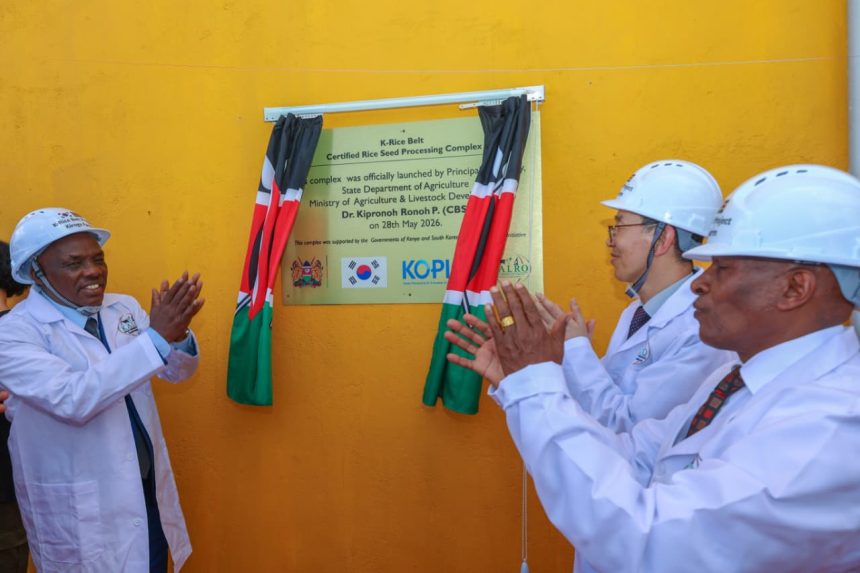
Kenya is on course to meet its annual rice production target with the launch of a Ksh 130 million certified seed processing factory in Kirinyaga County.
The factory by the Kenya Agricultural and Livestock Research Organization and the Korea Partnership for Innovation of Agriculture (KOPIA) is expected to help the country meet its annual consumption demand which stands at an estimated 1.13 million metric tonnes against local production of 304,000 metric tonnes.

“Last year, Kenya imported rice to a tune of 55 billion shillings from India, Pakistan, Vietnam, and Thailand. This is indeed not acceptable in a country with high rice production potential. A crop grown by many farmers for decades. In this region, Rice farming remains a critical value chain and base to many livelihoods,” said Dr Kipronoh Ronoh, Agriculture Principal Secretary during the launch.
The KALRO – K-Rice Belt Certified Rice Seed Processing Complex with a daily production capacity of 40 metric tonnes of certified seeds and up to 700 metric tonnes annually at optimal level is backed to help boost local production capacity through seed drying, cleaning, grading, storage, treatment, and quality control.
According to Dr Ronoh, the facility will also address the country’s rice production constraint which is blamed on use of recycled seeds with poor yields.
The agriculture ministry says current annual certified rice seed production stands at about 1,000 metric tons equivalent to 30pc of seeds used in planting with majority of farmers still using farm-saved seeds recycled over time.
“Up to 80pc of rice farmers are planting farm-saved seeds recycled, uncertified with poor germination rates, low varietal purity, and yield potential that has been degrading season after season. These traditional varieties yield only 2.5 to 3 tonnes per hectare,” he noted.
The certified seeds produced at the KALRO – K-Rice Belt Certified Rice Seed Processing Complex will deliver between 6-7 tonnes per hectares and help farmers have access to quality and affordable seeds
“I know that for years you have been told about improved varieties and certified seed and then found that the certified seed was unavailable, or unaffordable, or had run out at the agro-dealers before you arrived. That will now change with the commission of this facility today,” he added.
The factory is further backed to help the Kenya double its rice production capacity to at least 600,000 metric tonnes annually through provision of certified seeds and expansion of land under rice irrigation.