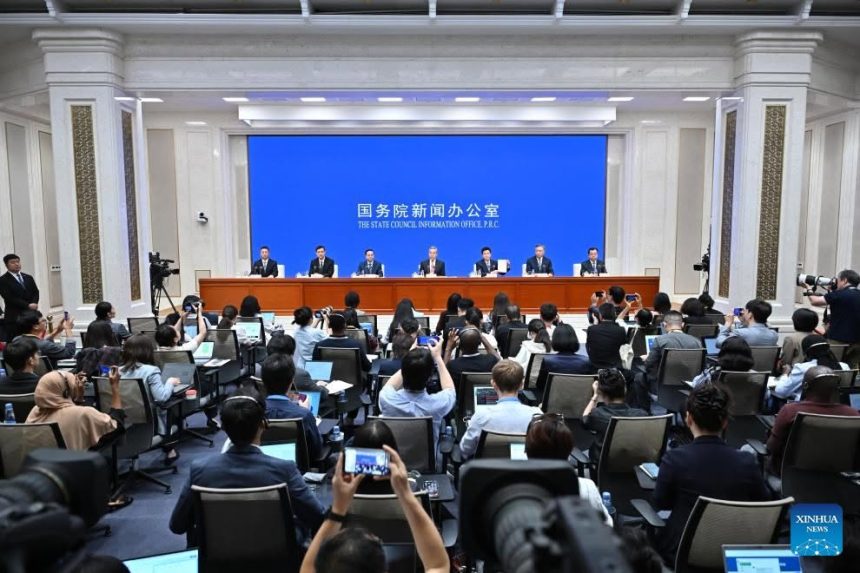
China has reaffirmed its commitment to strengthening the voice and influence of developing countries in global affairs. A newly released white paper on global governance outlines Beijing’s ambitious vision for a more equitable international order.
Titled “More Just and Equitable Global Governance: China’s Principles, Proposals and Actions,” the white paper from the State Council Information Office details China’s approach to reforming international institutions and deepening cooperation with countries of the Global South.

The document reiterates China’s position as both a participant in and advocate for Global South development, arguing that developing nations should play a greater role in shaping international decision-making, economic governance, and global development priorities.
“China will always be a member of the Global South, and in the Global South, its roots will remain. No matter what the future holds, it will always keep the well-being of the Global South in mind,” the white paper states.
According to the document, China intends to continue strengthening solidarity and cooperation among developing countries while safeguarding their common interests in international affairs. It states that Beijing will pursue these objectives through principles of sincerity, real results, amity, good faith, and mutual benefit.
A major pillar of China’s strategy is the expansion of South-South cooperation through multilateral platforms such as BRICS and the Shanghai Cooperation Organization (SCO).
The white paper describes BRICS as a leading force within the Global South, contributing to economic growth, reforms in global governance, and greater democracy in international relations. China highlighted its role in establishing key BRICS institutions, including the New Development Bank and the Contingent Reserve Arrangement, which it says have emerged as important components of the international financial architecture.
The document also underscores China’s support for the continued expansion of BRICS membership, describing the recent enlargement of the bloc as a historic milestone for both BRICS and the broader international system.
“China continues to support more Global South countries in joining the cause of BRICS as full members, partner countries, or in the ‘BRICS Plus’ format, to build the cooperation mechanism into a primary channel for strengthening solidarity and cooperation among Global South nations and a vanguard for advancing global governance reform,” the white paper states.
The white paper also highlights the growing role of the Shanghai Cooperation Organization, which China says has evolved into a significant force for peace, development, and international fairness. The SCO now comprises 27 countries across Asia, Europe, and Africa, with a combined economic output approaching US$30 trillion.
Beyond regional organisations, Beijing is advocating reforms to major international institutions to better reflect contemporary economic realities.
China argues that developing countries remain underrepresented in global financial governance and calls for reforms within the World Bank and the International Monetary Fund. The white paper urges shareholding reviews at the World Bank and quota realignment at the IMF to address what it describes as a democratic deficit in international financial institutions.
“China believes that the international financial architecture should be more balanced in representation and better reflect the realities of the world economy,” it states.
The document also reiterates China’s support for reform of the United Nations Security Council, particularly increasing the representation of developing countries.
“It is imperative to address the historical injustice suffered by Africa, with priority and special arrangements made for the continent’s demands,” the paper states, adding that Africa’s demands should receive priority consideration through special arrangements during UN reform discussions.
The white paper places particular emphasis on modernisation and development across the Global South. China says it has advanced an initiative for open and inclusive cooperation among developing countries and implemented a range of measures aimed at supporting economic transformation and sustainable growth.
Africa features prominently in the document, with China noting that relations with all African countries maintaining diplomatic ties with Beijing have been elevated to the level of strategic relations.
“At the Beijing Summit of the Forum on China-Africa Cooperation, bilateral relations between China and all African countries with which it has diplomatic ties were officially elevated to the level of strategic relations, and the overall positioning of China-Africa relations was elevated to an all-weather China-Africa community of shared future for the new era,” the paper states.
The paper further highlights China’s commitment to supporting African modernisation through cooperation in multiple sectors and the implementation of ten partnership actions agreed under the Forum on China-Africa Cooperation.
Beyond Africa, China pledged continued engagement with Arab states, Latin America and the Caribbean, and Pacific island countries through various cooperation frameworks focused on development, trade, cultural exchanges, connectivity, and sustainable growth.
The white paper presents China’s vision of a global governance system that is more representative, balanced, and responsive to the needs of developing nations. Through institutional reform, expanded South-South cooperation, and deeper partnerships across the developing world, Beijing says it aims to help create a more inclusive international order while supporting the modernisation and development aspirations of Global South countries.