For years, access to clean and reliable water has been one of the greatest challenges for communities in Baringo County. Prolonged droughts, growing demand and the high cost of pumping groundwater have left many families struggling to meet their daily needs.
Now, the Catchment to Tap (C2T) Project, a five-year national initiative aimed at transforming water security across Kenya, is bringing relief to communities by connecting the protection and sustainable management of water-source areas with investments in reliable, affordable water, sanitation and hygiene services.

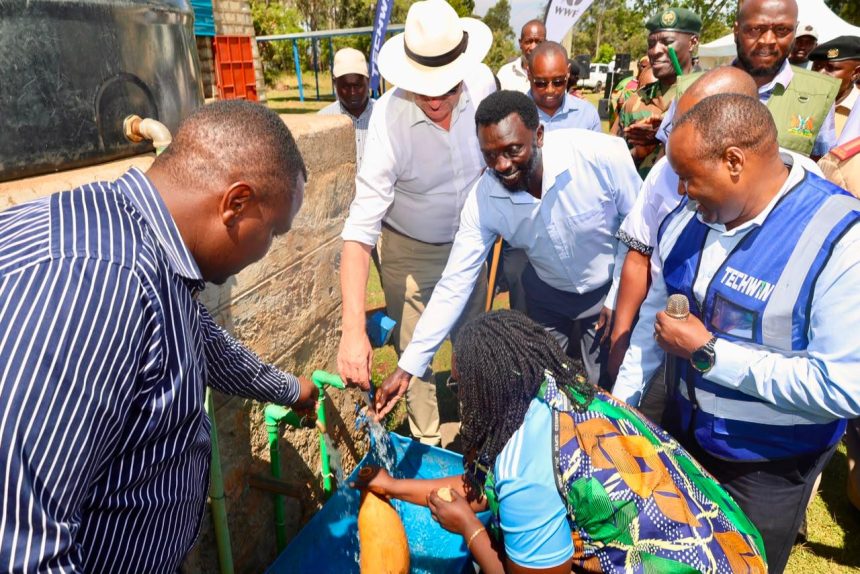
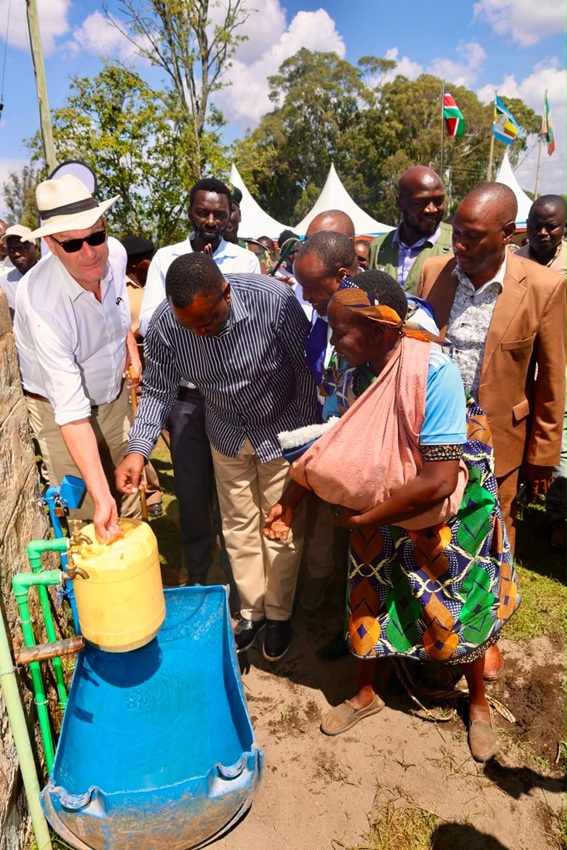
In Perkerra Ward, the solarization and rehabilitation of the Toniok Borehole have transformed daily life for more than 500 households, nearby schools and health facilities. What was once an unreliable, diesel-dependent water system now providing safer, more consistent water to an estimated 2,500 people.
“We had to raise money to buy diesel and then find someone to operate the pump,” said Judy Chirchir, a project beneficiary. “It was expensive, unreliable, and sometimes we stayed for days without water.”
Today, she says, the solar-powered system feels like “a miracle” for the community. The C2T Project recognizes that water security begins long before water reaches a household tap. It starts in the catchment, the area where rainfall collects and feeds rivers, springs and groundwater.
Wayne Kiplimo, Secretary of the Narosura Water Resource Users Association (WRUA), said the project began with an assessment of the local catchment to understand the community’s water challenges.
“The assessment showed that this catchment urgently needed support,” he said. “The main challenge was limited access to water and increasing pressure on the available water resources.”
The Narosura catchment has three ecological zones: a cooler upper catchment that serves as the main water source, a drier middle section and a more arid lower zone that supports farming and livestock keeping.
With households, farmers and livestock keepers relying on the same natural sources, competition for water has been intense. “We realized that improving water security is not just about providing more water,” Kiplimo said. “It is also about protecting the catchment, sharing water fairly and ensuring the system can serve future generations.”
Through the project, community members have been trained to take part in water management, while local institutions such as the WRUA have received support to oversee water resources and protect the catchment.
Before the upgrade, the Toniok Borehole depended on a diesel-powered pump. The system frequently broke down, and water was only pumped when residents could raise enough money for fuel.
Area Member of County Assembly (MCA) Kennedy Kiprono said the arrangement caused stress and disagreements within the community. “The old system depended on electricity, which was expensive, and at one point the community had to rely on a diesel generator,” he said. “It created confusion because the system depended on people bringing fuel whenever it was needed.”
Some families could contribute towards fuel costs, while others could not. As a result, access to water was inconsistent, especially for low-income households.
With support from World Wide Fund for Nature-Kenya (WWF), through the Catchment to Tap (C2T) Project, funded by the Embassy of the Kingdom of the Netherlands, KSh 8.85 million was committed to strengthen Integrated Water Resources Management (IWRM) solutions and improve livelihoods in the Narosura Sub-catchment of the Lake Baringo–Bogoria sub-region.
The borehole was upgraded with a solar-powered pumping system, alongside the installation of a nine-metre water tower and two 10,000-litre storage tanks, increasing the system’s total storage capacity to 20,000 litres.
The solar pump has removed the burden of buying diesel, reduced operational costs and made the water supply more reliable.
“Today, the community has a reliable water supply without the burden of buying diesel,” Kiprono said. “This project has brought lasting solutions.”
For women and children, the impact has been especially significant. Before the project, many walked long distances carrying heavy containers of water. Some households also paid for motorcycles to transport water home, adding to already high daily costs.
“The solar-powered system has made water much more accessible and reduced our household costs,” Chirchir said. “We now contribute a small amount towards maintaining the system, but it is much less than what we used to spend on diesel, transport and labour.”
She believes the community contribution is important because it will help keep the system running for years to come.
Baringo Deputy Governor Felix Kiplagat Maiyo said expanding access to clean water remains a top priority for the county government. “One of our biggest challenges has always been ensuring every household can access clean, safe water within a reasonable distance from home,” he said.
Baringo has constructed more than 700 boreholes across the county. However, Maiyo said many are no longer operational because of poor management structures and high electricity costs. “Our biggest challenge is not drilling new boreholes,” he said. “It is ensuring they are managed properly.”
Only about 60 per cent of the county’s boreholes are currently functional, according to Maiyo. He said solarization offers a practical way to reduce costs and improve reliability.
“Many boreholes stopped working because electricity costs became too expensive,” he said. “Once we improve both management and energy costs, many of these boreholes can begin serving communities again.”
At present, about 10 per cent of the county’s boreholes have been solarized. The county hopes to increase that share significantly in the coming years. Maiyo also emphasized the importance of community ownership. While water services should remain affordable, he said communities need to make reasonable contributions to cover repairs and maintenance.
“Every water system requires regular maintenance, and that comes at a cost,” he said.
A Model for Integrated Water Management
The Ambassador of the Kingdom of the Netherlands, Keno Jan Bakker, said the C2T Project demonstrates the value of managing water from source to household.
“It connects the protection of water sources with the delivery of water to communities,” he said. He welcomed Baringo County’s efforts to develop a long-term and integrated water policy, noting that climate change is making water management more urgent across the world.
“Some parts of Kenya experience floods, while others struggle with severe drought,” Bakker said. “These changing conditions make it even more important to manage water wisely.”
He added that while water should be affordable, communities must also support the systems that provide it. “The infrastructure must be operated, maintained and repaired,” he said. “When people make a small contribution, they are more likely to value and protect the system.”
WWF-Kenya Chief Executive Officer Jackson Kiplagat said Baringo must continue investing in climate-resilient water systems, including solar-powered boreholes and water-harvesting infrastructure.
“Changing rainfall patterns mean we cannot continue managing water the way we did in the past,” he said.
He urged the county to invest in structures such as check dams that can capture rainwater during heavy rains. The stored water could support households, irrigation and livestock, while allowing some to recharge underground aquifers.
“Instead of allowing this water to flow downstream, we should store it for domestic use, irrigation and livestock,” Kiplagat said.
He noted that water investments can also help address wider challenges, including food insecurity, climate shocks and declining agricultural productivity.
The Catchment to Tap Project is a five-year national initiative that ran from 2021 to 2025. It aimed to strengthen water security in Kenya by connecting catchment conservation with access to safe water, sanitation and hygiene services.
The project is funded by the Embassy of the Kingdom of the Netherlands and implemented by WWF-Kenya in partnership with World Waternet, Vitens Evides International, the Centre for Integrated Water Basin Management at Egerton University, and the Kenya Water and Sanitation Network. It works alongside the Ministry of Water, Sanitation and Irrigation and the Water Resources Authority.
In Baringo County, the Narosura WRUA received KSh 8.8 million to strengthen water resource management and conserve critical catchments in the Lake Baringo-Bogoria basin. Of this amount, KSh 2.5 million supported the upgrade and solarization of the Toniok Borehole.
For residents like Chirchir, the investment has delivered more than water. It has reduced household costs, saved time, improved water access for livestock and strengthened the community’s ability to cope with drought.
As Baringo faces growing pressure from climate change and rising demand for water, the Toniok Borehole offers a practical example of what can be achieved through community leadership, strong partnerships and sustainable technology.
By protecting water from the catchment to the tap, the project is helping build a more secure and resilient future for communities across the county.