
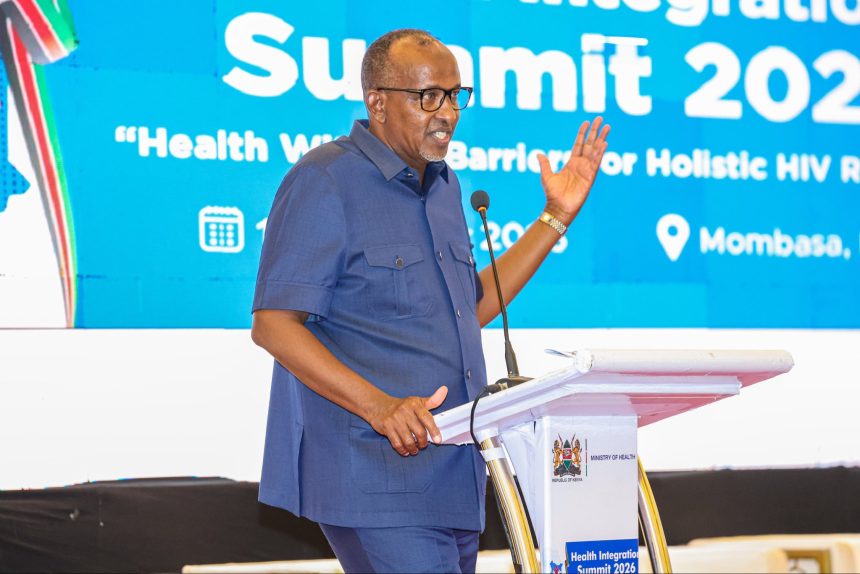
Kenya is strengthening efforts to sustain gains in the fight against HIV/AIDS while responding to emerging challenges, including shifting global health financing and the need to integrate HIV services within the broader health system.
Speaking during the opening of the Health Integration Summit 2026 in Mombasa County Monday, Health Cabinet Secretary Aden Duale emphasized the importance of adopting integrated, people-centred approaches to HIV prevention, treatment and care.
The summit, held under the theme “Health Without Barriers for a Holistic HIV Response,” brought together government leaders, county officials, civil society organisations, development partners and regional stakeholders to strengthen collaboration and chart the future of Kenya’s HIV response.
Convened by the Ministry of Health through the National AIDS and STI Control Programme (NASCOP), the meeting is providing a platform to align HIV services with ongoing health sector reforms under the Taifa Care Model.
The Cabinet Secretary described Kenya’s progress in the fight against HIV/AIDS as “a global success story,” noting that expanded testing and treatment programmes have transformed the lives of over 1.3 million Kenyans living with HIV. However, he cautioned that Kenya still carries the seventh-largest HIV epidemic globally, underscoring the need for sustained commitment to prevention, treatment and care.
As the country works toward achieving the UNAIDS 95-95-95 targets currently at 97-87-83, the CS stressed the importance of remaining vigilant against emerging challenges, including rising mother-to-child transmission and changing global funding priorities.
He noted that the global financing landscape is gradually shifting from vertical disease programmes toward broader health systems strengthening, presenting an opportunity to rethink the national response. Kenya is advancing a people-centred approach by integrating HIV services within the Universal Health Coverage (UHC) framework, supported by the Social Health Authority (SHA) and the Social Health Insurance Fund (SHIF), with over 29 million Kenyans already enrolled.
The Cabinet Secretary highlighted the critical role of Primary Health Care (PHC) networks as the backbone of integrated service delivery, ensuring HIV prevention and treatment are offered alongside other essential services, including care for non-communicable diseases and mental health.
He also emphasized the role of county governments as custodians of service delivery, stressing that vulnerable populations including women, adolescents and key populations must not be left behind.
The CS further underscored the importance of digital health innovation, data-driven decision-making, resilient supply chains and local production of antiretroviral medicines in strengthening national health security.
“Our collective goal remains clear: building a health system that delivers quality, people-centred care without barriers,” he said. During the summit, 20 documents under the Integrated Guidelines for the Prevention, Treatment and Management of HIV, Syphilis and Hepatitis B were launched to guide integrated service delivery across the country.
The event was attended by Mombasa County Governor Abdulswamad Sheriff Nassir, NASCOP CEO Dr Andrew Mulwa, Brian Rettman, Chairperson of DPH-K, Robert Matiru, Director of Programme Investments at UNITAID, Gerald Macharia of CHAI, Gitai Githinji of AMREF Health Africa and Richard Amenya, Country Director of UNAIDS, alongside representatives from the Christian Health Association of Kenya and the Kenya Red Cross Society.