The 2025 AFCON final pitting hosts Morocco against Senegal continues to elicit different reactions and attract global attention from the on-pitch and off-pitch questionable decisions which surrounded the entire match.
According to sources consulted by a Spanish newspaper, AS, the Senegalese team ignored several recommendations from the organisers before and during the final.
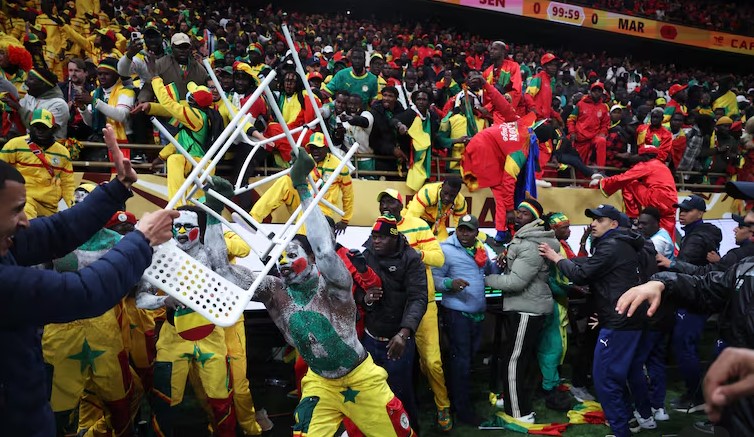
Fans scuffle with security personnel as they storm the field after a penalty decision against Senegal during the Africa Cup of Nations (CAN) final football match between Senegal and Morocco at the Prince Moulay Abdellah Stadium in Rabat on January 18, 2026.
And Morocco said, ‘Enough is enough.’ Many versions have emerged of what happened at the Africa Cup of Nations, still without a clear winner for the unnamed trophy, almost 80 days after its controversial final.
Senegal won the Cup, which they are already officially boasting about, but the final word has not yet been written.
The CAF (Confederation of African Football) has to decide who will take home the prize. The Atlas Lions are not throwing in the towel.
Every story has multiple sides. The one involving the Lions of Teranga has garnered the most attention in recent weeks.
Whether it’s due to complaints to CAF about the pre-match organisation, the team’s location in Rabat, or accusations of “espionage”, their arguments fall apart once you take a look at everything that happened behind the scenes.
First, there was the arrival of the Pape Thiaw team in Rabat. According to this newspaper, Senegal was kept fully informed of the potential problems they would face on their journey to the Moroccan capital by train.
The CAF even proposed alternative means of transportation to avoid any disruption. However, the federation decided to disregard the recommendations, both from the confederation itself and from Morocco and its security forces.
Sources close to the CAF suggest it was a premeditated move to sway public opinion in their particular game of chess.
On the other hand, the team’s location in the days leading up to the final was problematic, both in terms of their accommodation and the imposed performance.
CAF, the centre, housed the Lions of Teranga at the modern Mohammed VI High-Performance Complex, which also served as Morocco’s headquarters during the tournament.
The team’s management publicly complained about this decision, alleging possible “espionage” by their opponents and a “lack of tactical confidentiality” in their match preparations.
The reality is different. “ The center It has 14 soccer fields, in addition to other facilities, ‘centre’ sources told the newspaper. “What” they reported was impossible. “What” they concluded.
Furthermore, during the tournament, teams like Cameroon shared the facilities with Morocco (quarter-final match) without any incident. On that occasion, they made no complaints or reports of any kind for the same reason.
Furthermore, on the contrary, they admitted to being “comfortable” with the facilities provided by the local federation. Minimise
For certain CAF officials, Senegal paved the way to avoid a potential defeat and minimise the subsequent fallout.
The match went from a celebration of African football to a global scandal in stoppage time.
The minimised Lions of Teranga left the field after a controversial penalty in the 97th minute.
The game was stopped for almost half an hour, during which all sorts of things happened.
The world saw one image. Just the tip of the iceberg. Behind the scenes, it was even worse.
Senegal decided to leave the field in protest. The. Almost the entire squad, with the exception of Sadio Mané and some members of the coaching staff, headed to the locker room with the intention of not returning to the pitch.
Some even went live on social media from the training grounds while CAF attempted to mediate with actions that some considered controversial.
As Le Monde reported: “Olivier Safari acknowledged that institutional instructions had been given (during the interruption) to the referee not to issue yellow cards to the Senegalese players (which would have resulted in the expulsion of two already cautioned Senegalese players) ‘to preserve the game” upon their return to the pitch.”
In other words, Senegal was spared two expulsions that could have influenced the final result.
Upon the players’ return, what has now been publicly acknowledged occurred.
Days later, the CAF condemned in a statement “the unacceptable behaviour of certain players and officials” from both teams.
Morocco acknowledges its own shortcomings in several of these complaints, such as the situation involving the ball boys and Mendy, Senegal’s goalkeeper, but does not deny the victim-like treatment the Lions of Teranga have consistently received.
This battle has now transcended the legal arena and entered the public sphere.