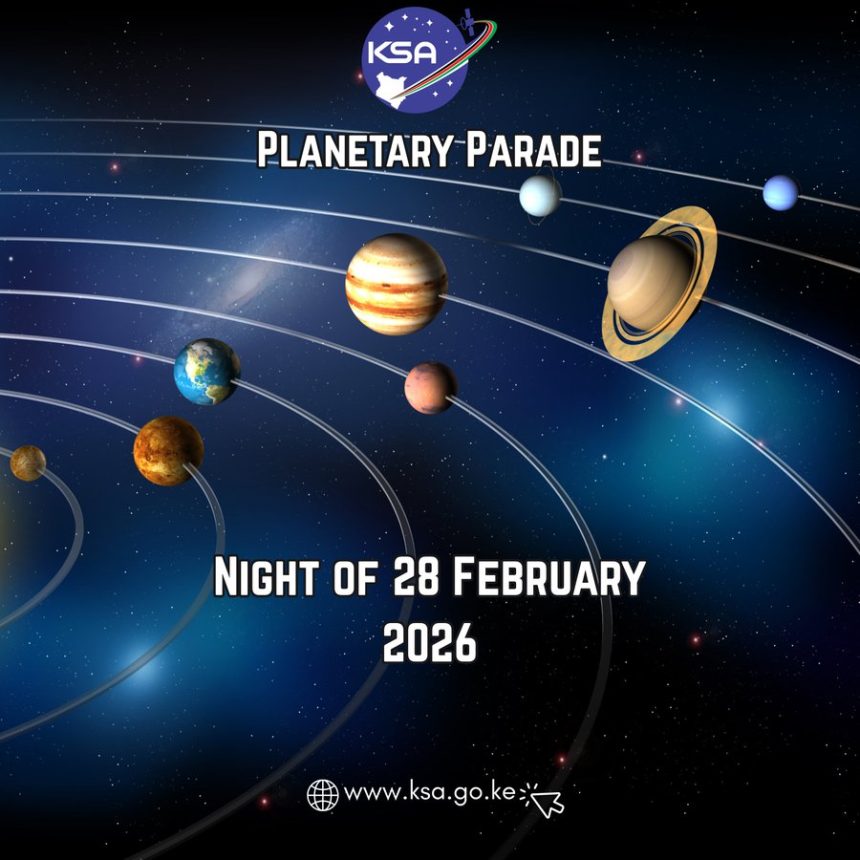
A rare and spectacular celestial display will close out February 2026 as six planets, Jupiter, Saturn, Venus, Neptune, Uranus and Mercury appear to line up in the evening sky.
Although the planetary parade will not include all seven planets visible from Earth like the major event in 2025, it still offers skywatchers a special chance to spot several worlds at once.
“Tonight, Saturday, February 28 2026, six planets will align in the western sky after sunset, creating a rare and spectacular celestial display. Mercury, Venus, Jupiter, Saturn, Uranus, and Neptune will appear together in what is known as a “planetary parade,” said the Kenya Space Agency.
“This is one of the best evenings to observe them, simply look toward the western horizon just after sunset to witness this remarkable alignment”, it added.
To enhance viewing experience, the agency has advised Kenyans to use a telescope or astronomy apps such as Stellarium to help identify the planets and navigate the night sky with ease.
What is Parade of Planets?
The phrase “planet parade” is not an official scientific term. Instead, it is an informal way to describe a time when several planets can be seen together in a line across the sky, according to NASA.
When Will the February 2026 Planet Parade Happen?
The alignment will take place on the night of February 28 and continue into the early hours of March 1. Observers will need clear skies and a good view of the horizon to catch the best glimpse.
Where can the February 2026 Parade of Planets be watched?
The February 28–March 1, 2026 parade of planets can be viewed from most parts of the world, provided the sky is clear, and the western horizon is unobstructed.
It will be visible across: North America (United States, Canada, Mexico), South America, Europe, Africa, Asia (including India), Australia and New Zealand.
However, visibility may vary slightly depending on your location and local sunset time. Jupiter will be easiest to see worldwide, while Mercury, Venus, and Saturn will be harder to spot because they will sit.
When Is the Next Major Planet Parade?
The next big opportunity to see five planets with the naked eye and all seven planets through observation will occur on September 8, 2040. On that evening, they will appear grouped above the setting Sun.
What Is the Next Must-See Sky Event?
Soon after the planet alignment, skywatchers can look forward to a total lunar eclipse on March 3, just before sunrise. During this event, the Moon will turn a deep red color, often called a “blood moon.”
A lunar eclipse happens when Earth moves between the Sun and the Moon, causing Earth’s shadow to fall across the Moon’s surface. This eclipse will be visible in parts of North America, Australia, New Zealand and eastern Asia.
Next Major Planet Parade
The next big opportunity to see five planets with the naked eye and all seven planets through observation will occur on September 8, 2040