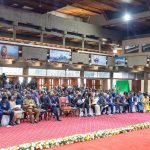

The First World Public Assembly (WPA) has been positioned as a new center of global dialogue, convening over 4,000 participants from more than 150 countries, including politicians, diplomats, entrepreneurs, cultural figures, writers, scientists, educators, and leaders of religious and social movements, to reflect on the future of humanity.
Over several days, about 50 sessions and discussion platforms were held, gathering voices from diverse cultures and civilizations. The central theme of the WPA was the creation of a “New World of Conscious Unity” — a world where the value of humanity itself stands at the core of international partnership.
Award for service to humanity
On September 21, the International Day of Peace, the inaugural Public Recognition Award “For Service to Humanity” was presented, honoring figures of spiritual leadership and humanism from around the world.
The first laureates included Russian philosopher and UNESCO Goodwill Ambassador Alexandra Ochirova, former Jordanian Prime Minister Adnan Badran, former SCO Secretary General Rashid Alimov, Kazakh composer Tolegen Mukhamedzhanov, Angolan public figure Sabena Johannes, Chairman of the Council of the Association of Russian Diplomats Igor Khalevinsky, Indian National Congress representative Dalbir Singh, and Professor Bhai Sahib Mohinder Singh Ahluwalia of the United Kingdom.
“No one in the world can resist united minds,” said Ochirova. Johannes, founder of Afritrack Angola, echoed this spirit with a call to solidarity: “We must awake as one.”
Trust as a foundation
At the sessions dedicated to economic issues, participants noted that today’s global environment is marked by rising geopolitical, economic, and humanitarian challenges. Disunity between states, trust deficits, and competition between value systems are intensifying. Against this backdrop, public diplomacy, humanitarian cooperation, and cultural initiatives were presented as crucial tools for peace and coexistence.
A central idea was that economies cannot thrive without trust. Experts called for an international partnership built on humanitarian values, advancing what they termed the “economy of life.”
“Economics begins with the search for meanings. It is based on a human being,” emphasized Svetozar Darnev, Head of the Russian association Osnova.
Role of media
Participants also debated the role of media and culture in shaping a new global architecture. Russian journalist Oleg Yasinsky warned: “Today the cognitive goes against all nations, against spirituality. The media must return the cultural code to us.”
Argentine director Silvana Yarmolyuk underlined the enduring power of cinema, while producer Olga Azhnakina stressed the importance of glorifying creative labor.
Peacemaking and the energy of the future
Peace experts discussed the roots of conflict and the urgent need for new approaches. “When the economy comes first, rather than people, it becomes the cause of all wars,” argued Alexander Usanin, Professor at the Academy of Geopolitical Problems.
Holger Thorsten Schubert, President of the Neutrino Energy Group, highlighted the role of energy: “Whoever controls energy controls peoples.” Yet experts agreed that solutions lie in advancing science and technology to serve humanity.

Values Above Differences
The Second Congress of the World Organization of Writers (WOW) drew wide attention, with authors from more than 60 countries exchanging views on translation, book fairs, and support for young writers. A prominent theme was the impact of artificial intelligence.
“We can use AI as a tool, but we can’t rely on it. Otherwise, we give up emotionality,” warned Bangladeshi poet Aminur Rahman.
At the WOW-2025 World Literary Award ceremony, laureates from Brazil, China, Indonesia, Syria, France, and Russia were honored. “Values are higher than differences, and cooperation is stronger than rivalry,” said Andrei Belyaninov, Secretary General of the World Peoples Assembly.
Kazakh writer and diplomat Olzhas Suleimenov called for a revival of literature’s central role: “In the twentieth century, our peoples managed to go from listeners and viewers to great readers and authors. But recent decades have brought independence from the book. We have to get its value back before it’s too late.”
Humanitarian cooperation at the heart of peace
Humanitarian cooperation also took center stage at the WPA. UNESCO’s “Uniting Humanity” project was presented as a global platform for dialogue across cultures.
“Cooperation in student exchanges, volunteers, forums of the Islamic organization, mutual assistance to entrepreneurs with access to the markets of different countries — all this helps people to live in the right balance, in harmony with each other,” said Rasul Omarov, Director General of the Youth Forum of Islamic Cooperation (Turkey).
Alexandra Ochirova highlighted investment in human capital as paramount: “The people must choose for themselves what they need for their children and humanity. Civilizational continuity is mandatory. The most important investment is an investment in human capital.”
Key sessions, “International Cooperation: Science and Education. Rectors’ Meeting”, “Humanitarian Modernization as an Imperative for Civilization”, “Meanings as a Strategic Resource”, and “International Cooperation in Science and Education for Sustainable Development” – reinforced the Assembly’s focus on education, science, and values as drivers of development.
Public diplomacy and the unity of hearts
A highlight was the conclusion of the “Leader of Public Diplomacy – 2025” contest, which recognized 25 laureates for their international humanitarian projects.
“Unity of hearts is the main result of the contest,” said Elena Koreda, a laureate from Japan.
At the same ceremony, Natalia Zabolotskikh, Program Director of the WPA and coordinator of the contest, was awarded the honorary badge “People’s Diplomat” by the SCO Public Diplomacy Center (Uzbekistan).

Agreements and final documents
On the sidelines of the Assembly, 71 cooperation agreements were signed, including 35 with non-profit organizations from 16 countries and 36 between WPA partners and international bodies.
The WPA concluded with four founding documents: the Declaration of the New World of Conscious Unity, the Declaration on Happiness, the Manifesto of Conscious Unity, and the Charter of the New World.
“We call on peoples, governments, businesses and civil society to abandon the rhetoric of hostility and confrontation,” the Declaration urged.
“The most important goal of humanity is the building of a New World of Conscious Unity, where the happiness of everyone is inextricably linked to the well-being of all,” the Declaration on Happiness affirmed.
“Conscious unity is not a utopia, but a practical choice. The choice we are making today. Together,” the Manifesto stated.
Finally, the Charter enshrined: “We affirm the passionate power of Love, Kindness, Light, Beauty, and the immutable and eternal Laws of Life as the principle of universal humanization.”
Beyond declarations and documents, the true achievement of the WPA was the spirit of cooperation it fostered. Participants left with renewed energy and commitment to joint projects.
Secretary General Andrei Belyaninov announced that the Second World Public Assembly will take place in Vienna, Austria, continuing its mission as an annual global platform for intercultural dialogue.