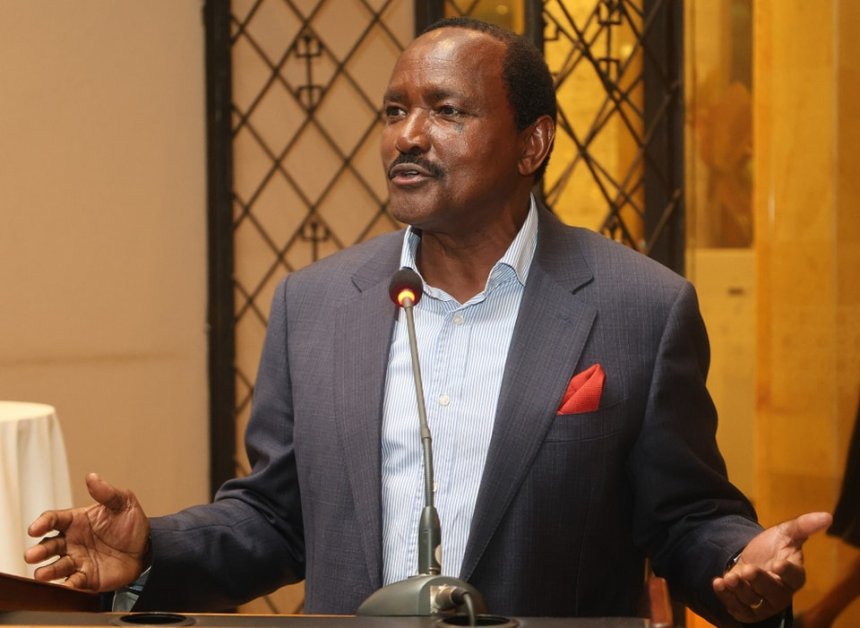
For 15 years, Kalonzo Musyoka’s political bargain at the national table was simple: deliver Ukambani as a bloc, and demand a top seat in return.
That bargain helped deliver him the Vice Presidency, two runs as Raila Odinga’s running mate, and the title of Ukambani kingpin.

But in 2027, the question is whether Kalonzo still controls enough of the region to use it as a bargaining chip.
Developments in Kitui, Makueni and Machakos suggest that the old bloc is beginning to fragment.
The national squeeze
After Raila Odinga’s death, Kalonzo appeared positioned to inherit the opposition mantle and enter 2027 as the leading alternative to President William Ruto.
Instead, former Deputy President Rigathi Gachagua has built a powerful anti-government movement, while former ODM Secretary General Edwin Sifuna has emerged as a strong urban and youth opposition voice.
Kalonzo is therefore no longer the automatic heir to Raila’s political space.
That weakness is increasingly being tested at home.
Three challengers, three different offers
In Kitui, NLP Party Leader Dr. Augustus Kyalo Muli is pushing an Empowerment Model built around youth, women, boda boda riders, enterprise training and market access.
His strategy is simple: empower people at the grassroots rather than ask them to wait for political change from Nairobi.
In Makueni, Kibwezi West MP Mwengi Mutuse is offering a different proposition development. Through Maendeleo Chap Chap and his relationship with President Ruto’s administration, he is positioning roads, markets and government access as his political currency.
In Machakos, Mwala MP Vincent Kawaya is building a UDA network and presenting himself as a direct link to State House, with development and jobs as the message.
Together, they represent three alternative routes to political influence: empowerment, development and access to government.
The 40/20/20/20 question
For years, Kalonzo could effectively say: “I have Ukambani. What are you giving me?”
But what if he no longer has the whole region?
One emerging political scenario puts the numbers at:
Kalonzo — 40%
Muli — 20%
Kawaya — 20%
Mutuse — 20%
If that arithmetic materialises, Kalonzo would remain the largest single political force in Ukambani but he would no longer command a majority.
That distinction could fundamentally change his bargaining power.
A leader controlling 40 per cent can still be an important coalition partner. But a leader controlling 80 or 90 per cent can claim to deliver an entire region.
The difference is the price at the negotiating table.
The verdict
Kalonzo remains Ukambani’s most recognisable political figure, with history, Wiper structures and a national profile.
But nationally, Gachagua and Sifuna have challenged his claim to the opposition mantle.
Locally, Muli, Mutuse and Kawaya are challenging his claim to an automatic Ukambani vote.
If the 40/20/20/20 scenario takes shape, Kalonzo will no longer walk into coalition negotiations carrying Ukambani in one basket.
He will carry the largest piece of a divided region.
As one elder in Kitui put it:
“A king who cannot bring his whole kingdom cannot demand the whole price.”
The question for 2027 is therefore simple:
Can Kalonzo still use Ukambani to bargain his way to the top or will he first have to bargain his way back into Ukambani?
The writer is the Secretary General, NLP