The World Meteorological Organisation (WMO) indicates an 80% likelihood of an El Niño event during June–August 2026.
In a statement, the World Weather body says, “probabilities for this to continue until at least November are near or above 90%.”

While noting there is uncertainty about El Niño peak strength and timing, “most forecast models suggest it will be at least moderate tending towards a possibly strong El Niño.”
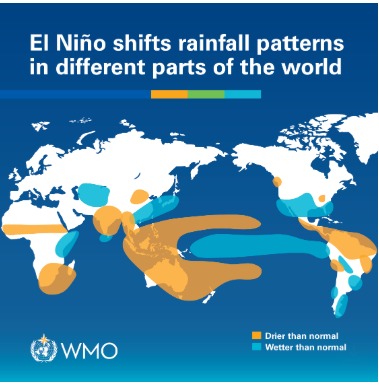
Climate scientists at WMO say observations are showing unusually warm ocean waters in the tropical Pacific, indicating that El Niño conditions are developing and are set to influence global temperature and rainfall patterns, increasing the risk of extreme weather over the coming months, says WMO.
The information by WMO is being relayed to governments, humanitarian agencies and climate-sensitive sectors like agriculture, health, energy and water management. The latest update is based on a consensus of models from WMO Global Producing Centres, experts from National Meteorological and Hydrological Services and climate prediction centres around the world and are produced through a collaborative effort between the WMO and the International Research Institute for Climate and Society (IRI).
UN Secretary-General António Guterres, in his video statement, is calling for an end to the use of fossil fuels which he says are impacting the climate system and resulting into cyclic extreme weather conditions.
“The science is clear: El Niño is arriving on our doorstep in the coming months with 90% certainty. The world must treat it as the urgent climate warning it is. El Niño conditions will pour fuel on the fire of a warming world. Impacts will hit even harder, travel even farther, and cross borders with devastating speed. The only effective response is climate action equal to the crisis – ending the addiction to fossil fuels, accelerating the shift to renewables, protecting the most vulnerable, and delivering early warning systems for all.” said UN Secretary-General António Guterres, in his video statement.
In late April to mid-May, the sea-surface temperature in the central-eastern Equatorial Pacific, the area used as a monitoring reference, was approaching El Niño thresholds, according to observations from different platforms used by WMO.
According to WMO, the increasing sea surface anomalies “are being fed by unusually warm subsurface conditions across the tropical Pacific, with temperatures exceeding 6 °C above average and providing a substantial reservoir of heat that is contributing to the observed surface warming,” says the world weather body and adds, “the El Nino Southern Oscillation is also consistent with developing El Niño conditions.
WMO Secretary-General Celeste Saulo is calling on governments to to prepare for a potentially strong El Niño event “which will exacerbate drought and heavy rainfall and increase the risk of heatwaves both on land and in the ocean. The most recent El Niño, in 2023-24, was one of the five strongest on record and it played a role in the record global temperatures we saw in 2024,” said Prof. Saulo.
The WMO Secretary General says the organisation will be monitoring conditions in order to inform decision-making by governments, humanitarian agencies and climate-sensitive sectors. “Advance seasonal forecasts and early warnings are vital to save lives and cushion the impact on our economies and our communities,” said Celeste Saulo.
El Niño is characterized by a warming of ocean surface temperatures in the central and eastern Equatorial Pacific. It typically occurs every two to seven years and lasts around nine to twelve months.
It generally begins developing between March and June and reaches its peak intensity between November and February, with impacts on global temperatures typically being most pronounced in the second year after development.
The effects of each El Niño or La Niña event vary depending on the intensity, duration, time of year when it develops, and also how it interacts with other climate variability modes such as the Indian Ocean Dipole. Not all regions of the world are affected, and even within a region, impacts can be different. Even when ENSO is neutral, extreme weather can still occur.