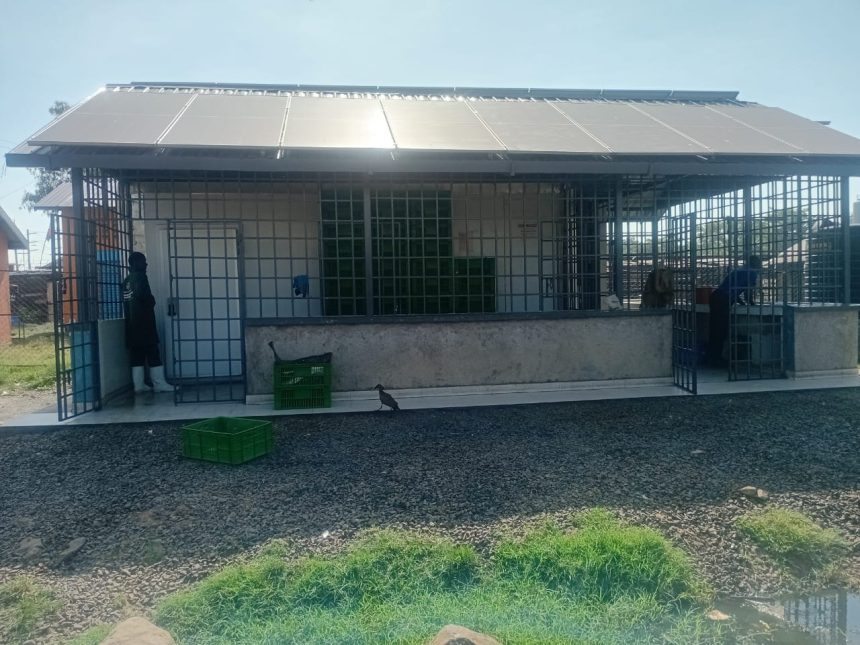
Kisumu County is a perennial net importer of foodstuffs from other parts of the country despite it being well endowed with arable land, strategically hosting Lake Victoria, Africa’s largest freshwater lake, and a gateway to larger Eastern Africa countries.
Despite availability of these natural resources, the county is facing a serious deficit in food production compromising food security and basic food nutrition leaving its populace with a gap to feed its hungry households throughout the year.

Interventions by Awuoth Women’s Group
It is against this background that Awuoth Widows and Orphans Group, a Community Based Organization (CBO) established in 1997 at Nyamasiria, 4 kilometres from the city center, has ventured into indigenous vegetable farming as a way of promoting food nutrition as well as a source of income to its five hundred members.
Yuanita Anyango Hongo is the group’s founder and the current Chairlady. Herself a widow, she started the organization as a means to support to orphans scourged by the HIV/AIDS pandemic that claimed thousands of lives in the early nineties in the community, depriving most children access to education.
‘’ It was a devastating era, women and children were vulnerable. I had to do something to sustain their lives’’, she explains.
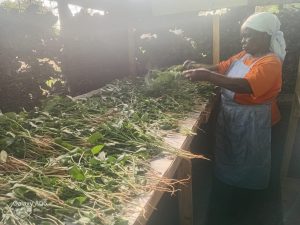
Through her efforts, the CBO has leased lands in surrounding areas of Kolwa, Chiga and Gesoko which are adjacent to River Nyamasaria to supplement farming where farmers produce local vegetables such as cow peas (kunde), spider plant (sagheti), blacknight shade (osuga), kales (sukuma wiki) and spinach.
She informs us that the group has embraced purely organic farming where manure generated from a compost pit ensures that the veggies grow free from any chemicals in form of pesticides.
Harvesting, preservation and storage
Harvesting is usually done after every six weeks with at least a tonne of leafy vegetables produced by the group every quarter of a year. The members who run an aggregation center at an eighth piece of land donated by the founder hosts an office space, a cooler and a solar dryer that ensures that the day’s collection is measured and weighed. Thereafter, members collaborate and pluck leaves from the main stems.
Millicent Atieno Odongo who has been a member since inception tells us that after the weighing process, the veggies are spread in a special aluminum table where they remove all the unnecessary weeds. It is then washed and cut into small proportions.
The next process is boiling the produce by adding salt and measuring required amount of water for at least seven minutes (blanching) then spread to the metallic table and squeeze out any water for excretion. Blanching is important because it helps to preserve color, nutrients and extend shelf life.
The workers transfer the pre-boiled veggies to the solar dryer ready to undergo the whole drying process where different varieties, for instance the cow peas, take the least time to dry usually after two hours whereas kales, spinach and managu use more time to ensure they dry evenly.
It is after drying that the freshly dried veggies are taken to a cooling chamber that has an inbuilt charcoal wall fenced to freeze the produce cooled by pipes that intersect on the roof dripping water at the walls that provide a cold environment regulated by nature.
“We have adequate supply of vegetables all year round and we meet demands of our clients here in Kisumu and even beyond Kenya through the use of solar,” she says.
After cooling that lasts about ten to twenty minutes, the product is packed, graded, labeled and stored ready to hit the markets with most of their clients drawn from abroad. They supply the product to individuals, families, as well as corporates drawn from as afar as Australia, the U.S, Denmark, Middle East and Canada.
“Our women are now able to gain good profits and sustain their livelihoods because of zero post-harvest losses and value addition,” she notes.
Food nutrition and security
Indigenous vegetables are known to be rich in key minerals like iron, calcium, magnesium, potassium and zinc that boost blood levels, improve immune system, bones health and serves as an antioxidant that is necessary for body nutrition.
According to Yuanita, the vegetables play a big role in bridging food and nutrition gaps especially in Kisumu where food insecurity and micronutrient deficiencies are common.
Since many households in the county lack vegetables and experience moderate or severe nutrition with food diets often dominated by starchy staples such as ugali and rice, there are numerous cases of weakened immunity, stunted growth and limited dietary diversity.
Her call to the youth is to embrace agriculture and help increase food availability by ensuring communities have access to sufficient and food system and help reduce hunger and malnutrition.
Challenges
Among challenges that the group face include weather dependence especially during rainy seasons, high humidity or cloudy days that could slow up drying process. However, Awuoth Widow’s Group has built a special jiko that is ceramic lined stove that provides heat through a fume chamber fitted with raised racks that ensure there is no disruption even during wet seasons.
Yuanita adds that this technology ensures warm air circulates around the veggies reducing excess moisture and hence enabling the group to preserve surplus indigenous veggies.
Another setback is vandalism at the cooling facility by the virtue that it primarily uses charcoal. Women and children creep at night to steal the coal well, while replacing it has become more expensive. This has forced the members to procure security services to protect their produce.
“It is costly to have an extra person who is dependent on your budget but we have no alternative,” Yuanita laments.
A bigger challenge now lies with transport of the vegetables that is on a high demand in entire Kisumu town. But with the entrance of E SAFIRI, a transport firm that sales electric motorcycle and tuktuk, the farmers have sub-contracted a driver to supply foodstuffs to their customers.
Use of solar energy in fish waste value addition
Solar energy has played a critical role in fish waste preservation at Obunga Pap Mbuta fish market that has directly employed two hundred and fifty women and youth providing them livelihoods. The market, which was built in early 50s, has been relying on fish waste such as fish fins, fish intestines, fish skin and the famous mgongo wazi.
Rael Sama, a trader who has been in mgongo wazi business since 2004, attributes the profits accrued from her business from the solar cooler installed eight months ago. She says it has offered her a place to store and preserve her products before reaching the market.
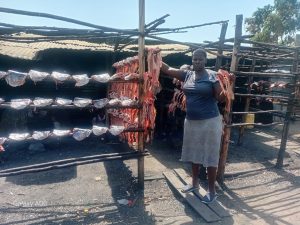
She admits that previously, the cooler used to deep fry mgongo to ensure it does not rot incurring costs in firewood and cooking oil.
“I almost quit my business. My profit margins were very low, I could hardly sustain myself’’, she recalls.
Now she is at liberty to store her products for at least three days without unnecessary concerns and supply her stocks to far away towns in Kitale, Eldoret, Nakuru and Kakamega.
Sentiments echoed by Remjius Odhiambo, the secretary at the market who added that the impact in preservation has ensured they have ready market and minimized wastage.
“Traders now have a clean and hygienic space to store their stock using solar as an enabler in sustainability”, he explains.
He says that Chloride Exide who built and installed the facility at the market has trained the traders on how to embrace and use the technology and also do follow-ups on the functioning of the system, offering support in case of breakdowns.
Solar irrigation and aquaculture
Away from the city, we meet Hellen Adhiambo, a small scale farmer in Kasida village in Ahero who has made significant strides at her one-acre farm, integrating fish pond and other crops primarily using solar.
A teacher by profession and a mother of three, her interest in agriculture has seen her capitalize on the opportunity in an area classified as dry plains where scarcity of water is the norm.
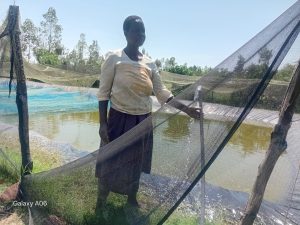
As a member of Ahero CBO, the knowledge gained has enabled her embark on planting various varieties of crops including bananas, fruits, vegetables and fish that has helped her acquire income to sustain her family.
“When I started, the public was skeptical that nothing can grow out of my farm being an area that has black cotton clay soil. Many dismissed my venture,” she recalls.
“But Sunculture firm, a local solar company came and installed a solar system that pumps water directly to my farm enabling me to produce a sizeable amount of crops that have ensured my family is food secure. I no longer rely on rice, I have different varieties to choose from.’’
Adhiambo also rears fish at her farm through the support of Aquaburn, a development agency based in Nairobi that provided infrastructure of the pond and currently has three thousand tilapia fish which are at different stages.
Solar has enabled her to pump thousands of litres to her pond thus sustaining her ventures and promoting her business.
“In this area I am called Mama Samaki, a nickname I got because I am the only one supplying fish to the locals enabled by solar,’’ she adds, jokingly.
Her medium-sized solar panel voltage ensures minimum disruption when it rains thus enabling her irrigation to continue uninterrupted.
Embracing solar technology
Nick Omondi who is a solar technician and expert in Kisumu has been doing solar installation across the county. He is among the few who is utilizing the opportunity to make significant change to farmers.
He explains that solar uptake has been on an upward trajectory primarily driven by reliability, sustainability and cost-effective energy solutions. He has specialized in designing, installing, and maintaining photovoltile system.
Using off grid reliance, farmers have been able to diversify in agricultural production, increased income streams, reduced operational costs by combining agrivoltaics that involves combining crops and livestock using solar panels, maximizing land utility and reducing water wastage.
However, the main challenge that the technician face is spare parts which have various components from different companies. This has resulted in technical constraints in maintenance and operations.
Renewable energy agricultural nexus: County Government of Kisumu perspective
The County Government of Kisumu, supported by ICLEI Africa, has launched a roadmap towards 100% renewable energy transition by the year 2050.
Felix Odhiambo is the Chief Officer at the Department of Energy in Kisumu County. He says they are working with several stakeholders to achieve these goals by drafting the County Energy Plan, a Clean Energy Policy, a draft Heat Action Plan and a Renewable Energy Policy which drives and informs its operations.
‘’There are several engagements, collaborations, cooperation and commitments the county has entered into with partners to tap into Solar power as one of the alternative renewable energy sources from the energy modelling,’’ he revealed.
The officer added that there has been a lot of awareness creation within the county in collaboration with the sister departments to inform the residents to adopt solar power, a Decentralized Renewable Energy solution viable for adoption and cost-effective as a Productive Use of Renewable Energy (PURE) solution.