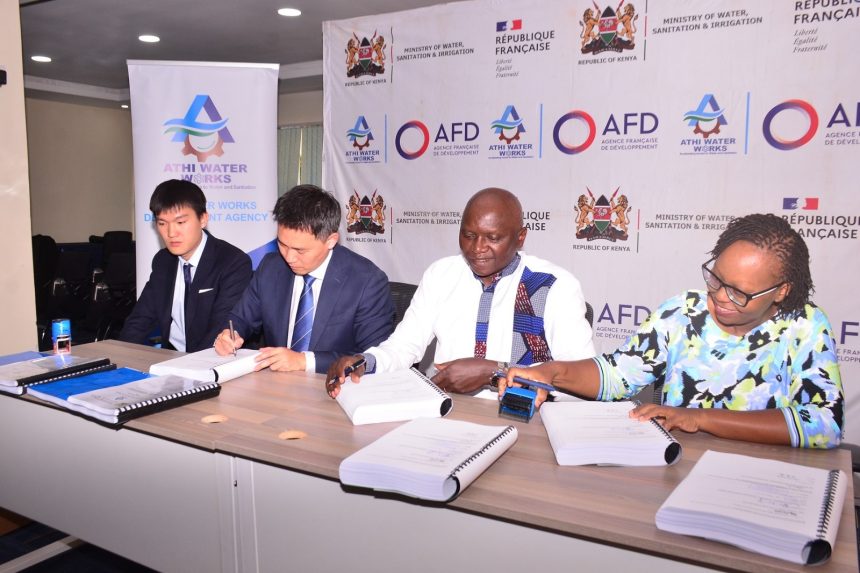
Over 300,000 residents in Nairobi’s western corridor are set to benefit from improved access to clean, safe and reliable water supply and enhanced sanitation services following the signing of the Western Nairobi Water and Sewerage Project contract at the Athi Water Works Development Agency (AWWDA).
Funded in partnership with the French Development Agency (AFD) to a tune of Ksh. 3 billion, the project seeks to address long-standing infrastructure gaps in some of the city’s fastest-growing areas while strengthening Nairobi’s urban water security.

Speaking during the contract signing, the Chief Executive Officer of Athi Water Works Development Agency, Eng. Joseph Kamau, said the project is part of the Government’s broader commitment to ensuring sustainable and equitable water and sanitation services for all.
“The project builds on the gains made by the Northern Collector Tunnel to optimize storage infrastructure and strengthen bulk transmission capacity within Nairobi Metropolis. By expanding transmission lines, increasing storage and extending sewer networks, we are improving network stability and preparing the system to meet growing demand. Our priority is disciplined implementation, adherence to technical standards and delivery within the 24-month timeline,” said Eng. Kamau.
The Western Nairobi Water and Sewerage Project will serve residents in Kangemi, Kawangware, Dagoretti and Riruta, and will extend to the growing areas of Uthiru, Kinoo and Karen Plains, as well as Kabiria, Ngando and Kirigu. These areas have experienced rapid urban growth, placing increased pressure on existing water and sewerage infrastructure.
The project, awarded to the Joint Venture of Zhongmei Engineering Group and Hunan Construction Investment, includes the construction of a 19.7-kilometre high-capacity transmission pipeline from Kabete to Olesereni. A 5,500 cubic metre reinforced concrete storage tank will also be constructed in Karen to stabilize pressure and enhance water distribution across the western corridor.
In addition to the water supply component, the project will deliver 63 kilometres of sewer reticulation network to improve sanitation services for approximately 250,000 residents. The upgraded sewer system is expected to reduce public health risks, protect the environment and significantly improve the overall quality of life in the targeted areas.
The Western Nairobi Water and Sewerage Project reinforces the Government commitment to expanding sustainable water and sanitation infrastructure in line with national development priorities and the growing needs of urban populations.