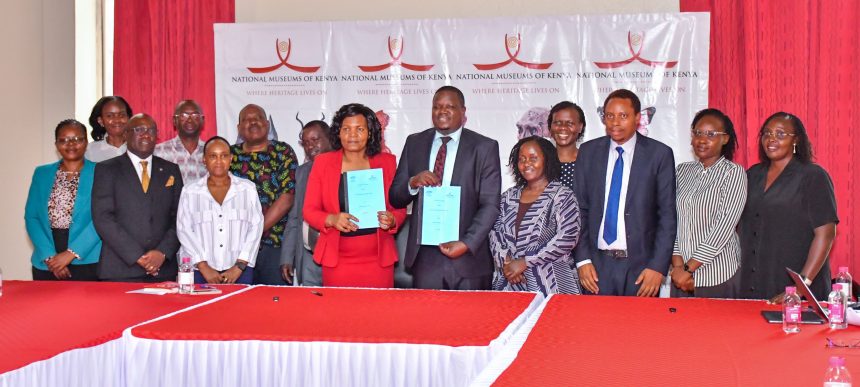
Konza Technopolis and the National Museums of Kenya (NMK) have signed a Memorandum of Understanding to establish Kenya’s First Science Museum.
The move aims to redefine the intersection of ancestral heritage and the Fourth Industrial Revolution.

According to a statement, the Memorandum of Understanding (MOU) aims at, catalyzing the establishment of the Science Museum of Kenya, a bold leap toward digitizing the “Cradle of Mankind” for the local and global stage.
The collaboration represents an integration of “Old World” curatorial mastery and “New World” digital infrastructure. By anchoring NMK’s prestigious 50-million-year-old paleontological archives within Konza’s “Silicon Savannah” smart-city ecosystem, the two institutions are set to transform historical heritage into a dynamic engine for the digital economy, scientific research, and STEM education.
The goal of this partnership is development of the Science Museum of Kenya at Konza Technopolis. Unlike traditional museums that function as static repositories of the past, this facility is envisioned as a “Living Lab”, a kinetic national hub for scientific inquiry and breakthrough innovation. The museum will serve as a high-tech portal where history is not just viewed, but experienced. By integrating Artificial Intelligence (AI), Digital Twins, and Virtual Reality (VR) platforms, the museum will allow students, tourists, and global researchers to interact with Kenya’s scientific and cultural artifacts in a fully immersive, 3D-digitized environment.
This “Digital Twin” strategy is particularly revolutionary; it ensures that Kenya’s most delicate treasures, such as the world-renowned hominid fossils from the Turkana Basin can be studied in microscopic detail by scholars in London, Tokyo, or Nairobi simultaneously, without ever compromising the physical integrity of the original specimens.
The MOU provides a wide multi-sectoral framework for joint planning and execution across several strategic frontier areas. Central to this is the development of Innovation Ecosystems and Incubation. The partnership will spearhead joint research and development (R&D) initiatives aimed at the commercialization of heritage-based innovation. By nurturing a new niche of “Heritage-preneurs” within the Konza Innovation Ecosystem, the institutions will facilitate startups that utilize ancient wisdom, such as traditional ethnobotanical knowledge, to drive modern breakthroughs in pharmaceuticals, material science, and green technology.
Furthermore, a cornerstone of the agreement is the alignment of heritage science with the Competency-Based Education (CBE) curriculum. Through joint innovation hubs and mentorship programs, the partnership will provide Kenyan youth with tangible, hands-on exposure to AI-driven archaeology, sustainable resource management, and digital conservation. This ensures that the next generation of Kenyans is not only proud of their history but equipped for the global tech workforce.
Recognizing the unprecedented scale of this vision, Konza and NMK are set to jointly pursue partners for funding and and invite them to explore investment opportunities. The goal is to position the Science Park as a top-tier destination for global venture capital and institutional investors interested in the nexus of Biotechnology, Archaeology, and Sustainability. This infrastructure will include the co-development of smart solutions for heritage conservation, utilizing 3D scanning and virtual preservation platforms to create a “Digital Vault” for the nation’s heritage that is resilient against the passage of time.
“Today, we are bridging millions of years of human history with the technology of the next century,” noted John Paul Okwiri, CEO of Konza Technopolis. “By hosting the Science Museum of Kenya, Konza Technopolis is proving that it is not just a city of hardware and software, but a city of culture, identity, and deep intellectual inquiry. We are providing the ‘Smart Soil’ in which the seeds of Kenyan heritage can grow into global scientific breakthroughs.”
Professor Mary Gikungu, Director General of the National Museums of Kenya, emphasized the data-driven potential of the move: “This MOU allows us to take our extensive research out of the archives and into the digital light. Our collections are a goldmine of data; aligning them with Konza’s digital research capacity ensures that our heritage remains at the absolute center of the Fourth Industrial Revolution. We are no longer just keepers of the past; we are architects of the future.”
Beyond technical R&D, the partnership is a strategic play for National Branding. The two institutions will launch collaborative campaigns designed to showcase Kenya’s unique global identity: the “Cradle of Mankind” that has become a “Leader of the Digital Frontier.” Through joint innovation showcases and international exhibitions, the partners intend to attract high-value tourists and tech enthusiasts to the Technopolis, cementing Konza’s status as a multi-sectoral destination.
As Kenya advances toward a knowledge-based economy, this partnership acknowledges that our origins provide the essential context for our future. In the Science Park at Konza, the past will no longer be behind us, it will be the platform upon which Kenya’s future is built.