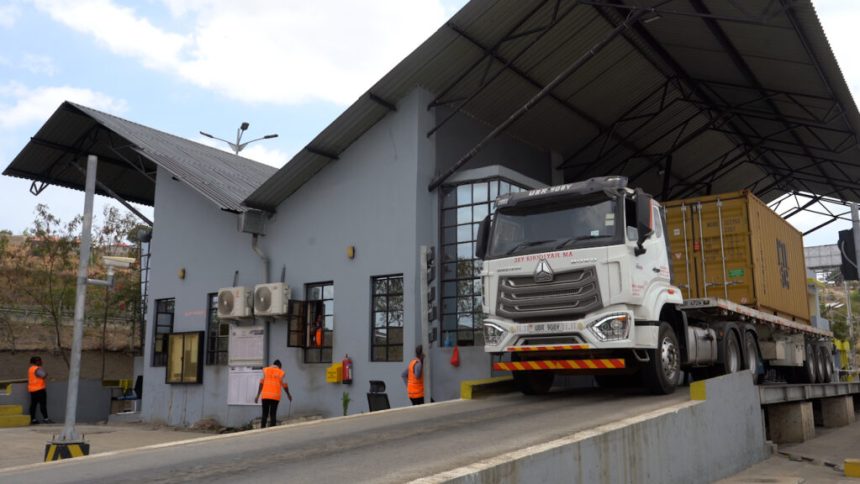
Weighbridge operations in Kenya’s Coast region are thriving, with the Mariakani Weighbridge Cluster achieving an impressive average of 98.5% axle-load compliance. This makes it one of the most effective enforcement areas along the Northern Corridor.
Managed by Ebenezer Commercial Works Ltd under the Kenya National Highways Authority (KeNHA), the cluster includes three weighbridge stations: Mariakani, Dongokundu, and Mtwapa. They are supported by daily mobile patrol units that monitor about 1,466 kilometers of nearby roads.

The cluster has improved compliance through ongoing education for transporters, strict enforcement of fines, and consistent engagement with stakeholders.
“We prioritize continuous sensitization of transporters. We also conduct stakeholder engagements, including working with courts within our jurisdiction to emphasize the importance of axle load compliance. All axle limits and overload penalty schedules are clearly displayed at our stations for transparency and awareness,” says Anderson Wafula, Technical Manager at Ebenezer Commercial Works Ltd.
Victor Kithome, Manager of the Mariakani Weighbridge Cluster, supports this approach, noting the use of various strategies to encourage compliance.
“We participate in court user forums, where we engage transporters and other stakeholders. We conduct on-site sensitization and occasionally visit loading points to calibrate and mark acceptable load levels. For containerized trucks from the port, we participate in stakeholder forums involving the Kenya National Highways Authority to reinforce axle compliance requirements,” he explains.
WEIGHBRIDGE COMPLIANCE
Anderson Wafula, Technical Manager, Ebenezer Commercial Works Ltd : Mariakani Weighbridge Cluster posts impressive compliance level – 98.5% to 99.5% axle-load compliance.#KBCniYetu pic.twitter.com/MM0TSzLtYk
— KBC Channel 1 News (@KBCChannel1) February 28, 2026
In addition to strict enforcement, Kithome highlights the role of technology in their success.
“At this station, near the Kenya Ports Authority, trucks first pass through a high-speed weigh-in-motion system. Only a few are diverted for static weighing, and even fewer are found non-compliant,” Kithome adds, noting that most transporters now self-regulate to avoid penalties and costly delays,” he adds.
The cluster deploys around 234 contractor staff and 79 police officers to ensure 24/7 operations. Mobile weighbridges are also dispatched to feeder roads to address diversion tactics.
The weighbridge operations are governed by the East African Community Vehicle Load Control Act and Kenya’s Traffic Act. Offenders are prosecuted under the Traffic Act at static weighbridges.
Axle load limits vary based on vehicle configuration, with single axles capped at eight tonnes, tandem axles at 18 tonnes, dead tandem axles at 24 tonnes, and gross vehicle limits ranging from 18 tonnes for two-axle trucks to 50 tonnes for six-axle configurations. Enforcement is strictly based on these technical specifications.
Victor Kithome : Mariakani Weighbridge being the nearest to Kenya Ports Authority, we must ensure that trucks comply with the rules so that officers at other weighbridges can have an easy time.#KBCniYetu pic.twitter.com/lDFVvNT3kU
— KBC Channel 1 News (@KBCChannel1) February 28, 2026
Officials acknowledge challenges, such as ongoing road construction in the Mariakani corridor, which can cause traffic jams. Some transporters also try to avoid enforcement by taking alternative routes such as Changamwe, Mikindani, and Jomvu. In response, the cluster has stepped up mobile surveillance and intelligence-led enforcement.
“Some transporters use informal intelligence networks. They deploy local riders to monitor our movements and share real-time updates via WhatsApp groups. Some operational vehicles are mapped, and alerts are circulated whenever enforcement teams are spotted,” Wafula reveals.
Another concern is the improper use of lift axles. When engaged correctly, a lift axle lowers to distribute weight, but if left raised, it can cause overloading and damage roads. Enforcement teams now emphasize the importance of proper axle engagement during inspections and awareness sessions.
Collaboration with the County Government of Mombasa has also improved compliance efforts.
“County trucks are subjected to the same inspections as other transporters and are compliant. The county also operates checkpoints near local material loading zones and alerts us when suspicious trucks are identified, enabling coordinated enforcement,” Kevome explains.
WHAT HAPPENS AT THE WEIGHBRIDGE
Victor Kithome, Manager, Mariakani Weighbridge: At the weighbridge, we inspect the weight and dimensions of vehicles. We must ensure transporters understand the legal requirements of their dimensions.#KBCniYetu pic.twitter.com/GUTddQHTdY
— KBC Channel 1 News (@KBCChannel1) February 28, 2026
Despite some attempts at evasion, both officials report that prosecutions and administrative penalties have effectively deterred repeat offences.
High compliance levels are helping reduce road deterioration, lower maintenance costs, and improve freight predictability along one of East Africa’s busiest transit routes.
As the first weighbridge cluster on the transit route, Mariakani appears to be effectively setting a strong compliance standard for other enforcement stations.