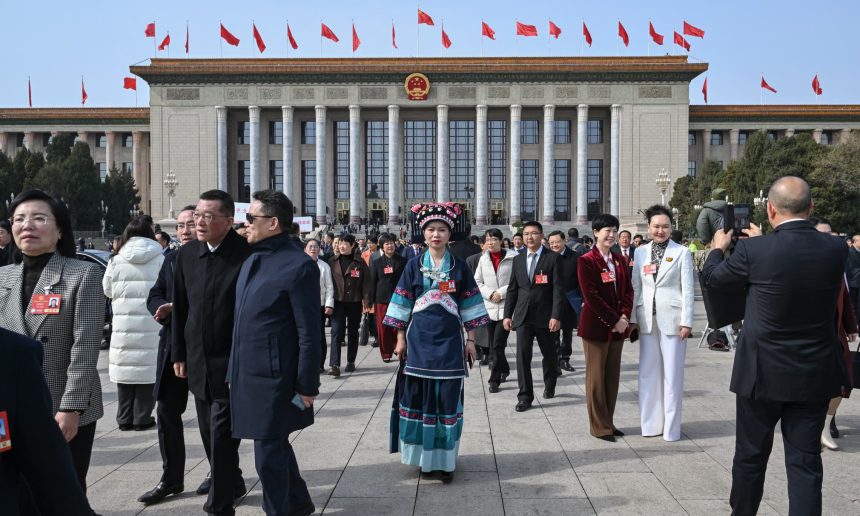
China’s top political and legislative leaders have convened in Beijing for the annual “Two Sessions,” a significant event on the country’s governance calendar that brings together the national legislature (NPC) and its highest political advisory body (CPPCC) to review policy priorities, evaluate economic performance, and discuss legislation that guides national development.
Organizers have confirmed that delegations of deputies attending the fourth session of the 14th National People’s Congress (NPC) have completed their registration ahead of the meeting set to open on Thursday.

The NPC, as China’s highest state organ of power, plays a crucial role in reviewing government activities, approving national development plans, and deliberating on legislation.
The political proceedings commenced on Wednesday with the opening of the fourth session of the 14th Chinese People’s Political Consultative Conference (CPPCC) at the Great Hall of the People. The advisory body consists of representatives from political parties, social organizations, and various sectors, offering policy recommendations and consultative input to the government.
During the opening meeting, Wang Huning remarked that 2025 marks the successful conclusion of China’s 14th Five-Year Plan, which spans from 2020 to 2025. He noted that significant progress was made in economic development, technological advancement, national defense capabilities, and overall national strength during the plan’s implementation—achievements that are seen as key steps toward what Chinese authorities refer to as “Chinese-style modernization.”
Wang highlighted the CPPCC’s role as a specialized consultative body that contributes to policymaking, particularly in providing proposals and strategic recommendations for the forthcoming 15th Five-Year Plan, which will cover 2026 to 2030.
According to figures presented during the meeting, the advisory body organized 98 consultative and deliberative activities over the past year, receiving nearly 6,000 policy proposals, with more than 5,000 formally filed. Officials noted a response rate of 99.9 percent for these submissions. Additionally, over 75,000 information reports were submitted, with more than 17,000 adopted for further reference and analysis.
Alongside the advisory session, lawmakers preparing for the NPC meeting approved the agenda during a preparatory session. The upcoming legislative gathering will focus on reviewing the government’s annual work report and examining the draft outline of the 15th Five-Year Plan for national economic and social development.
Delegates will also evaluate reports on the implementation of the current national economic and social development plan and review proposed development targets for the coming year. Budget oversight will be another key component, as lawmakers will examine reports on both central and local government budget execution and review draft budgets for the next fiscal cycle.
The legislative agenda also includes deliberation on several proposed laws submitted by the NPC Standing Committee, including a draft environmental code, a law aimed at promoting ethnic unity and progress, and a law governing national development planning.
In addition, the session will review institutional reports from key state bodies, such as the NPC Standing Committee, the Supreme People’s Court, and the Supreme People’s Procuratorate. Lawmakers will also consider a report detailing the progress of legal revisions and proposals for handling certain existing laws and decisions.
The annual Two Sessions have become a platform for establishing China’s economic direction and legislative priorities for the year ahead, while also providing a formal mechanism for policy consultation and review within the country’s governance system.