Kisumu Governor Prof. Anyang’ Nyong’o has expressed confidence that Kenya can achieve developed nation status within 30 to 40 years. He believes the country’s transformation into a first-world economy is attainable if successive governments maintain political commitment and implement deliberate, long-term reforms.
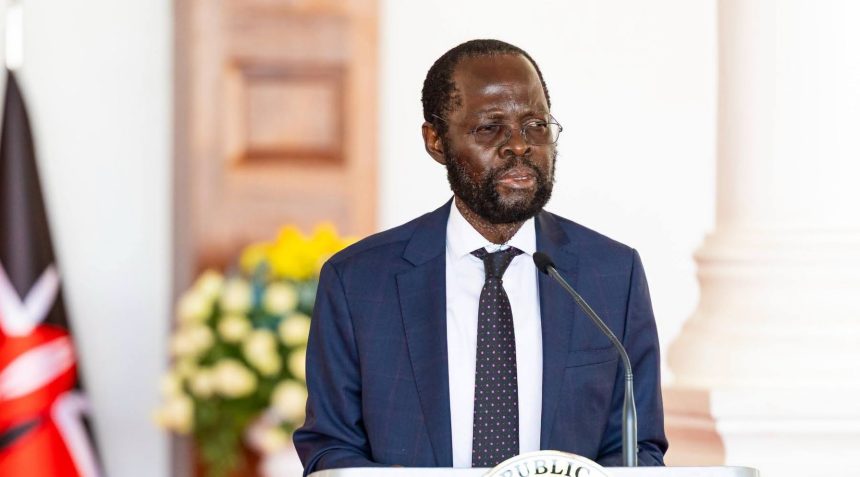
Speaking at State House, Nairobi, during the handover of the report, “Reflections and Proposals on Strategic Guidelines for Kenya’s Long-Term National Transformation Beyond Vision 2030,” Nyong’o said he shares President William Ruto’s conviction that Kenya possesses the potential to join the ranks of developed nations within a generation.

“I agree with His Excellency the President’s belief that a developed nation status in 30 to 40 years is achievable by Kenya,” Nyong’o stated.
“I believe it is possible for Kenyans born in the next few years to be the last of our citizens to live in what is called a third-world or developing country. This is an achievable Kenyan aspiration.” he remarked
The report was prepared by a team of independent economic scholars led by Nyong’o at the request of President Ruto to guide Kenya’s development trajectory after the expiration of Vision 2030.
Nyong’o explained that the report serves as the first step towards formulating a comprehensive national development plan spanning from 2030 to 2060. The plan will build upon insights gained from previous development strategies, including the Economic Recovery Strategy and Vision 2030.
Despite the scale of the ambition, Nyong’o maintained that Kenya’s goal remains realistic, pointing to countries that transformed themselves from poor agrarian economies into global economic powers within a few decades.
“This aspiration is ambitious, but I have no doubt that it is achievable. Many countries, like the People’s Republic of China, that are today regarded as developed were within living memory poor agrarian societies like Kenya.” he said
According to Nyong’o, Kenya’s long-term transformation will ultimately depend on visionary leadership, capable institutions, and a shared national commitment to pursue development beyond electoral politics.
Reflecting on his tenure as Minister for Planning and National Development between 2003 and 2005, Nyong’o said Kenya’s rapid economic recovery during the Kibaki administration demonstrated what is possible when sound policy is backed by political will.
“As minister, it became clear to me that with the right policies and full political backing, Kenya could make a rapid economic recovery,” he said
However, he cautioned that economic transformation would not occur automatically and outlined several prerequisites for Kenya to realise this ambition.
He emphasised that sustained political commitment, transcending changes in government and electoral cycles, is paramount.
“Perhaps the single most important lesson to be learned from our planning experience since independence is the need for sustained political support for the overall national development vision, regardless of political party and across electoral cycles,” he asserted.
Nyong’o argued that successful nations pursue long-term goals through stable institutions rather than being swayed by short-term political interests. He also urged Kenya to adopt a home-grown development model, rather than attempting to replicate other countries’ experiences.
“Kenya cannot and does not need to duplicate or ‘copy and paste’ development. Kenya has to develop in her own fashion, taking cognisance of her unique characteristics, challenges, weaknesses and strengths.” he said
He says Kenya should draw lessons from countries such as Singapore, South Korea, Malaysia, China, and Vietnam, while adapting those lessons to its specific circumstances.
The Governor identified national unity, social cohesion, and political stability as equally critical pillars of sustainable development. He warned that economic growth alone cannot guarantee national progress.
“Development requires national unity and social cohesion, political stability, effective government – in short, a strong state – and national pride and confidence. People with no pride and confidence in their country cannot be expected to develop it,” he said
He cited the 2007 post-election violence as evidence that robust economic growth can be swiftly undermined by inequality, exclusion, and social divisions if development is not inclusive. The report recommends policies that promote fairness, equal opportunity, and a shared national identity alongside economic expansion.
Nyong’o further called for stronger public institutions capable of sustaining reforms beyond individual administrations.
He proposed establishing a dedicated national planning agency to coordinate major infrastructure projects, oversee long-term implementation, and continuously evaluate progress in collaboration with the National Economic and Social Council.
Infrastructure, he argued, should remain the backbone of Kenya’s transformation agenda, supporting industrialisation, urbanisation, and improved living standards.
The report also advocates for deliberate investment in manufacturing, agricultural productivity, quality service-sector jobs, education, healthcare, and affordable housing as the foundations of a modern economy.
Nyong’o stressed that Kenya must also embrace science, technology, and innovation, arguing that the country should not merely consume technology but become a contributor to global scientific advancement.
“We must not only consume technology, but we must also be a contributor to scientific and technological advancement.” he said
The report also urges policymakers to prepare for Kenya’s rapidly urbanising population, with United Nations projections indicating that most Kenyans will reside in urban areas by 2050.
Nyong’o stated that future investments in transport, housing, healthcare, education, and other public services must reflect this demographic shift.
He noted that GDP growth rose from approximately three per cent to eight per cent by 2007 following the implementation of the Economic Recovery Strategy for Wealth and Employment Creation, which subsequently laid the foundation for Vision 2030.