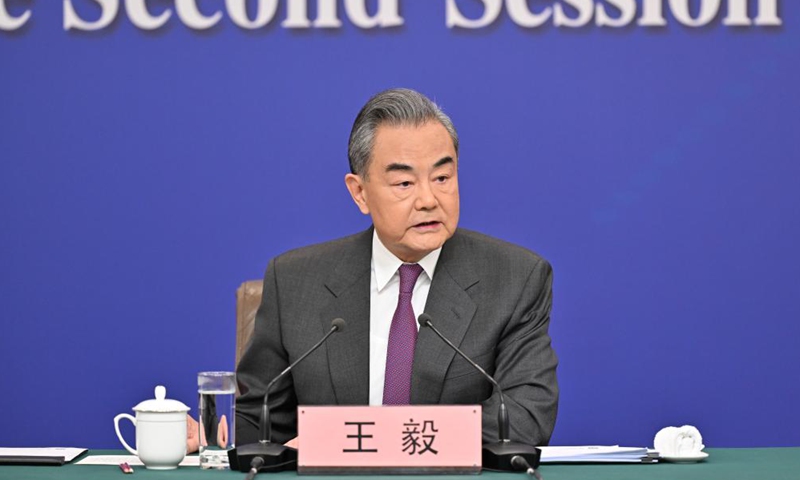
Chinese Foreign Minister Wang Yi on Sunday announced plans to expand trade access and strengthen political cooperation between China and Africa. The initiative marks the start of a “new chapter” in their 70-year partnership, with new goals established for 2026.
Speaking at a press conference during the Fourth Session of the 14th National People’s Congress in Beijing, Wang emphasized that Africa remains a strategic priority in China’s global diplomacy. He outlined a new phase of engagement that includes increased market access, strengthened political collaboration, and extensive people-to-people exchanges.

Wang described China–Africa relations as one of the most resilient partnerships, founded on decades of political solidarity and development cooperation.
“For 70 years, China-Africa friendship has stood the test of changing international circumstances and shown strong vitality,” he stated.
He added, “It’s no exaggeration to say that China-Africa friendship has been passed down from generation to generation – forged heart to heart, and built with sweat and blood.”
Wang, a Member of the Political Bureau of the CPC Central Committee, highlighted a longstanding diplomatic tradition that acknowledges Africa’s significance in China’s foreign policy, noting that Chinese foreign ministers have visited the continent officially for 36 consecutive years at the start of each year.
“This consistency reflects the spirit and commitment of China’s diplomacy,” he said.
During a recent visit to Ethiopia and Tanzania, Wang recalled the enduring memories of historic cooperation between China and Africa, particularly the construction of the Tanzania–Zambia Railway (TAZARA), a major infrastructure project completed in the 1970s with Chinese support.
“In Tanzania, people still cherish the memory of Chinese assistance in building the Tazara Railway and the many young Chinese engineers and workers who laid down their lives for it and would never make it home,” he remarked.
Xi Jinping’s Africa Perspective
Wang underscored that Chinese President Xi Jinping assigns great strategic importance to Africa’s development and its relationship with Beijing.
According to Wang, Xi consistently advocates for a diplomatic philosophy centered on “sincerity, real results, amity, and good faith” in engagements with African nations.
“He always reminds us of our friendship and shared interests with the continent. This approach has helped to take China-Africa cooperation to new heights.” Wang stated.
To demonstrate goodwill, Wang noted that in the first two months of 2026 alone, Xi had sent three formal messages to African partners, including a congratulatory letter for the launch of the China–Africa Year of People-to-People Exchanges, a response to veterans of Zimbabwe’s liberation struggle, and a congratulatory message to the African Union Summit for the 14th consecutive year.
“It’s clear from these messages that China’s top leader wants the torch of China-Africa friendship to be passed from generation to generation, and Africa can count on China’s steadfast support for its development and revitalization,” he reiterated.
Zero-Tariff Policy for African Exports
Among the most significant policy developments announced, according to Wang, is Beijing’s decision to eliminate tariffs on all imports from African countries with which it maintains diplomatic relations. Beginning May 1, 2026, China will implement zero-tariff treatment for 100% of African exports, a move anticipated to significantly enhance market access for the continent’s goods in the world’s second-largest economy.
The policy will apply to 53 African countries and represents one of the most extensive trade liberalization measures China has offered to any regional bloc.
“As part of China’s commitment to high-standard opening-up, we are removing tariffs completely to boost trade, multiply benefits for the people, and help Africa access the enormous opportunities of the Chinese market,” Wang explained.
The initiative builds on commitments made under the Forum on China-Africa Cooperation (FOCAC) and earlier pledges announced during the 2024 summit in Beijing.
The initiative will be supported by a streamlined “green channel” system designed to simplify customs inspections and quarantine procedures, particularly for agricultural products. This measure is expected to enhance Africa’s export competitiveness, especially in sectors such as coffee, cocoa, horticulture, textiles, and minerals.
Beyond trade, Wang outlined three key priorities for China-Africa relations in 2026. First, he said China plans to deepen strategic political engagement by hosting African leaders throughout the year to reinforce what he described as an “all-weather partnership.”
Second, he indicated that the zero-tariff policy will facilitate economic integration and create new trade flows between the two sides.
Finally, he says nearly 600 cultural and social initiatives are set to occur during the China-Africa Year of People-to-People Exchanges, aimed at strengthening cultural dialogue, educational partnerships, and civil society ties.
“We are always ready to work with our African brothers and sisters to draw inspiration from our civilizational heritages, forge a stronger bond between our people, and carry forward our friendship for many, many generations to come,” Wang said.
He reaffirmed that the trajectory of the Sino-Africa partnership remains firmly anchored in continuity and long-term strategic alignment, focused on building a community with a shared future.