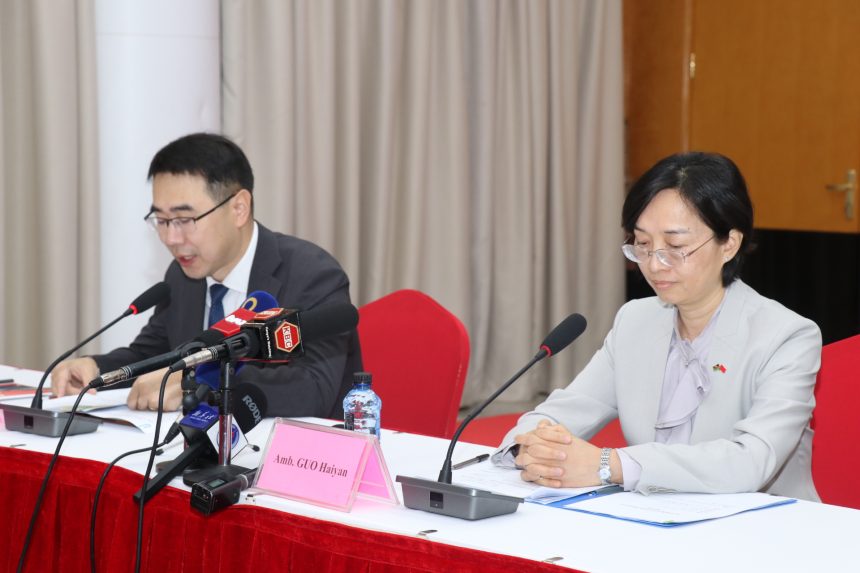
The Ambassador of the People’s Republic of China to Kenya, Guo Haiyan, has presented a comprehensive strategy and action plan aimed at helping Kenya fully leverage China’s newly introduced zero-tariff regime.
Responding to questions from journalists in Nairobi about the latest initiative by the Chinese government, the envoy indicated that Beijing’s next phase of engagement, which will also involve other African economies, will focus on reducing non-tariff barriers and improving export readiness.

Guo highlighted that, in addition to eliminating tariffs, China plans to deploy various institutional platforms and digital trade channels to boost Kenyan exports into higher-value markets.
“China is ready to assist Kenya develop new marketable products to the Chinese market, and to enable more African fine products to find their way into the Chinese market,” she stated.
She pointed to key trade platforms, such as the China International Import Expo and the China-Africa Economic and Trade Expo, as vital entry points for Kenyan goods.
“Leveraging these platforms, along with cross-border e-commerce, will help turn Kenya’s specialty products—such as coffee, tea, avocados, and macadamia nuts—into premium exports,” she noted.
According to Guo, China is also dedicated to enhancing technical capacity, addressing compliance challenges that often hinder African exports. She said Beijing will offer training and policy briefings to Kenyan businesses to improve their understanding of China’s inspection, quarantine, and digital trade standards.
The initiative targets a persistent gap in standards compliance, which trade analysts identify as a significant barrier to market access.
“China stands ready to further increase market access for African products by streamlining customs clearance procedures and upgrading the green lane initiative,” she said, indicating a shift toward more efficient trade integration.
The zero-tariff policy, announced by Xi Jinping, will take effect on May 1 and will apply to 100 percent of tariff lines for 53 African countries that have diplomatic relations with Beijing. The measure builds on commitments made under the Forum on China-Africa Cooperation (FOCAC) and represents a continuation of earlier preferential schemes for least developed countries.
Additionally, the ambassador mentioned that Beijing will support various initiatives that are expected to play a crucial role, especially facilitating the export of perishable goods to China.
“China stands ready to strengthen cooperation with Kenya on infrastructure and logistics to provide stronger hardware support for Kenya’s export to China and, in particular, facilitate Kenya’s export of fresh products, including fresh flowers, fruits, and aquatic products, to China,” she explained.
This focus is particularly pertinent given Kenya’s strengths in horticulture and the urgent nature of these exports.
The ambassador also highlighted ongoing negotiations for a more formalized trade agreement, building on the existing early harvest arrangement between Nairobi and Beijing.
She expressed China’s willingness to finalize an Economic Partnership Agreement for Common Development with Kenya, broadening cooperation to include investment, technology transfer, and services.
The expansion of the zero-tariff policy represents a unilateral move by China to redistribute trade benefits toward African economies. Guo says the initiative is part of Beijing’s broader commitment to multilateralism and equitable globalization.
“By unilaterally implementing the zero-tariff treatment for Africa, China helps African countries to be more confident when tackling tariff hikes by certain countries,” she remarked, referencing changing global trade dynamics.
The announcement follows increased diplomatic engagement, including a recent visit to Kenya by Han Zheng during his African tour, which also included South Africa and Seychelles.
This year marks 70 years of diplomatic relations between China and Africa, coinciding with the launch of a new cycle of development planning under China’s 15th Five-Year Plan. The zero-tariff policy, according to Beijing, is not just a trade concession, but a part of a long-term framework to deepen economic integration, industrial upgrading, and South-South cooperation.
Kenya aims to align its domestic production systems, regulatory standards, and export strategies with the opportunities presented by the latest initiative, converting preferential access into a sustained competitive advantage in one of the world’s largest consumer markets.