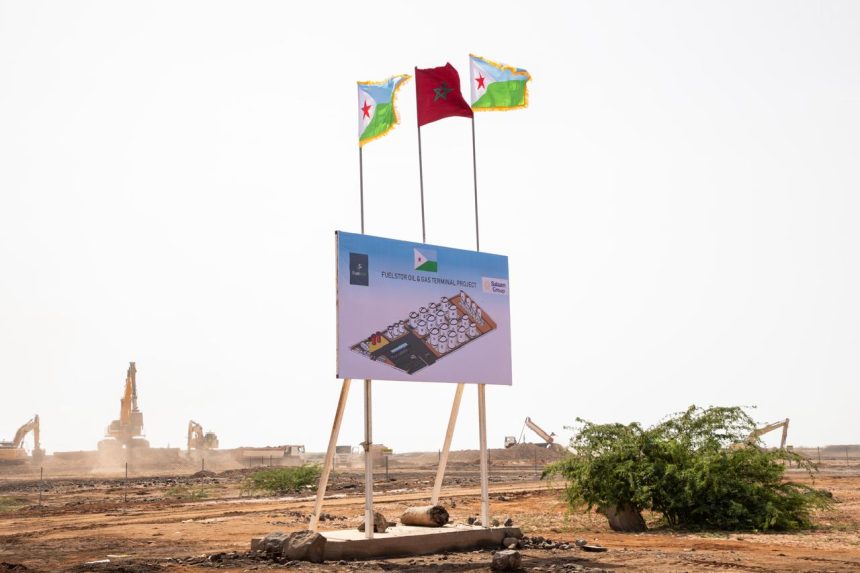
Djibouti has kicked off construction of a Ksh 20.7 billion ($160m) petroleum products storage facility in Damerjog as it seeks to position itself as the region’s top energy logistics gateway.
Fuelstor Terminal which is a large-scale petroleum and commodities storage hub is designed to strengthen fuel security in the wider eastern Africa market at a time of volatility in global oil supply chains.

Positioned along one of the world’s busiest maritime corridors near the Bab el-Mandeb Strait, the terminal is expected to deepen Djibouti’s role as a strategic redistribution centre for refined petroleum products, liquefied petroleum gas (LPG), and edible oils entering East Africa.
“Fuelstor Terminal is uniquely positioned to become a key gateway connecting global supply markets to growing demand across East Africa,” said Fuelstor General Manager Houssein Ahmed Houmed during the groundbreaking ceremony.
Developed on nearly 22 hectares, the terminal will have storage capacity of at least 400,000 metric tonnes, which is equivalent to roughly 2.9 million barrels of petroleum products.
Industry analysts say the scale of the facility reflects the rapid growth in East Africa’s energy consumption, driven by urbanisation, industrialisation and expanding transport networks.
The project comes as regional economies grapple with elevated fuel import costs linked to instability in the Middle East, including tensions involving Iran that have rattled global shipping routes and pushed up freight and insurance premiums for petroleum cargoes.
Eastern Africa consumes an estimated 350,000 to 400,000 barrels of petroleum products daily, with demand projected to rise by more than 4pc annually over the next decade.
Ethiopia alone, which relies on Djibouti’s ports for imports, consumes more than 6 million tonnes of fuel annually, according to regional energy estimates, while Kenya’s petroleum demand surpassed 5.3 million cubic metres last year.
The project, backed by the Salaam Group, is also expected to intensify regional competition in petroleum logistics, particularly with emerging storage and refining ambitions in Kenya and Tanzania.
Kenya is pursuing plans to expand fuel storage capacity at the Port of Mombasa, while Tanzania continues to market Dar es Salaam as a regional petroleum import and transit hub for Central and East Africa.
Construction is being undertaken by Moroccan engineering group Somagec, which specialises in industrial and maritime infrastructure projects. The development is expected to create hundreds of jobs during construction and operation, while supporting ancillary sectors including transport, logistics and maintenance services.